

Saudi East-West Pipeline Attack Exposes Oil Supply Vulnerabilities
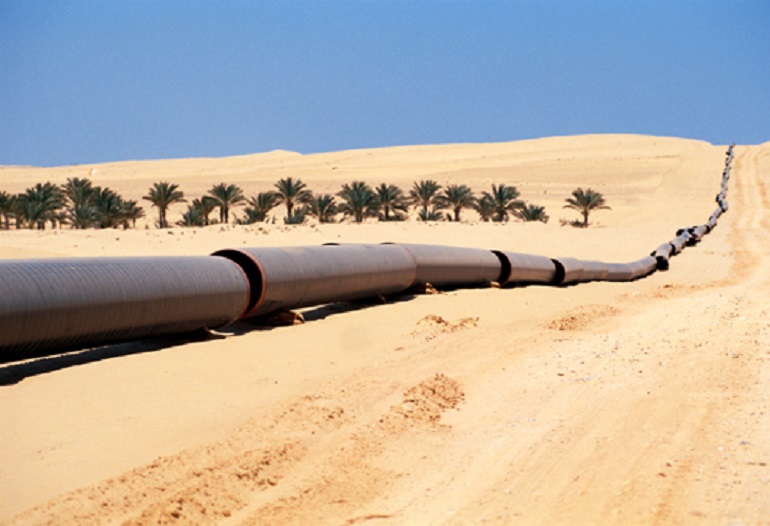
The global oil market faces fresh uncertainty after the temporary shutdown of Saudi Arabia’s East‑West pipeline (Petroline) on September 10, following a series of drone strikes. The disruption has raised concerns over the kingdom’s crude exports and the outlook for international oil prices.
Petroline’s role has grown since the outbreak of the US‑Iran conflict, with Riyadh diverting more than 70% of daily crude shipments to Yanbu to avoid Hormuz shipping risks. Stretching 1,200 kilometers (km) from eastern oil fields to the Red Sea port, the line has recently carried 4–5 million barrels per day -equal to about 4-5% of global supply, according to Reuters.
“Suspending flows through the East‑West pipeline will inevitably affect world oil prices, particularly given the unresolved crisis in the Strait of Hormuz,” said Salah Hafez, former vice‑chairman of the Egyptian General Petroleum Corporation (EGPC).
The Brent oil prices recorded $104.08 on September 13 compared to $100.90 on September 10, according to EGPC data.
In March, Saudi Aramco instructed several buyers of its Arab Light crude to load shipments from Yanbu port on the Red Sea coast instead of the Arabian Gulf terminals. The company operates the East-West pipeline, which has a capacity of up to 7 mmbbl/d.
During August, oil loadings from Yanbu’s port were estimated at 2.38 mmbbl/d in the week beginning August 3, down from 2.71 mmbbl/d a week earlier, according to Vortexa. Meanwhile, Kpler estimated a much sharper decline to 1.78 million bpd from 4.04 mmbbl/d, while AXSMarine estimated that loadings increased to 850,000 bbl/d from around 420,000 bbl/d.
These contradictions came as a result of Saudi Arabia’s crude oil exports from the Red Sea were increasingly being conducted without visible vessel-tracking signals to avoid attacks by Yemen’s Iran-aligned Houthi.
Oil transported to Yanbu reaches global markets through two principal routes: Northbound to Europe and the Americas, where crude travels through the Red Sea to Egypt’s Ain Sokhna terminal, enters the Suez-Mediterranean (SUMED) pipeline, and is transported to Sidi Kerir on the Mediterranean coast for re-export. The Other route is southbound to Asia, where tankers sail south through the Bab el-Mandeb Strait.
However, continued attacks and threats to commercial shipping in the Red Sea by the Iran-supported Houthis have reduced the reliability of the southern route, increasing the importance of the northern route through Egypt.
Houthis took control on September 11 of three strategic islands in the Red Sea and Bab Al Mandeb strait that could block off another major trade route. The islands include Mayun (also known as Perim Island), the Hanish Islands (comprising Greater Hanish and Lesser Hanish), and Zuqar Island. Together with Iran’s Hormuz blockade, this may lead to loss of roughly a third of the world’s seaborne trade.
The two developments create a double constraint on Saudi Arabia’s oil-export routes. The Petroleine shutdown limits how much crude can reach Yanbu. Even if the pipeline resumed, the Houthi’s control around Bab al-Mandeb makes the Red Sea route from Yanbu to Asian markets more difficult, leaving only one route open for crude oil export, the SUMED pipeline.
Established in 1974, the SUMED pipeline is designed to transport Gulf crude to Europe while bypassing the Suez Canal’s limitations. The pipeline emerged as a cornerstone of global oil logistics during the last few months. SUMED’s combined storage capacity across both the Ain Sokhna and Sidi Kerir terminals is 6 million cubic meters (mmcm) of crude oil and petroleum products.
Crude and condensate loadings at Egypt’s Sidi Kerir terminal averaged a record 2.17 mmbbl/d in the last week of August, about 50% above the first week of July. About 90% of those volumes were Saudi crude, according to Reuters.
The pipeline is operated by the Arab Petroleum Pipelines Company, a joint venture between Egypt (50%) and Gulf countries including Saudi Arabia, Kuwait, the UAE, and Qatar.
Hafez believes Egypt could play a vital role in securing the global oil market by using its tremendous ground storage facilities to accommodate oil production from different oil-producing countries, rather than serving as a mere transit line for oil exports via the Suez Canal or the SUMED pipeline.
Saudi Aramco has been actively routing crude through Egypt’s SUMED pipeline and using associated storage facilities at Ain Sokhna and Sidi Kerir as part of a negotiated fallback strategy to bypass Red Sea risks.
“Egypt should pursue agreements with oil‑ and gas‑producing nations to allocate a substantial share of their output to its storage facilities. Such arrangements would help cushion the impact of disruptions like the temporary shutdown of the Saudi Petroline, safeguard the stability of global oil exports, and reinforce Egypt’s standing as a regional energy hub,” he said.
Credit: Source link