

S/C Sends Koffa Capitol Arson Case Back for Retrial | Legal
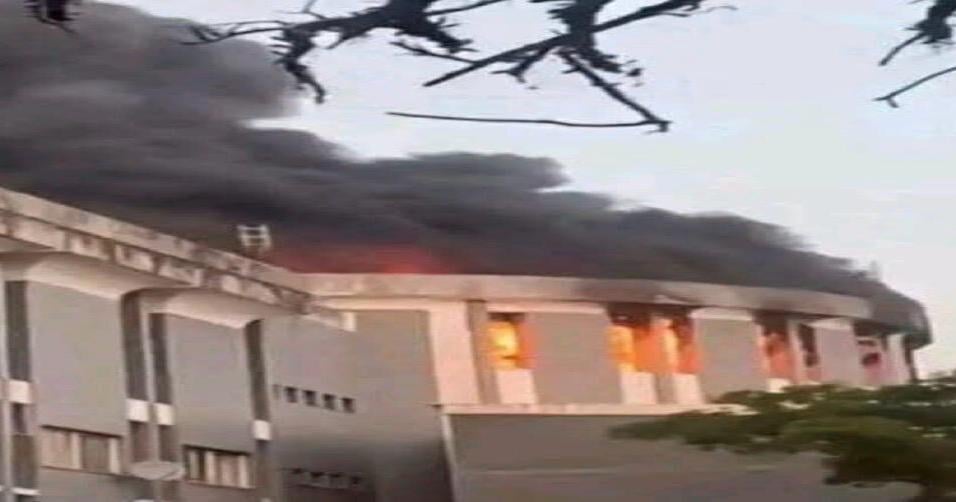
The Supreme Court of Liberia has ordered a fresh trial in the controversial Capitol Building arson case involving former Speaker of the House of Representatives J. Fonati Koffa and eight co-defendants, rejecting a bid to reinstate the jury previously dissolved by Criminal Court “A.”
In a full-bench decision delivered Thursday, August 27, 2026, Chief Justice Yamie Quiqui Gbeisay Sr. announced the Court’s denial of a petition for a writ of prohibition filed by Koffa and his co-defendants.
The ruling effectively clears the way for Criminal Court “A” to empanel a new jury and restart the trial de novo, meaning the proceedings will begin again from the start.
The decision represents a major development in one of Liberia’s most politically sensitive criminal cases, which has drawn intense public attention because of its connection to the December 2024 fire at the Capitol Building and the subsequent political crisis surrounding Koffa’s speakership.
Koffa’s legal team, led by Cllr. Jonathan Massaquoi, had asked the Supreme Court to prohibit Judge Roosevelt Z. Willie from proceeding with the case, arguing that the trial judge exceeded his authority when he dissolved the original jury on January 2, 2026.
The Supreme Court, however, declined to grant the extraordinary remedy.
At the center of the Supreme Court’s reasoning was the scope of a writ of prohibition.
The Court held that prohibition is available where a lower court is acting outside its jurisdiction. Where a court is acting within its lawful jurisdiction, even if it makes an error, the appropriate remedy is generally an appeal following a final judgment rather than prohibition during an ongoing trial.
That distinction proved decisive for Koffa and his co-defendants.
Although the petition challenged Judge Willie’s decision to dissolve the original jury, the Supreme Court determined that the circumstances did not provide a sufficient basis for the extraordinary intervention requested by the defendants.
The ruling therefore leaves Criminal Court “A” with authority to proceed with a new jury.
The original jury became a major point of controversy after jurors questioned prosecution witness Chief Superintendent Rafael A. Wilson, particularly over missing closed-circuit television footage and photographs connected to the Capitol fire investigation.
The questions raised concerns about the availability and authenticity of key pieces of evidence.
Prosecutors subsequently sought the dissolution of the jury, arguing that some jurors had been compromised.
Judge Willie granted the request, effectively ending the proceedings before the original jury.
The move became a major point of contention between the prosecution and defense.
Koffa’s lawyers argued that the jurors’ questioning should not have been treated as evidence of bias or misconduct and that dissolving the jury deprived the defendants of a fair trial.
The prosecution, however, maintained that concerns surrounding the impartiality of members of the jury justified the action.
The case carries significant political implications because several of the defendants are politically aligned with the opposition.
Among those facing trial are sitting lawmakers Dixon Seboe of Montserrado County District #16, Abu Kamara of Montserrado County District #15 and Jacob Debee of Grand Gedeh County District #3.
The defendants face charges including arson, criminal mischief, reckless endangerment, criminal attempt to commit murder, criminal facilitation and conspiracy.
The charges stem from the December 18, 2024, fire at the Capitol Building, an incident that occurred during an intense political confrontation over efforts to remove Koffa as Speaker.
Koffa and his political allies have consistently contested the allegations and the manner in which the prosecution has handled the case.
With the Supreme Court’s decision, the defendants must now prepare to face the charges before a newly constituted jury.
The ruling also means that evidence and arguments presented during the previous proceedings will have to be presented again as part of the new trial.
For the prosecution, the decision removes the immediate legal obstacle that had prevented Criminal Court “A” from moving forward.
For the defense, however, the ruling represents a setback after months of legal efforts to challenge the dissolution of the original jury.
The Supreme Court had previously frozen proceedings while the prohibition petition was being considered.
Justice-in-Chambers Jamesetta Wolokolie initially halted the proceedings, while Justice Yussif D. Kaba subsequently summoned Judge Willie for a Chambers Conference on March 5, 2026, and ordered an immediate halt to further proceedings pending resolution of the legal challenge.
Thursday’s full-bench decision now clears the way for the case to resume.
The dissolution of the first jury remains one of the most contentious aspects of the case.
The defense has argued that jurors should be allowed to ask questions and scrutinize evidence without their conduct automatically being interpreted as evidence of bias.
The prosecution, meanwhile, raised concerns about the alleged political affiliations and relationships of some jurors.
The dispute has generated broader questions about jury independence, political affiliation and the ability of jurors to critically examine evidence in politically charged cases.
The Supreme Court’s ruling did not amount to a finding that Judge Willie’s decision to dissolve the jury was substantively correct on every point. Rather, the Court determined that the legal remedy sought by Koffa and his co-defendants—prohibition—was not available under the circumstances presented.
That distinction is likely to remain central to the continuing public debate over the case.
The ruling now shifts the focus back to Criminal Court “A,” where Judge Willie is expected to oversee the formation of a new jury and the commencement of a fresh trial.
The proceedings will place renewed attention on the prosecution’s evidence, the defense’s response and the circumstances surrounding the Capitol Building fire.
The case has already become a test of Liberia’s criminal justice system, particularly its ability to handle politically sensitive allegations while protecting the constitutional rights of defendants.
For Koffa and the other accused lawmakers, the next phase will mean returning to court to defend themselves against the charges.
For prosecutors, it presents another opportunity to establish their allegations before a new jury.
And for the Liberian public, the retrial is likely to reignite debate over the Capitol fire, the political crisis that surrounded Koffa’s speakership and the broader question of whether Liberia’s justice system can maintain public confidence when criminal cases intersect with intense political rivalry.
The Supreme Court’s decision has therefore not ended the controversy surrounding the Capitol arson case.
It has simply moved the battle back to Criminal Court “A,” where the evidence, witnesses and competing claims will once again come under scrutiny before a new jury.
Credit: Source link