

Russia’s Supreme Court Upholds Yabloko Ban, Sentences Chairman to 11 Years in Prison
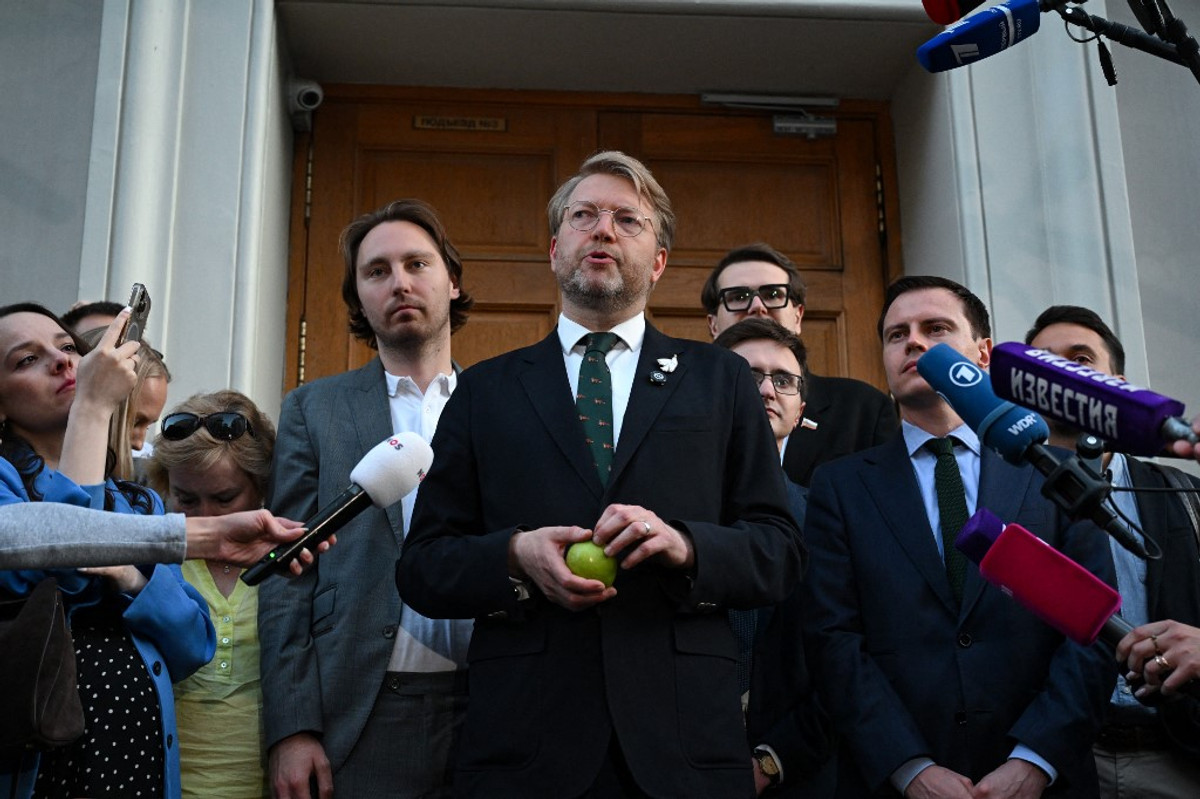
Russia’s Supreme Court upheld its earlier decision to bar Yabloko, the country’s only registered liberal and openly anti-war party, from participating in September’s parliamentary elections.
The ruling was reported by AFP on Monday, Aug. 17, whose reporters witnessed police pushing back journalists and supporters gathered outside the court.
JOIN US ON TELEGRAM
Follow our coverage of the war on the @Kyivpost_official.
“The Appeals Chamber of the Supreme Court upheld the court’s decision to revoke the registration of Yabloko’s federal list of candidates for the State Duma elections,” the party said according to AFP, adding that it would seek a supervisory review.
Separately on Monday, a court sentenced the party’s deputy chairman, Lev Shlosberg, to 11 years and one month in a general-regime penalty colony, after state prosecutors had requested 12 years and one month.
Second case against deputy leader
According to a Russian media outlet Novaya Gazeta on Aug. 14, the Pskov City Court sentenced Shlosberg over public comments criticizing Moscow’s full-scale invasion.
His sentence combines near-maximum penalties under wartime censorship laws with a previous conviction in November 2025, in which Shlosberg was sentenced to 420 hours of community service for violating Russia’s “foreign agent law,” according to the exiled Russian news outlet Mediazona.
The case stemmed from Shlosberg’s Telegram channel repost in 2022 of the Daily Mirror’s front page photo which paired an image of Russian President Vladimir Putin with a photo of a bloodied woman.
Other Topics of Interest
Russia’s Jet Drones Are Changing the Air War, Ukraine Racing to Respond
Faster Russian drones are giving Ukrainian air defenses less time to react, but production limits and high costs could prevent Moscow from replacing conventional Shaheds.
He was accused of “discrediting” the army and spreading military “fake news” motivated by political hatred, due to his remarks during a debate on the Youtube Channel “Zhivoy Gvozd,” in which he called for “the swiftest possible ceasefire in Ukraine,” Novaya Gazeta reported.
“I am an innocent man, against whom criminal charges have been unlawfully brought, who was unlawfully deprived of liberty pending a court verdict, and who is being unlawfully deprived of liberty following a court verdict,” Shlosberg said in his final statement in court according to The Moscow Times.
Defense denied multiple times through trial
According to Novaya Gazeta, Judge Viktoria Malyamova denied the defense multiple requests during the trial, including time to prepare for closing arguments and to submit additional evidence.
Reportedly, she also declined to question Shlosberg directly, and instead read aloud transcripts of his testimony from earlier hearings.
Meanwhile, three of Shlosberg’s defense attorneys had missed the hearing due to illness and scheduling conflicts, prompting the judge to appoint him a state lawyer, whose request for time to review the case file was also denied.
Party’s removal began last week
Yabloko’s leader, Nikolai Rybakov, called the detentions “intimidation” in the courtroom, according to AFP on Monday.
On Aug. 10, Russia’s Supreme Court barred Yabloko from participating in the Sept. 18-19 elections after Judge Vyacheslav Kirillov granted a lawsuit filed by lawyers for the nationalist Rodina party, which accused Yabloko of promoting “extremism” and receiving foreign funding.
“The Yabloko party is full of traitors. These are people who work for the West and hold Western values,” Rodina leader Alexei Zhuravlyov told reporters outside the Supreme Court building on Aug. 7.
Rodina leader Zhuravlyov, who also serves in the State Duma as a member of the nationalist Liberal Democratic Party, said his party had uncovered various violations committed by Yabloko, though he did not provide any specific evidence for his remarks.
In response, Yabloko threatened to sue Zhuravlyov for defamation, and denied receiving foreign funding.
“We’re funded by Russian citizens, and we answer to Russian citizens, as well as the Central Election Commission,” Rybakov told the Supreme Court, rejecting the allegations. “What’s new about Russian citizens donating to the Yabloko party?” he added.
Hundreds of Yabloko supporters gathered outside the courthouse following the initial ruling, chanting “Shame! Shame!” as security forces moved to disperse the crowd.
“I am in Russia and will remain in Russia”
Speaking to Reuters on Aug. 13, Rybakov said that he would remain in Russia despite the mounting pressure, arguing that public support for ending Russia’s war against Ukraine continues to grow – regardless of the court’s decisions.
“For us, the support of the people that exists now, which is completely obvious and impossible to hide, is far more important than the court’s decision,” Rybakov said, adding that he would stay in Russia and keep pushing for peace.
Yabloko currently holds only a handful of regional seats and no representation in the State Duma, which is dominated by the Kremlin-backed United Russia party.
Despite being pro-peace, Yabloko is not pro-Ukrainian. Rather, the party is pushing for an immediate ceasefire that would leave the current front line largely intact.
Yabloko, however, managed to unite not only past traditional liberal voters, but also families of servicemen, men worried about being drafted, and ordinary citizens tired of economic and civilian losses with one shared desire – for Russia’s war to end.
A broader pattern of liberal suppression
According to the Levada Center, a non-governmental pollster designated by Moscow as a foreign agent, public support for war and Russia’s armed forces fell to 66% in July.
The numbers mark the lowest level recorded since the beginning of Russia’s full-scale invasion in 2022.
In Russia, Yabloko is the only party that campaigns for peace and freedom. Many nationalist parties had previously accused Yabloko of “betraying the motherland” because of this.
Therefore, Yabloko’s removal from the upcoming elections does not come as a surprise. Rather, it fits Russia’s broader pattern of systematically suppressing anti-war civilians and politicians, with many of them fleeing the country so as to not face legal prosecution.
Moscow continues to legally target voices it associates with Western values.
In June, Moscow also promoted residency programs for foreigners who explicitly reject Western values and progressive social norms by issuing a “traditional values” visa scheme, framing itself as a refuge for those “under pressure” in liberal democracies.
Outside the court on Monday, dozens of party supporters gathered, with about 60 of them detained by the police, according to AFP.
A protestor told AFP that he had come simply “to support what is left of a declining democracy.”
Another said that he came as “neither a member nor a supporter of Yabloko,” adding that “what is happening today is a blow to democracy across the whole country.”