

Russia’s Jet Drones Are Changing the Air War, Ukraine Racing to Respond
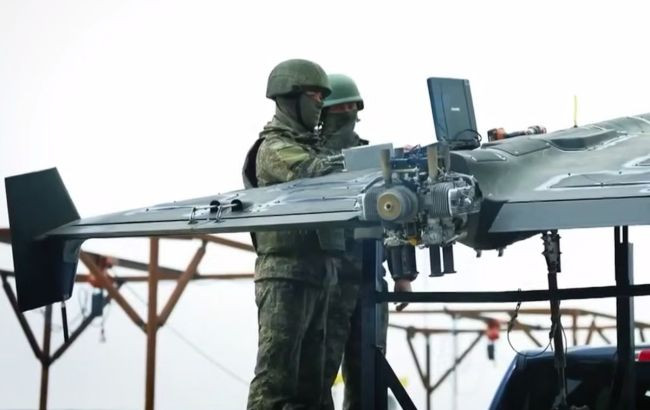
Russia is increasingly turning to jet-powered and missile drones as it seeks to overcome Ukrainian air defenses, with newer versions of the Geran and Banderol systems posing a faster and potentially more difficult-to-intercept threat.
The shift was examined by RBC-Ukraine on Monday, which spoke with military experts about Russia’s growing use of jet drones.
JOIN US ON TELEGRAM
Follow our coverage of the war on the @Kyivpost_official.
According to Anton Zemlyanyi, a senior analyst at the Ukrainian Center for Security and Cooperation, Russia is increasingly relying on faster drones as the effectiveness of conventional Shaheds in large-scale attacks declines.
“The Russians are increasingly establishing mass production of jet drones and missile drones and are increasingly using them to strike the territory of Ukraine,” Zemlyanyi said, according to RBC-Ukraine.
The key advantage is speed. Faster drones give Ukrainian air defenses less time to detect, track, and destroy them, potentially allowing more targets to penetrate defensive layers and reach areas farther from the frontline.
A new class between drones and missiles
The emerging Russian systems are set to include new Geran modifications as well as Banderol missile drones.
However, military expert Oleh Katkov, editor-in-chief of Defense Express, said that the term “jet drone” increasingly covers weapons with significantly different characteristics.
Some newer Geran variants, including the Geran-4 and Geran-5, are approaching cruise missiles in terms of their design and capabilities, he said.
Other Topics of Interest
Ukraine Says Russian Explosives Plant Hit, Two Workshops Destroyed
Ukraine’s General Staff said a strike damaged Russia’s Kаmensky explosives plant, destroying two workshops and damaging four others.
This makes the distinction increasingly important for air defense planners: weapons that are faster than conventional Shaheds but cheaper and potentially easier to produce than cruise missiles could give Russia another way to conduct large-scale strikes.
However, jet drones are also considerably more difficult to manufacture at scale. Their main bottleneck is the jet engine, which is more expensive and technologically complex than the engines used in conventional Shaheds.
Katkov said Russia’s ability to expand production depends heavily on how many engines it can obtain from Chinese private companies.
Russia could eventually attempt to reproduce the approach it used with Shahed-type drones: initially importing components before developing domestic production and simplifying designs for mass manufacturing.
Composite materials and other components also pose production challenges, according to Zemlyanyi.
The greater speed of the new drones creates another problem for Ukraine: the economics of interception. Systems such as Patriot, SAMP/T, and IRIS-T can engage high-speed aerial targets, but using expensive surface-to-air missiles against relatively inexpensive drones is often economically inefficient.
That is driving interest in cheaper interceptor drones, including systems similar to Ukraine’s P1-Sun. Ukraine is developing new interceptor models, although their ability to reliably engage the fastest Russian targets remains a key question.
Other air defense systems, including Mistral, Skynex, and Gepard, can also be used against some high-speed targets, depending on their characteristics.
Ukraine is developing its own jet drones
Ukraine is not simply reacting to the Russian shift. According to Zemlyanyi, Ukrainian developers began working on jet-powered drones before Russia, with systems including Bars and Palyanytsya already being used for long-range strikes.
Ukrainian jet drones have been employed against military and strategic targets in Russian-occupied territories and inside Russia.
However, speed comes with trade-offs. More sophisticated engines and designs increase production costs, while a larger engine can limit the warhead that a drone can carry.
For Ukraine, the challenge is therefore to balance speed, range, payload, and cost rather than simply develop the fastest possible drone.
Will jet drones replace Shaheds or cruise missiles?
Experts cited by RBC-Ukraine do not expect jet drones to completely replace either conventional Shaheds or cruise missiles.
Jet drones can be faster and potentially cheaper than cruise missiles, but they remain technologically inferior to missiles in areas such as navigation, electronics, protection systems, and warhead capabilities, Zemlyanyi said.
Instead, they are emerging as an intermediate category between conventional long-range attack drones and cruise missiles.
For Russia, their main attraction is the possibility of combining greater speed with mass attacks. For Ukraine, the answer will likely involve a combination of improved air defenses, cheaper interceptor drones, and its own growing fleet of high-speed long-range weapons.
The result is unlikely to be the disappearance of Shaheds or cruise missiles.