

Russian drone strikes SBU headquarters in central Kyiv, injuring at least 12
Editor’s note: This is a developing story and is being updated.
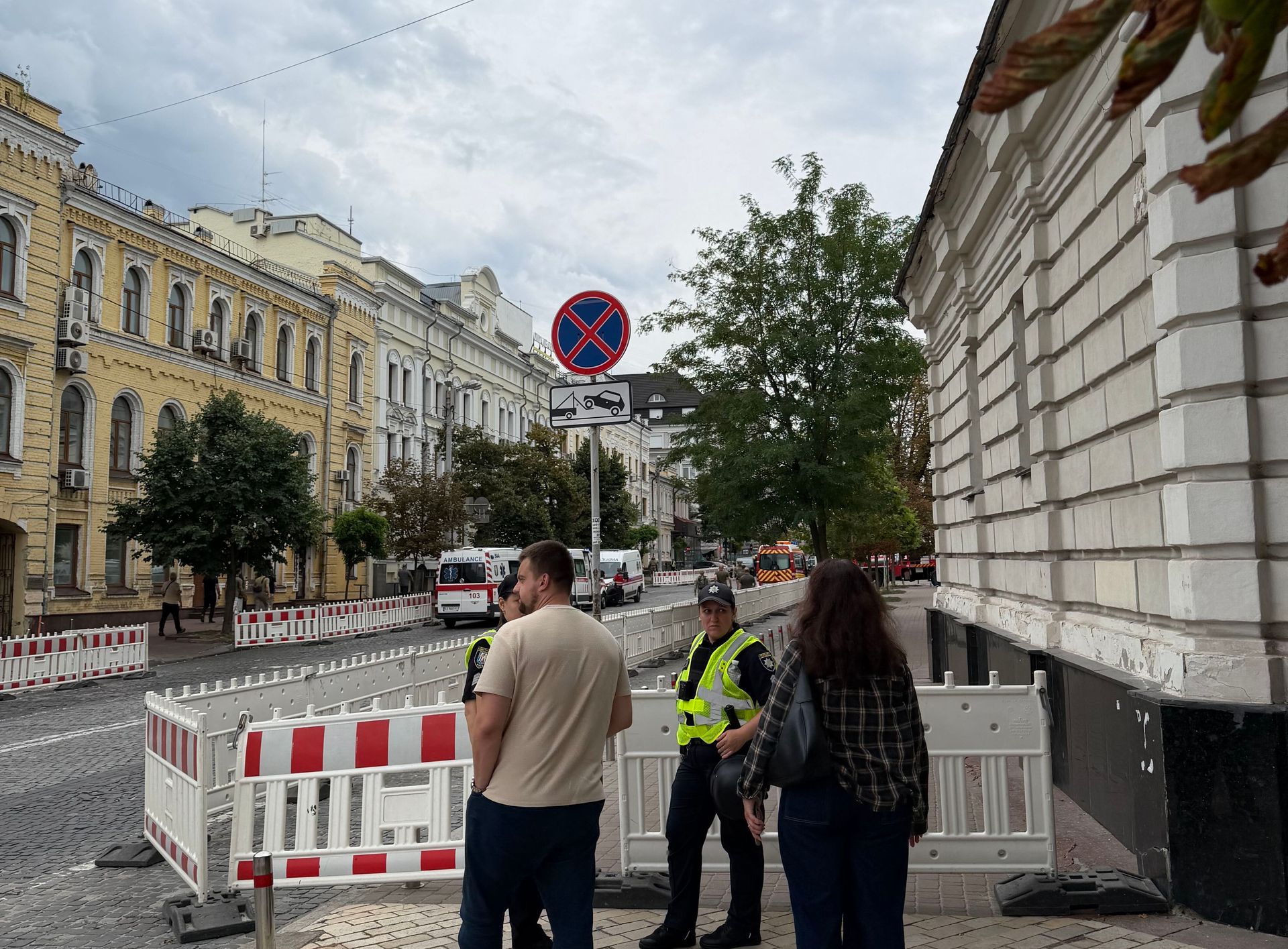
A Russian drone struck the headquarters of Ukraine’s Security Service (SBU) opposite St. Sophia’s Cathedral in central Kyiv on Sept. 4, injuring at least twelve people, local authorities said.
An air raid alert was activated in Kyiv at around 3 p.m. local time, followed by explosions in the city center about half an hour later. Kyiv Mayor Vitali Klitschko said the attack damaged a non-residential building in the Shevchenkivskyi district, without providing further details.
The drone was targeting the office of SBU acting head Oleksandr Poklad, President Volodymyr Zelensky said.
Speaking to the Kyiv Independent, a former intelligence officer also confirmed that the Russian drone had appeared to strike the location of Poklad’s office.
The SBU confirmed that the drone purposefully struck Poklad’s office, but had not achieved its goal, as the SBU head did not suffer any damage. The SBU further said that “the Russians will receive a painful response to their blows.”
“I gave Poklad the task of responding to this Russian attack in an appropriate, significant, and — if possible — symmetrical manner once everything is ready,” Zelensky said.
Serhii “Flash” Beskrestnov, an adviser to Zelensky, suggested on Facebook the drone may have been guided online through a nearby MESH radio repeater with internet access.
“In my personal opinion, the Shahed was controlled and guided online through a MESH radio repeater with internet access, which a Russian agent activated somewhere nearby, within five kilometers, for a short period during the attack,” he wrote.
At 6 p.m. local time Zelensky said Ukraine had decided where it will respond with retaliatory strikes, with only the timing left open “for maximum effect,” following a report from Poklad.
Twelve people were injured in the attack, according to the Kyiv City Military Administration, seven of whom had been hospitalized as of 5 p.m. local time, Klitschko said. The fire at the site was extinguished, but the attack damaged the building’s exterior wall, the mayor added.
Later on Sept. 4, Slovakia said it would summon the Russian ambassador over the strike near its embassy in Kyiv.
“We call on Russia to refrain from actions that may endanger the lives and safety of innocent civilians,” Slovak Foreign Minister Juraj Blanar said on X.
On Sept. 5, Beskrestnov provided further details about the attack on Telegram, saying Ukrainian systems had tracked the jet-powered drone from the direction of Donetsk to Kyiv at an altitude of more than 7 kilometers.
He said debris recovered after the strike was identified as belonging to a Geran-4 drone. Two jet-powered drones were launched toward Kyiv during the attack, but only one reached the city.
The drone strike in the heart of the city center has shaken those who live and work nearby.
“All the time we’ve been walking around this area, we felt safe,” Alina Zamanova, an artist whose studio is close to the site of the impact, told the Kyiv Independent.
“I slept in the studio today, and whenever I sleep here, I feel like I’m super safe — I don’t even think about going to a shelter at all,” she said. “I guess not anymore, though.”
Asked whether the strike would make her consider relocating, Zamanova said her first reaction was, “I’m going to leave,” but acknowledged that making such a drastic move would be difficult.
“I have my studio, my dog is here, and my home is here,” she said.
Dmytro, 43, was driving to a meeting when the drone hit. He heard a “very loud explosion” but carried on to his meeting anyway “to do my job.”
Dmytro, who asked to be identified by his first name only because he works in the defense tech sector, said he was “definitely not surprised” that such a building was targeted. He added that Russia’s newer jet-powered drones are far harder to intercept than previous piston-engined versions.
“So I just hope that we’ll have enough finance for (defense) companies to protect Ukraine and the sky, as well as upgraded air defense drones,” he added.
Dmytro urged those abroad to “keep supporting Ukraine” in its fight against “these barbarian eastern tribes which we have on our border now.”
“You should help the one who is fighting them, otherwise you’ll be fighting next,” he added.
This is the first known Russian attack on the SBU headquarters in central Kyiv. On March 18, a Russian drone targeted Lviv, more than 460 kilometers (285 miles) from the capital, with debris from the downed drone falling on the grounds of the SBU’s regional office.
“The Russian attack on Ukraine’s Security Service Headquarters is a major escalation that demands resolute responses,” Foreign Minister Andrii Sybiha said on X.
“Moscow launched this strike during a renewed push for peace — laying bare its true rejection of diplomacy.”
The Russian attack also damaged one of the buildings within the St. Sophia Cathedral and Related Monuments National Sanctuary, which includes an 11th-century cathedral.
Vadym Kyrylenko, first deputy director general of the St. Sophia of Kyiv National Sanctuary, said the strike hit about 100 meters from the complex, damaging windows and other elements in nearby historic buildings. The cathedral itself was not damaged.
“Nothing has ever fallen this close to us before,” Kyrylenko said. “The main blast wave that was heading toward St. Sophia Cathedral was absorbed by the surrounding historic building, which was damaged instead.”
Sybiha urged international partners to condemn the attack unequivocally and intensify pressure on the Kremlin regime. The minister also called on UNESCO to “act decisively” to protect Ukraine’s endangered cultural heritage, after the attack struck near the UNESCO World Heritage Site of St. Sophia’s Cathedral.

As a result of the constant Russian threat, the monitoring group of Ukraine’s railway service Ukrzaliznytsia announced the suspension of Kyiv City Express trains in both directions at 8 p.m. local time. The service resumed at 8.30 p.m. according to the KMDA.
The Russian attack also damaged the Zavertailo restaurant, located near the SBU building, the restaurant’s co-owner, Stanislav Zavertailo, said on Telegram.
Zavertailo said one restaurant guest was injured in the strike and hospitalized. People were sheltering in the building’s basement during the attack, he added.
“Everyone is safe and unharmed, but they are still in shock, so everyone will need to be examined again,” Zavertailo wrote.
The Russian attack marked the second time a Zavertailo restaurant has been damaged. Another Zavertailo branch in Kyiv’s Podil district was damaged overnight on May 24. The blast wave shattered the restaurant’s windows and damaged the building’s facade, but the restaurant resumed operations later that day.
Zavertailo is also a co-owner of the Honey restaurant chain. One of its branches was damaged in a Russian attack on Aug. 28, 2025. The restaurant near St. Sophia’s Cathedral is therefore the third Zavertailo-owned establishment to be damaged in Russian attacks.
The attack came on the ninth consecutive day of Russian strikes on Kyiv, with the capital facing near-constant attacks by jet-powered Shahed-type drones, as well as a ballistic missile attack earlier in the week.
Constant air raid alerts, air defense fire and explosions have taken a toll on Kyiv residents, depriving them of sleep and increasing anxiety throughout the day.
“We’re tired. We’re very, very tired,” Diana To Hang, a student, told the Kyiv Independent on Sept. 2 after a Russian drone strike on a university in the capital.
“A lot of people right now are patriotic and they’re doing everything they can to help people who aren’t safe right now get out of those situations. But looking at the situation, I can see that it’s simply not getting any better, and we still have winter ahead of us,” she added.
The onslaught has prompted Zelensky to announce a change in Ukraine’s aerial alert system.
Under the new plan, alerts will be divided into red and yellow levels, with yellow corresponding to drone threats and red signaling incoming missiles and massive combined attacks.