

Russia Says Digital Ruble Ready for Sept. 1 Launch Despite Weak Public Demand
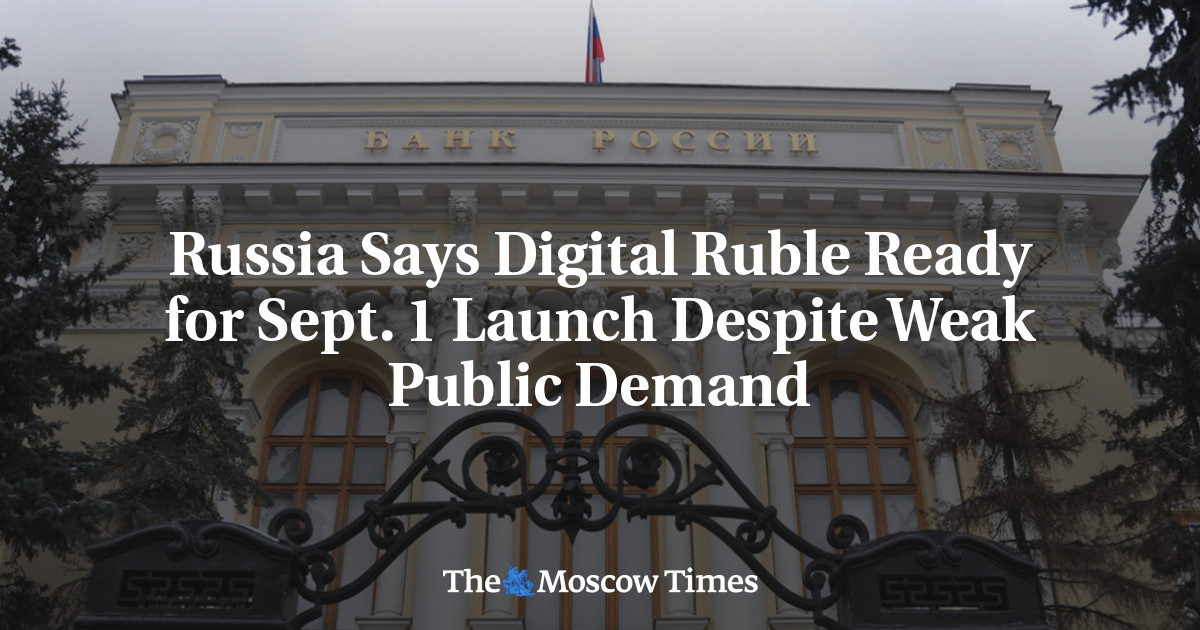
Russia’s Central Bank said Thursday that all preparations have been completed for the nationwide rollout of the digital ruble on Sept. 1, as authorities move ahead with a flagship payments project that has so far failed to generate significant public interest.
Beginning Sept. 1, all 12 of Russia’s systemically important banks will be required to support digital ruble transactions, while large retailers will also have to accept payments in the new currency, Central Bank Governor Elvira Nabiullina said.
“Technologically, everything is ready. We have carried out extensive preparatory work for this stage,” Nabiullina said, according to the state-run TASS news agency.
The Central Bank unexpectedly removed from its website the list of banks participating in the digital ruble platform, making it unclear which institutions beyond the 12 systemically important lenders are currently connected to the system.
Unlike cash or conventional bank deposits, digital rubles are issued directly by the Central Bank and held in digital wallets on its platform. Authorities have said the system will make it possible to trace the full history of transactions, allowing tighter oversight of how budget funds are spent.
Government employees will be allowed to receive their salaries in digital rubles on a voluntary basis, although both the Central Bank and the Finance Ministry have said workers will not be required to do so.
Public enthusiasm for the project remains limited.
A survey by state pollster VTsIOM found that most Russians do not understand why they need a third form of money alongside cash and bank deposits, describing the digital ruble as an “abstract” concept for most people.
A separate survey by employment platform SuperJob found that only one in 10 economically active Russians would be willing to receive their entire salary in digital rubles, while another 5% said they would accept part of their wages in the new currency.
Demand for cash has meanwhile increased in Russia following repeated internet outages and public speculation about the possibility of restrictions on bank deposits.
The Central Bank had originally envisioned that digital rubles could also be used for offline payments, but that functionality has yet to be introduced.
Nabiullina said the digital ruble platform would continue to evolve after its launch.
Initially, only the Central Bank will be able to open digital wallets for users, but regulators are considering allowing commercial banks to perform that function in the future.
“This project will continue to develop. We want the digital ruble to be genuinely востребован by people and businesses, to be convenient,” Nabiullina said. “We see significant potential in the use of smart contracts for businesses.”
To encourage adoption, the Central Bank will pay commercial banks a commission for processing salary payments in digital rubles. Banks will receive 0.67 rubles (about $0.01) for each completed payment instruction, with a minimum payment of 10 rubles (about $0.13) for each payroll distributed to employees.
Read this article in Russian at The Moscow Times’ Russian service.