

Russia recognised the Taliban. A convict’s 14‑year sentence for backing It stands
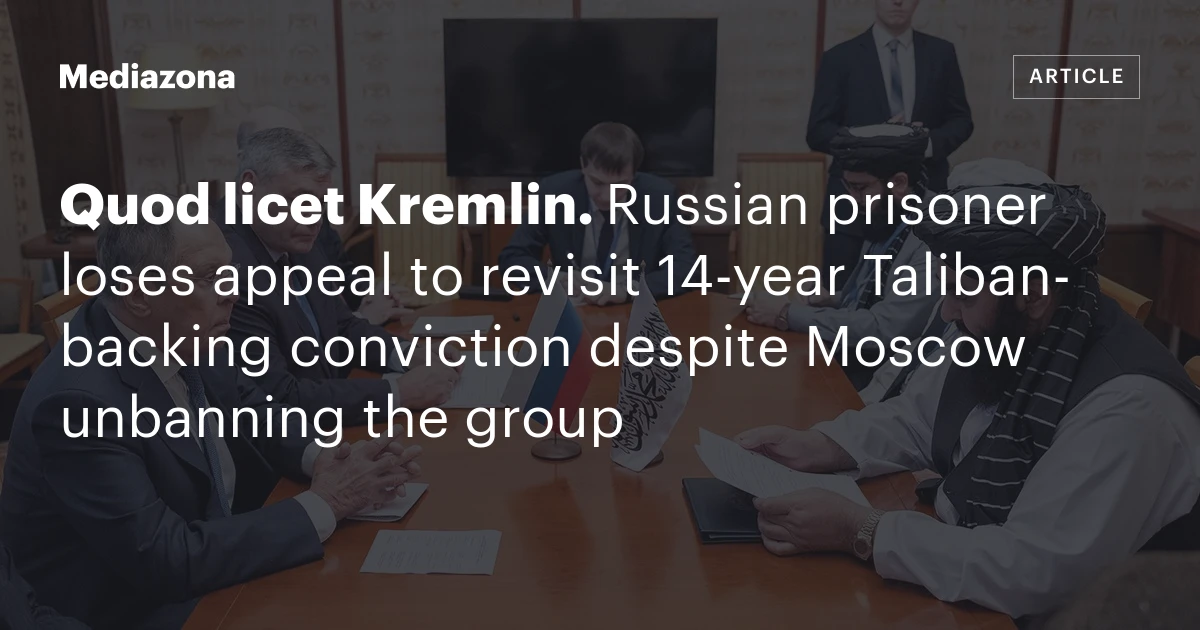
The prisoner is named in the published ruling only as “FIO1”, the placeholder Russian courts insert where a defendant’s name would go.
The 1st Eastern District Military Court convicted him on three counts: facilitating terrorist activity, public justification of terrorism and participating in a terrorist organisation. He was sent to a strict-regime colony for 14 years, the first three to be served in a “prison”. The terrorist organisation involved in the case was the Taliban.
From his colony in Krasnoyarsk Krai, the prisoner petitioned to have his sentence “brought into conformity” with changes in the law: the Criminal Code gives retroactive force to any statute that decriminalises an act or softens a punishment. His reasoning tracked the news: the Supreme Court had suspended the Taliban’s terrorist status on April 17, 2025, so association with the group was no longer a crime, yet he “continues to serve his sentence, which is unjust.”
FIO1 never got a hearing on the merits. Local to his colony Yeniseysk District Court refused even to accept the petition, finding no “subject of consideration”. On appeal, the Krasnoyarsk Regional Court upheld that refusal. It found “no grounds to reclassify FIO1’s acts or to mitigate the punishment under the sentence […] since in the period elapsed since the sentence was handed down no changes improving the convicted person’s position have been made” to the articles under which he was convicted.
What had changed was not the law but the status of one organisation on a register, to “suspended”. “The arguments of the convict FIO1 regarding the elimination of the public danger of the acts… in connection with the suspension of the ban on the activity of the Taliban movement… are untenable,” the court explained in stellar bureaucratese, “since, as follows from the sentence, FIO1 was convicted of participating in the activity of an organisation which, in accordance with the legislation of the Russian Federation, is recognised as terrorist, of public justification of terrorism, and propaganda of terrorism.”
The appeal court reached its result on this ground alone, but an even harsher bar against leniency was available. Law No. 513-FZ, signed by Vladimir Putin on December 28, 2024, which created the very mechanism for suspending a “terrorist” designation, contains a clause instructing that suspension “is not grounds for the review of court verdicts that have entered into legal force.”
How the Taliban was delisted
The suspension the prisoner cited came on April 17, 2025, in a closed session of the Supreme Court.
Granting an administrative suit brought by Prosecutor General Igor Krasnov, judge Oleg Nefedov announced that “the previously established ban on the activity of the Taliban movement… is suspended,” effective immediately. It was the first use of the December 2024 mechanism, which permits suspension “in the event of the cessation of activity aimed at the propaganda, justification and support of terrorism.”
Russian Foreign Ministry was quite candid about the purpose. Removing the terrorist label from the movement, “which after the collapse of the pro-Western regime of A. Ghani in 2021 formed the Afghan government”, it said, “opens the way to establishing a full-fledged partnership with Kabul.” The ministry thanked the Taliban for counter-terrorism efforts against “Afghan wing of ISIS, ‘Wilayat Khorasan’.”
President Vladimir Putin had used the same framing in July 2024, when he called the Taliban “without doubt, our allies in the fight against terrorism.”
Less than three months after the suspension, on July 3, 2025, Russia formally recognised the Islamic Emirate of Afghanistan—the first state to do so—and a Taliban flag was raised over the movement’s embassy in Moscow.
However, the Foreign Ministry noted in passing that none of this altered Russia’s obligations under the UN Security Council sanctions regime on Taliban-linked individuals.
Persecution in Russia
The about-face was never meant to be applied to Russian citizens. In March 2025, even as Moscow moved to embrace the movement, the journalist Nadezhda Kevorkova was fined about $8,300 for “justifying terrorism” over Telegram posts, one of them noting that the Taliban sought the release of its prisoners from Afghan jails.
Russia’s Supreme Court declared the Taliban “terrorist” in 2003, several years after the fall of the Taliban regime. The ruling cited the movement’s support for Chechen separatists and its 1995 seizure of an aircraft, belonging to the Kazan company Airstan, along with its crew. The plane had been carrying weapons from Albania to Ahmad Shah Massoud’s “Northern Alliance”. A year later the pilots managed to escape by hijacking the aircraft.
Since the designation in 2003, courts have convicted a string of people over ties to it, most of them Russian citizens or Central Asian migrants, several never publicly named.