

Russia Quietly Anchors Its Economic Presence in Egypt
Executive Summary:
-
On July 15, Cairo and Moscow announced the selection of an industrial developer for the Russian Industrial Zone in the Suez Canal Economic Zone, with operations expected to begin in 2030. The Rosatom-built El-Dabaa nuclear plant, the other bilateral flagship project, is expected to start producing energy in 2028 and reach full capacity by 2030.
-
Russia is filling sector-specific gaps in investment in Egypt with long-term physical assets that Western actors are unwilling or unable to provide. Egypt, however, continues to balance its Russian ties against its partnerships with the European Union and the United States.
-
Talks on a free trade agreement between the Russia-led Eurasian Economic Union and Egypt paused in 2025. If this agreement is revived, it would be a sign of deeper political alignment beyond Egypt’s diverse financial interests.
On July 15, Cairo and Moscow announced the selection of an industrial developer for the Russian Industrial Zone (RIZ) in the Suez Canal Economic Zone. Egyptian Foreign Minister Badr Abdelatty called this step “pivotal” for the zone’s activation, and Russian Industry Minister Anton Alikhanov credited Cairo’s legislative reforms and investment incentives for the project’s progress (Ahram Online; Egypt Today, July 15). A day later, Moscow named the Crystal Fund, founded by Russia’s former Far East Development Minister Alexander Galushka, as the developer. The Crystal Fund already manages several Russian state projects, including its Arctic development program, and will act as a “single access point” for Russian companies entering the Egyptian market, with plans spanning machine-building, pharmaceuticals, electronics, and petrochemicals (Interfax, July 16). First agreed upon in May 2018 as a 50-year framework centered on East Port Said, the project was reconfigured in 2021 across two sites—East Port Said on the Mediterranean and Ain Sokhna on the Red Sea—placing Russian industrial facilities at both ends of the Suez Canal. A long-term agreement signed in September 2025 granted Russia the right to operate the zone. Construction is slated for 2026 through 2029, starting at Ain Sokhna, with operations planned to begin in 2030 (Ahram Online, July 15).
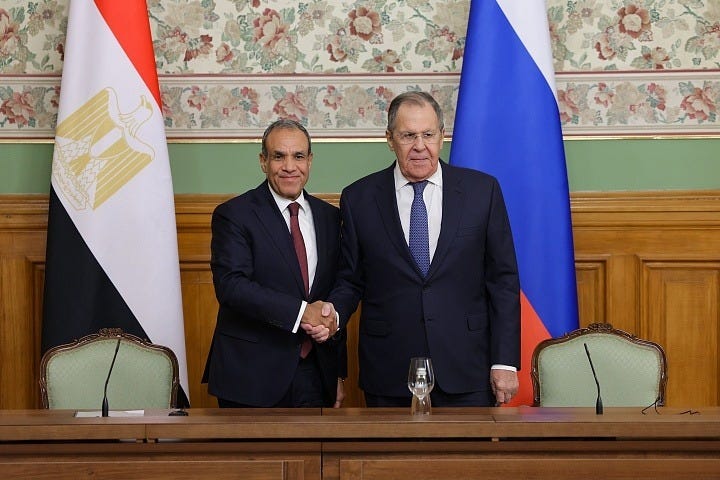
The Russian Industrial Zone is the second pillar of the Kremlin’s growing economic presence in Egypt. Construction on the first pillar, the El-Dabaa Nuclear Power Plant, began on Egypt’s Mediterranean coast in July 2022, marking a major milestone in Russian–Egyptian relations. In April, Russian Foreign Minister Sergei Lavrov received Abdelatty in Moscow to discuss the two “flagship” bilateral projects (Russian Ministry of Foreign Affairs, April 3). At the El-Dabaa site, some 300 kilometers (186 miles) northwest of Cairo, Rosatom—Russia’s state-owned atomic energy corporation—is building Egypt’s first nuclear power plant. The plant will be Rosatom’s first major nuclear power plant in Africa, featuring four VVER-1200 reactors (Водо-водяной энергетический реактор-1200, Vodo-vodyanoi energetichesky reactor-1200) that have a combined electricity-generating capacity of 4,800 megawatts. The plant is being constructed under a 2015 agreement financed largely through a $25 billion Russian state loan covering approximately 85 percent of the construction costs, with Moscow supplying nuclear fuel and related services (Rosatom, June 30).
In November 2025, Russian President Vladimir Putin and Egyptian President Abdel Fattah al-Sisi jointly celebrated the installation of Unit 1’s reactor pressure vessel by video link, with Sisi hailing a “dream finally come true” (President of Egypt, November 19, 2025). Once fully operational in 2030, with the first unit expected to start generating electricity in 2028, El-Dabaa should account for up to 12 percent of Egypt’s power capacity, substantially diversifying its energy mix (Middle East Observer, June 10; Egypt Today, July 15). Amid deepening cooperation on the industrial free zone and nuclear energy, however, negotiations for the free trade agreement between Egypt and the Eurasian Economic Union (EAEU), which have been under discussion since 2015, have stalled. In December 2025, Eurasian Economic Commission Trade Minister Andrei Slepnev said that the talks were “on pause” because of Egypt’s economic situation (Izvestiya, December 14, 2025).
Moscow’s engagement with Egypt follows a familiar pattern of Russia’s engagement with North Africa. In the past, Russia expanded its influence in North Africa by exploiting geographic vacuums, entering countries and sectors at minimal cost where European and U.S. actors were not active, benefiting business leaders close to Putin (see EDM, November 20, 2019). Today, however, Russia fills more sector-specific gaps. The European Union is actively seeking Cairo’s alignment. Just one month before the July RIZ announcement, EU High Representative for Foreign Affairs and Security Policy Kaja Kallas urged Cairo to help strengthen sanctions enforcement against Russia’s shadow fleet in the Mediterranean at the EU–Egypt Association Council in Luxembourg. At the same meeting, Kallas unveiled a 690 million euro ($803 million) EU clean energy investment in Egypt (EUNews, June 15). Abdelatty welcomed the EU investments but did not mention Russia.
Egypt’s EU and Russian energy partnerships do not substantially overlap. Brussels provides financing for renewable energy and grid modernization, while Moscow focuses on sectors in which it remains unmatched, such as turnkey nuclear power backed by state financing on terms that no Western consortium offers. Over the past few years, Russia has also increased its leverage over Egypt through grain, with Egypt now the world’s largest buyer of Russian wheat (Manassa News, June 2). Russia is filling niches in Egypt with long-term physical assets: the 50-year RIZ, reactors involving multidecade fuel commitments, and 20-year loans, more insulated from both sanctions pressure and Egypt’s macroeconomic fragility.
Whether the deepening of Moscow’s economic presence in Egypt will translate into political influence is unclear. Russia’s grain-driven expansion elsewhere in North Africa, including in Morocco and Tunisia, has generated trade revenues rather than political alignment (see EDM, January 31, 2024). Egypt has so far followed the same pattern, accepting what only Moscow can offer while freezing initiatives that carry high political costs. Although Egypt has been a BRICS member since 2024, it remains the largest southern Mediterranean recipient of EU funds and a crucial U.S. partner. [1] This time, however, Russia’s bet is slightly different than in the past—commodity flows can be redirected, whereas a nuclear power plant and an industrial zone cannot. Looking ahead, the key development to watch is the stalled EAEU agreement. A functioning industrial zone producing goods for African and Middle Eastern markets would give Moscow both a local commercial constituency and a stronger case for reopening EAEU negotiations. Unlike project-based cooperation, however, a free trade agreement with the Russia-led EAEU would carry broader political costs for Egypt. Such an agreement would be harder to portray as mere pragmatic, project-based hedging and could rather indicate Egypt’s increased willingness to politically align with Russia.
[1]BRICS is a loose political-economic grouping originally comprised of Brazil, Russia, India, the PRC, and South Africa, but now comprising 11 member states (BRICS Info, accessed September 9).
This article was originally published in Eurasia Daily Monitor.