

Russia Disguises Warship as Building in Bid to Evade Ukrainian Drones — UNITED24 Media
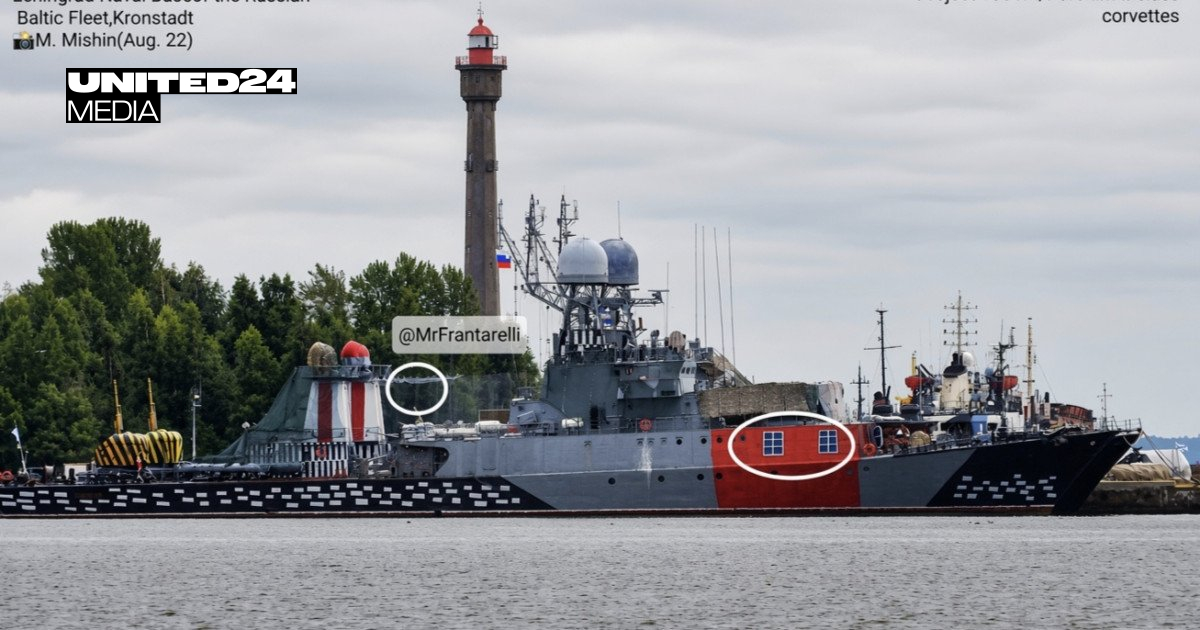
A Russian Navy corvette stationed at Kronstadt has been painted to resemble a waterfront building and fitted with protective netting, as Moscow continues adapting its Baltic Fleet vessels against Ukrainian drone attacks.
We bring you stories from the ground. Your support keeps our team in the field.
According to Defence Blog on September 14, photographs published by military observer Massimo Frantarelli show a Project 1331M corvette, known by NATO as the Parchim II class, with painted outlines resembling windows and doors across its hull. Netting has also been installed above parts of the deck as a physical barrier against incoming drones.
Russian Navy ship with deceptive camo and anti-drone netting.
Project 1331M/Parchim II-class corvettes(“Zelenodolsk” and “Kazanets”?).
🗺️Leningrad Naval Base of the Russian Baltic Fleet, Kronstadt.
📸M. Mishin(Aug. 22) pic.twitter.com/LejHVBDwEU— Massimo Frantarelli (@MrFrantarelli) September 13, 2026
The vessel was photographed at the Leningrad Naval Base in Kronstadt on August 22. Frantarelli said the ship could be either the Zelenodolsk or Kazanets, although its exact identity has not been confirmed. Russia operates roughly six of the East German-built anti-submarine corvettes, each displacing about 800 tons.
The modified vessel is part of a broader effort to alter the appearance of Russian warships based at Kronstadt. Naval analyst H I Sutton has documented several Baltic Fleet ships using black-painted bows and sterns, checkerboard patterns, and other disruptive designs since mid-2026.
Two Project 22800 Karakurt-class missile corvettes, Mytishchi and Burya, were also seen in July with unusual paint schemes and anti-drone netting.
The measures followed successful Ukrainian strikes against Russian naval assets in the Baltic region. On June 3, Ukrainian forces struck the corvette Boikiy while it was undergoing work in dry dock at Kronstadt, causing significant fire damage. Ukrainian officials said the vessel may have been damaged beyond repair.
In March, Ukrainian drones also sank the Russian patrol ship Purga near Vyborg, northwest of St. Petersburg. According to Defence Blog, neither vessel had protective anti-drone netting installed when it was targeted.
Similar techniques have historical precedent. During World War Two, warships were sometimes painted to distort their outline or blend into nearby infrastructure. Germany’s battleship Tirpitz reportedly carried a scheme during fitting-out at Wilhelmshaven that included painted features intended to make the hull resemble buildings along the waterfront.
-9a7b3a98ed5c506e0b77a6663f5727c5.png)
