

Riviera – News Content Hub
The IMO is set to hold an intersessional meeting from 1 to 4 September 2026, followed by a second meeting in November ahead of MEPC 85, in an effort to resolve outstanding concerns and build broader convergence around a global measure.
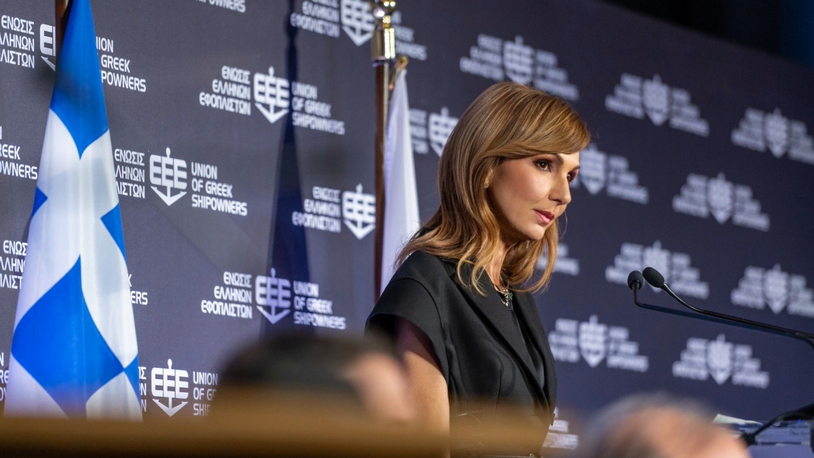
“The approach suggested by Panama and Liberia, while leaving room for further improvement, provides a balanced and pragmatic foundation for continuing the international dialogue,” UGS president Melina Travlos said in a statement published on 24 August.
“It takes into account critical parameters, such as the affordability, availability and scalability of the required fuels,” she added.
Ms Travlos noted that Japan’s proposal also acknowledges the importance of these parameters in determining shipping’s decarbonisation pathway.
However, focusing on the Panama-Liberia proposal, she highlighted that it also recognises the crucial role of ship energy efficiency and its contribution to reducing emissions, “a factor of particular importance while suitable fuels are either not available at all or only at excessive prices.”
The UGS president reiterated that the IMO Net-Zero Framework is not the solution, saying negotiations had “revealed significant weaknesses” in its current form.
“It is critical that the voice of shipping, the sector that will be called to implement these measures, is meaningfully heard. The green transition of shipping cannot succeed without the actual involvement of the industry,” she added.
She also called for a single, functional and truly workable global framework, adopted by the industry’s international regulatory body, the IMO, which the shipping industry has consistently supported.
“The goal is one: meaningful decarbonisation. Because progress is ultimately defined by what can be achieved in practice, always guided by the common good, not by what is planned in theory.”
Speaking about the next stages of IMO negotiations on a global measure, Ms Travlos had pointed to the alternative proposals submitted by Liberia and Japan, but declined to say which option the UGS favoured during the final day of Posidonia earlier this summer.
A matter of urgency
Ms Travlos pointed to the urgency of substantially reducing greenhouse gas emissions amid climate change and the growing frequency of extreme weather events.
She highlighted that the shipping industry has recognised the role it needs to play, remaining “firmly committed” to making a meaningful contribution towards the goal of decarbonisation.
“We are systematically investing in energy efficiency, new technologies, steadily reducing the carbon intensity of the sector’s emissions,” she said.
However, she emphasised that ambitious targets need to remain realistic, “and go hand in hand with solutions that reflect technological capabilities and the realities of the global market.”
“Otherwise, we risk placing an undue burden on economies and societies without delivering the desired environmental benefits,” she cautioned.
Credit: Source link