

Restocking US missile interceptors will take years. China and Russia are watching.
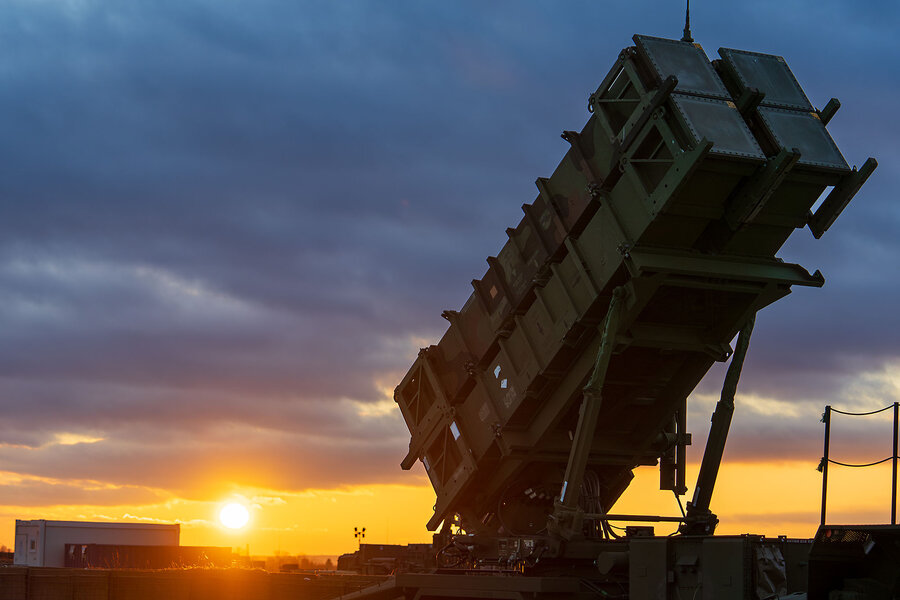
U.S. stockpiles of some of America’s key defensive missiles have been seriously depleted – some estimates say by more than two-thirds – since the Iran war began in February. It will take years to replace them, say analysts who add that the shortage could embolden U.S. rivals, such as China and Russia.
Gen. Dan Caine, the Pentagon’s top officer, warned the White House about potential shortages of Patriot and other missiles weeks before it decided to attack the Iranian regime, news articles at the time noted.
More recently, President Donald Trump has reportedly demanded answers from Defense Secretary Pete Hegseth about the shortages, which are already influencing how the United States conducts war. The White House called off attacks against Iran due to concerns about troop defense given the depletion of interceptor stocks, the New York Times and Wall Street Journal reported.
Why We Wrote This
The military’s top officer warned the Trump administration about a possible missile shortage if it attacked Iran. Stockpiles are now depleted, and plans to rebuild them focus less on the current war than on preparing for possible future conflicts.
Publicly, however, President Trump has continued to say that the U.S. has “massive amounts” of missiles. He also threatened to prosecute “treasonous” leakers.
In response, retired Marine Corps Col. Mark Cancian, who has conducted widely cited studies tracking depleted U.S. missile stockpiles, says that his numbers came from public records, not leaks. A defense analyst with the Center for Strategic and International Studies (CSIS), Mr. Cancian also says that he’s ready to show the work that went into his reports.
“If two analysts at a Washington think tank can come up with these numbers,” he says, “then the Chinese government – with tens of thousands of intelligence officials and way more sources of information – can come up with the same numbers.”
What is the current situation with U.S. missile stockpiles?
Patriot missiles are valuable because they are versatile from a military perspective, designed to handle relatively low-flying threats – ranging from incoming missiles to drones and aircraft – and leaving the more specialized THAAD system to defend against high-flying, faster missiles.
These Patriot stockpiles are down about 65% since the U.S. and Israel launched their war against Iran, according to the CSIS study, co-written by Mr. Cancian, and based on budget materials and publicly released information. The exact numbers are classified. But by these estimates, there are fewer than 850 Patriots left in America’s arsenal.
To defend U.S. forces stationed at bases in the Middle East from more high-flying Iranian ballistic missiles, which are harder to intercept, the U.S. has THAAD (Terminal High Altitude Area Defense) missiles. Since the war began, analysts estimate that supplies of those are down by anywhere from about 50% (by CSIS’ count) to some 80% (as cited in a widely circulated CNN report).
What are U.S. options for filling the shortfalls?
The U.S. is taking several major steps to boost its missile stockpiles.
It has a $58 billion, seven-year contract with Lockheed Martin to help increase Patriot missile production from roughly 620 to 2,000 a year.
Under another $35 billion contract, the defense contractor is also slated to ramp up THAAD missile production from 96 to some 400 per year over seven years.
The Pentagon said Friday that it is increasing production of ship-fired SM-3 interceptor missiles, designed to take out ballistic missiles, which “form the backbone” of naval defenses, according to a Pentagon statement.
“We are stabilizing our supply chains, expanding munitions production and putting our entire defense industrial base on a wartime footing,” said Michael Duffey, undersecretary of defense for acquisition and sustainment.
While the administration has pushed back on reports that the U.S. missile defense stockpile is low, it has used the alarm surrounding them to drive up Pentagon spending requests, some analysts note. That has prompted concerns about the growing number of no-bid contracts beneficial to big defense corporations and the political donors who run them.
Brokers representing President Trump bought millions in defense-sector shares during 2025, public records show. The following year, the government awarded Lockheed Martin the Patriot and THAAD contracts. Mr. Trump’s trades were made under a blind arrangement in which brokerage firms are prohibited from accepting direct trade requests from the president or his family.
In the meantime, President Trump said at the NATO summit in Ankara, Turkey, last month that he was considering granting Ukraine a production license to allow it to use Patriot technology to build missile parts locally. Weeks later, however, Mr. Trump appeared to walk back the offer.
What could this mean for the wars in Iran and Ukraine?
For the U.S., the problem is less about an immediate shortage of missiles – since about one-third or half of the arsenal remains – and more about what it portends for future conflicts, analysts say.
The risk comes from U.S. adversaries, particularly China, as well as North Korea and Russia, which could view the depleted U.S. stockpiles as a window of opportunity to attack American allies at a time when the nation’s defenses are already stretched.
This is already playing out in countries like Ukraine, says Luke Coffey, a senior fellow at the Hudson Institute.
Aware that the scarce Patriot missile is the main weapon capable of effectively and consistently intercepting Russian ballistic missiles, the Kremlin has put its own missile production into high gear to try to exploit Kyiv’s shortages. Its ballistic missile strikes on Ukraine have climbed steadily, from 61 in April to 198 in July, according to the Institute for the Study of War.
European countries like Spain have stockpiles of interceptors that could be transferred to Ukraine with little risk, Mr. Coffey adds.
And not all munitions are in short supply. But those that are more plentiful come with trade-offs for conflicts like the current war in Iran, including shorter ranges that could require U.S. military forces to fly over enemy territory. That, Mr. Cancian warns, could result “in greater vulnerability” for American troops, “and potentially greater losses.”