

OAS offers help as Haiti prepares first elections in decade
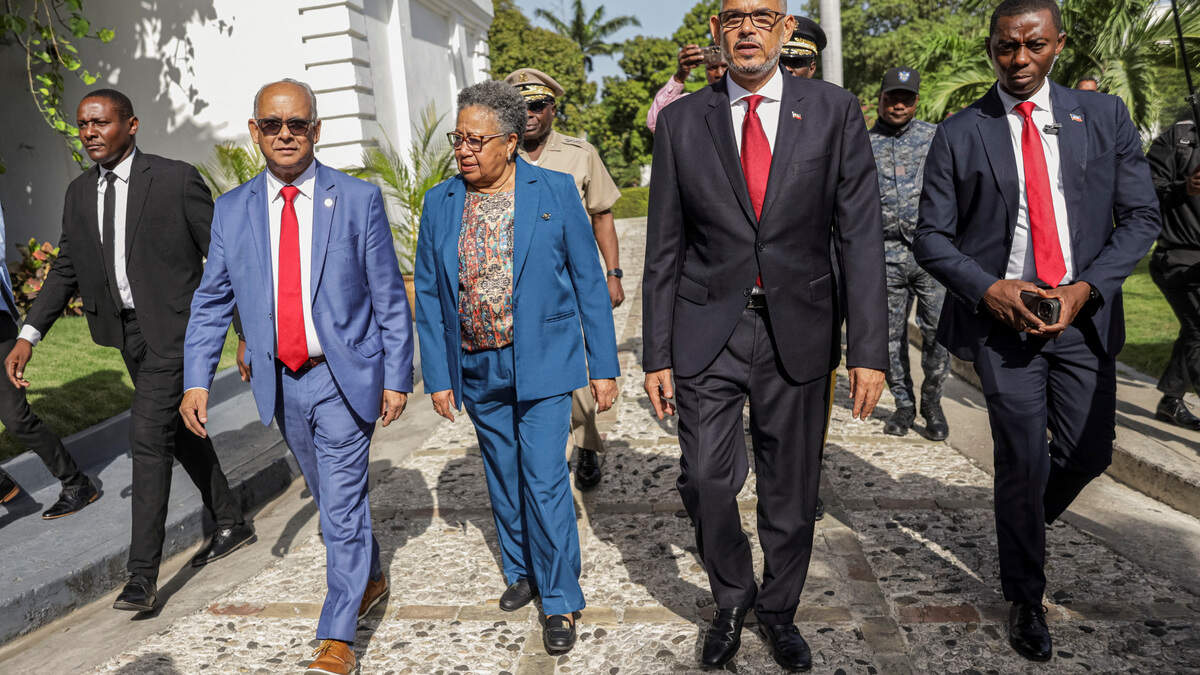
Haiti Prime Minister Alix Didier Fils-Aime meets with Organization of American States Secretary General Albert Ramdin and Caribbean Community Secretary General Carla Barnett ahead of the country’s first presidential vote in a decade, at the National Palace in Port-au-Prince, on Aug 17, 2026.
REUTERS
The Organization of American States says its remains ready to help Haiti strengthen political stability and basic governance as the country prepares for its first general elections in a decade amid persistent gang violence and uncertainty over who will be eligible to run.
Among the issues the hemispheric organization plans to address is one of the thorniest facing Haiti’s transitional authorities and elections entity: How to treat candidates who are under sanctions by foreign governments — but not the United Nations — and whose blacklisting has no formal standing under Haitian law.
OAS Secretary General Albert Ramdin said Thursday that the organization plans to seek guidance from the Venice Commission, the council of Europe’s advisory entiti on constitutional matters, to help Haiti confront questions over candidates eligibility and the integrity of the electoral process.
“The integrity of the process also requires confidence in the rules governing candidacies and their consistent application,” Ramdin said as he reported on a high-level delegation visit he led to Haiti in August. “Any concerns regarding candidate eligibility or potential links to illicit activities must be addressed transparently and in accordance with Haitian law and international electoral standards and good practices.”
The question about the eligibility of individuals sanctioned by the U.S., Canada, the Dominican Republic and European Union, but not the U.N., has become particularly sensitive as the Provisional Electoral Council prepares to launch the registration period for candidates seeking the presidency, posts in local government and Parliament.
The electoral decree only lists the UN sanctions as a reason under which someone can be barred from running for office. However, a June 2nd document published by the executive branch also states that people under sanctions by the U.S. Treasury and other foreign governments are not eligible and requires a number of documents that theoretically they should not be able to access if institutions did their job.
So far foreign governments have largely left it to Haitian voters to decide on candidates’ support, while Haiti’s politicians have largely avoided the issue.
Ramdin did not say how Haiti should handle the sanctions. He told the electoral council his reason for reaching out to the Venice Commission is to seek “more information regarding these types of elements in a credible and legitimate election for the consideration of Haitian authorities and [we] will be ready to support the Haitian authorities, as requested.”
The offer was one of several Ramdin outlined Thursday in his report on the high-level Inter-American and International delegation visit.
Among those on the visit was Carla Barnett, secretary-general of the Caribbean Community. A group comprised of the former prime ministers of The Bahamas, Jamaica and Saint Lucia is currently visiting Port-au-Prince.
Their visit comes as Haiti’s electoral authorities struggle to register voters and meet deadlines ahead of the scheduled Dec. 13 vote.
This week, the electoral council announced several extensions for candidates’ registration and for political parties and groups to enroll the 30,000 supporters required under the process.
As of Friday morning, less than two dozen of the 105 political parties and groups approved to field candidates had met the requirement. In a radio interview, Reynold Guerrier, the director general of the National Identification Office, said 857,306 ID numbers had been registered by groups while millions of identification numbers had been rejected due to data mismatch or duplications. The National Identification Office has said 6,583,753 citizens have a card, which is required in order to register to vote.
Neither the National Identification Office nor the Provisional Electoral Council has said how many Haitians have already registered to vote, though due to gang violence, the tally is presumably low.
Barnett said among the individuals the CARICOM leaders plan to engage with in Haiti are “political actors, including, the new parties and coalitions.”
Their purpose is to encourage dialogue among the various groups involved in the electoral process, she said, as she called for enhanced coordination of support to Haiti by regional and international governments.
The diplomatic efforts are taking place against the backdrop of continued gang violence, the slow deployment of the latest international armed force and growing pressure to hold elections.
Both Barnett and Ramdin backed renewal of the international Gang Suppression Force which will have its mandate discussed by the Security Council later this month.
Progress on security, Barnett said, “would not only help release the chokehold of the armed gangs on the people of the country, but would also be essential to creating an enabling environment for the coming elections.”
Acute security crisis
Haiti continues to face an acute security crisis, Ramdin said, with heavily armed gangs controlling between 80% to 90% of Port-au-Prince and expanding their presence into other parts of the country.
“There has been a noticeable surge in kidnappings and other violent crimes, as reported by the Haitian National Police, including of foreign citizens,” he said.
Ramdin highlighted the recent brutal gang attack in the hills above Port-au-Prince in Kenscoff where dozens of people were killed and many remain in captivity.
“We must condemn these attacks and realize the immense human and psychological toll that relentless violence continues to inflict on the Haitian people, robbing families of peace and young people of hope for a secure future,” he said.
The violence is adding to an already growing humanitarian emergency with 1.47 million people displaced from their homes and 6.4 million requiring assistance.
The efforts of the anti-gang force, Ramdin said, are essential to regain territories, help the government reestablish public services and keep them from gang control.
“Progress must be visible and measurable as soon as possible, and this is an area where we confirmed we need to be doing more,” he said
Members of the delegation to Haiti unanimoulsy support the renewal of the international force’s mandate, Ramdin said.
“We hope that the Americas as a region can also act with one voice” in the Security Council, he added, “to ensure this happens.”
Jacqueline Charles has reported on Haiti and the English-speaking Caribbean for the Miami Herald for over a decade. A Pulitzer Prize finalist for her coverage of the 2010 Haiti earthquake, she was awarded a 2018 Maria Moors Cabot Prize — the most prestigious award for coverage of the Americas.