

OAS Concerned That Politicians Linked to Criminal Gangs Are Contesting Haiti’s Elections
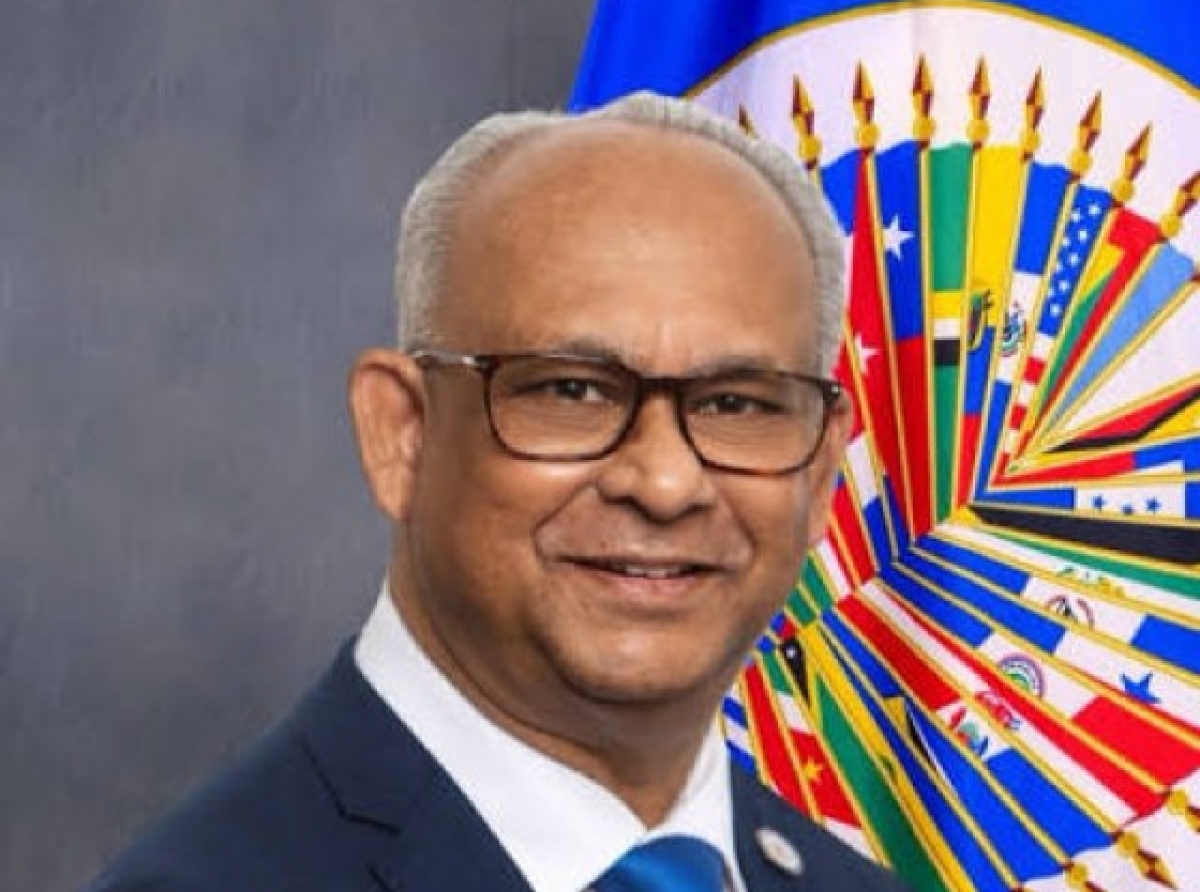
BRIDGETOWN, Barbados – The Secretary General of the Organization of American States (OAS), Albert Ramdin, Friday expressed concern that some politicians linked to criminal gangs were being allowed to contest the presidential and legislative elections in Haiti in December this year.
OAS Secretary General, Albert Ramdin, speaking to a select group of Caribbean journalists on Friday (CMC Photo)“Let me be clear about this. I speak openly about this, and I’m not speaking about all politicians. There are some politicians who have links with the gangs. That is a known fact,” Ramdin told a select group of Caribbean journalists during an hour-long virtual news conference.
“So I’m not in a situation to announce who and where and so on, but the fact is that this is a concern. So the disclaimer is that it is not about all the political candidates, all the political class. We have to make sure that we have clean elections, elections that will be respected by the Haitian authorities, by the Haitian political groups,” Ramdin said.
The first round of long-awaited presidential and legislative elections, alongside a constitutional referendum are scheduled for December 13, marking the first time Haitians will be casting ballots since 2016 when President Jovenel Moise was elected. Moise was later assassinated on July 7,2021.
The preliminary results are expected to be published December 19, with final results for the first round scheduled for January 9, 2027. A second round of presidential and legislative elections, along with local elections, is scheduled for February 21, 2027 with final results for the second round of presidential and legislative elections scheduled for March 7, with final local election results expected March 12.
Ramdin said that he has held several conversations with the Caribbean Community (CARICOM) appointed Eminent Persons Group (EPG) chaired by the former St. Lucia prime minister Dr. Kenny Antoine on the issue of politicians linked with criminal gangs.
“I have had several conversations with the EPG not only about this matter, but also the impediments to elections,” he said, noting that “only a couple of days ago” he held talks with Anthony and in the “coming week I will be talking to the EPG once they complete their mission in Haiti.
“I think the EPG does valuable work to connect with political organisations, and as such gets information, but also understands where they stand in the political realm of developments in Haiti. It is a very difficult situation.
“It is not easy to organise elections after 10 years, and certainly not under the conditions when many parts of Haiti are controlled by gangs, and that is something which needs to be addressed.”
Ramdin said he would not be identifying by name any of the politicians linked to criminal gangs, saying “we don’t mention names in any case, that’s not my habit.
“You will see my interviews are very, very scarce on naming persons because our job is not to create more problems. Our job is to facilitate solutions, and naming persons creates unnecessary issues.
“On top of that, I may be wrong, but it needs to be investigated then,” Ramdin told reporters.
Ramdin said he has also asked that the Gang Suppression Force (GSF) “to intensify its activities in a very targeted way.
“That means creating more trust by getting more gangs out of the way. We have to be careful there because there are many young people with guns in their hands, so we have to keep in mind the human rights situation as well.
“But intelligence gathering, more clear targeted operations will be required,” Ramdin said, adding that there is a stronger collaboration between the Haitian National Police, and the other law enforcement forces in Haiti.
Ramdin said that the OAS is preparing to send missions to Haiti “to expedite the planning and the collaboration between all these important organisational capabilities in Haiti.
“Again, it is not easy. We should not underestimate. I know that for many of you it is difficult to go to Haiti, but at some point, as I did in the past, I would like the Caribbean media to join us on a trip to Haiti as well and see firsthand the challenges which a government faces to maintain stability, maintain security, at the same time provide the necessary social and economic services to the people of Haiti.
“It is an extremely difficult situation, but that is why it is urgent and needed to be addressed and I am conveying this message simply because abandoning Haiti, demonstrating fatigue on support to Haiti is not an option, not in a political sense, not in the sense of finances or technical assistance.”
On the issue of voter registration, the OAS Secretary General said that he has held discussions with the Provisional Electoral Council (CEP) regarding the number of persons who have been registered to cast ballots in the elections.
“I’ll be frank with you. I have the same question to the CEP, and the reason I received for that is that Haiti has an electoral base of approximately five million Haitian citizens…and in the 2011 election, I think there were 1.5 million people taking part in the elections.
“In the 2015-16 election, it was something like 1.1 million. Ultimately, the president was elected with 500,000 votes cast. They find that if they have an idea how many people are going to really be interested to vote, they can prepare better in terms of the numbers of polling stations, but also in terms of the numbers of ballot papers to be printed.
“It makes a big difference between five million ballot papers to be printed if you think everybody is going to vote, compared to only one million or 1.5 million. For me, it’s something which is, of course, a decision of the CEP.”
Ramdin said he thinks that under the current circumstances, “my suggestion was really voluntarily, nothing pressured there, is why not go with, as it was done before, anybody who has a national ID card, and we have already distributed 5.3 million ID cards to Haitian citizens above 18 years.
“We have approximately one million, 1.5 million still to go. We have received funding from Japan to do this for a certain part, and other banks and countries are willing to provide more support. If we can provide those ID cards in the coming weeks faster, we’ll have a critical mass.
“But it is a consideration of the CEP I don’t want to come into their operational mechanisms as such, but time is running.”
Ramdin was also concerned at the increased number of kidnappings in the country, saying “anybody that is being kidnapped and taken against their will, it is something that we cannot condone.
“We must reject, and it has to be addressed. There is no other way of looking at this. So I regret all those kidnappings which are taking place, and regretfully there is an increase of kidnappings over the past couple of weeks.”
The GSF is a United Nations Security Council-backed multinational security mission deployed to Haiti to dismantle armed gangs and restore public order within an initial 12-month mandate.
Ramdin said member OAS countries are supporting a further six-month extension of the GSF mandate adding that inter-American institutions, international partners have already, have also confirmed that.
“So there is, and I’m going to undertake some activities in the coming weeks, among which speaking to the UN Security Council chair and sending some letters, but also have an activity here in Washington for that purpose.
“We want to show that we support Haiti. The GSF is important. Whether six months will be enough or not, it should not bring uncertainty about the value of the mission going forward.”
Ramdin said he does not know exactly what the reasoning is behind the six-month extension, and that he intends to raise the issue with the United States
“But fact is, I think, generally speaking, everybody believes that the GSF will continue,” he said, even as he urged countries that were intending to deploy soldiers to ensure that the GSF is indeed 5,000 strong to do so.
‘I have appealed to all countries who have pledged support, forces and equipment, to expedite that. It’s taking too long. The force commander cannot function, cannot do his job, if he doesn’t have the forces or the equipment.
“I’m very happy that one country in Europe is going to make airlift capabilities available to bring the Bangladeshi troops to Haiti. But there are other countries ready for deployment, but they don’t have the airlift. So we are working very hard to talk to countries to provide that.
“If they cannot provide troops, we ask them to provide airplanes to transport the troops to Haiti. The GSF should continue under a similar mandate, but with more aggressive operations. As I said before, the security mission will be heading to Haiti from our side, combined with some other agencies in the hemisphere, for that purpose,” Ramdin told reporters.