

NIHRC and UNTMIS Discuss Handover of Human Rights Monitoring Responsibilities
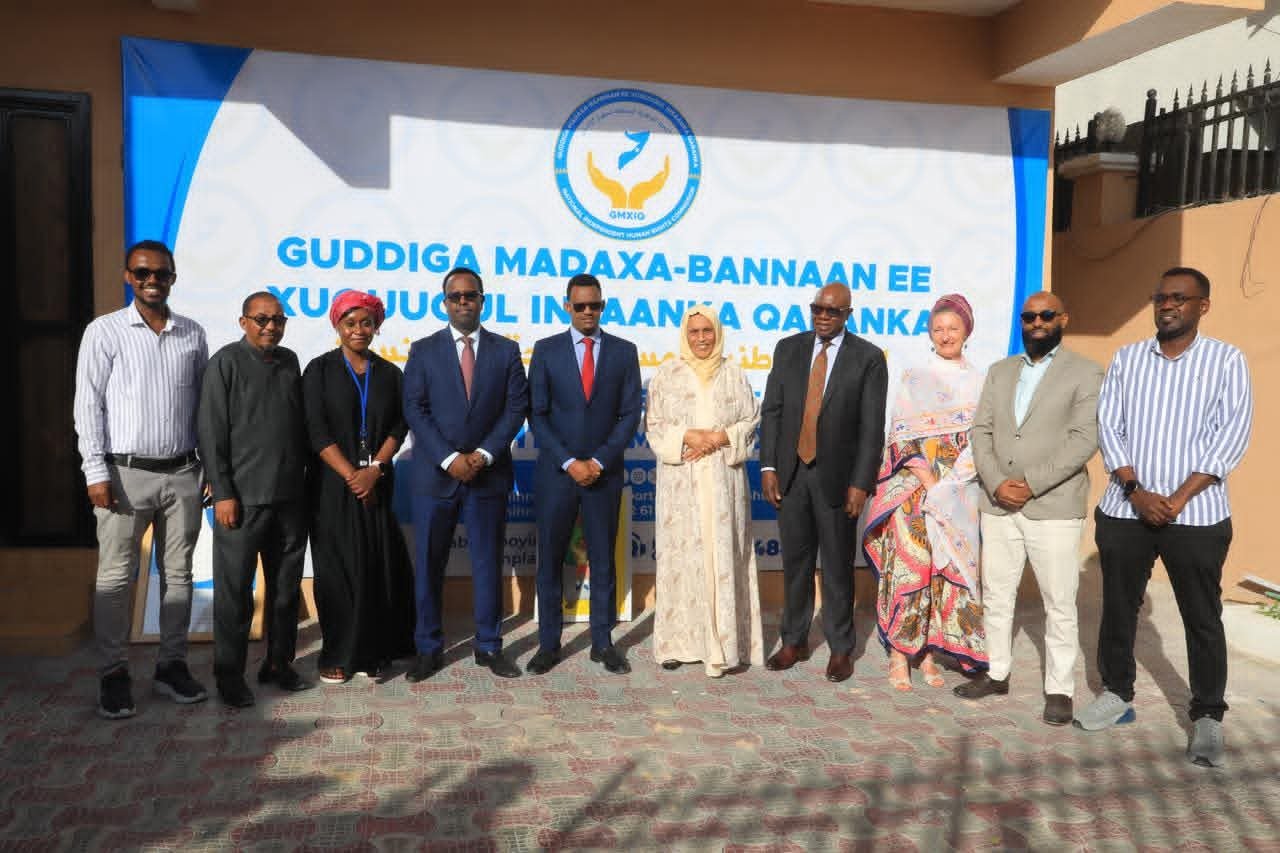
MOGADISHU — The Chairperson of Somalia’s National Independent Human Rights Commission (NIHRC), Dr. Maryan Qasim, received the Head of the United Nations Transitional Mission in Somalia (UNTMIS), Raisedon Zenenga, and his delegation at the Commission’s headquarters in Mogadishu on Monday to discuss the transition of human rights responsibilities as the UN mission prepares to close.
The meeting focused on the handover of UN human rights activities to the Commission, and the body’s expanding role in monitoring, reporting, and responding to human rights concerns in Somalia.
Zenenga stated that the United Nations will continue to support the Commission after UNTMIS concludes its operations in October 2026, particularly in the areas of institutional capacity building, monitoring and reporting, and strengthening the Commission’s ability to independently fulfil its constitutional mandate.
Dr. Maryan Qasim welcomed the continued cooperation between the two sides, reaffirming the Commission’s commitment to strengthening national ownership and building a transparent, independent human rights institution that is accessible to the public.
The UNTMIS Transition and Human Rights Handover
UNTMIS succeeded the UN Assistance Mission in Somalia on November 1, 2024, in accordance with UN Security Council Resolution 2753. The transition is a two-year process scheduled to conclude by October 31, 2026, when UNTMIS will end its operations and transfer remaining functions to Somali national institutions and the UN Country Team.
The transition is structured in two main phases. Phase One (November 2024 – October 2025) prioritized support and capacity building in state-building, human rights, rule of law, security sector support, coordination of international aid, and countering violent extremism. Phase Two (November 2025 – October 2026) involves the progressive transfer of all remaining functions to the Federal Government, the UN Country Team and other partners.
The conclusion of UNTMIS support for Somalia’s justice and corrections services was marked in August 2026, with Minister of Justice Hassan Moallim Mohamud expressing gratitude to the United Nations, UNTMIS, and other partners for their support in developing Somalia’s justice and corrections institutions, building institutional capacity, and strengthening the rule of law.
Building Somalia’s Human Rights Institution
Dr. Maryam Qasim was elected in February 2026 as the first chairperson of Somalia’s Independent Human Rights Commission, a landmark step toward national ownership of human rights oversight. The Commission is mandated to document human rights violations, support victims, and advise the government on rights-based governance. Dr. Qasim brings over four decades of expertise in public administration, health, education, and humanitarian affairs to the role.
The Commission launched a week-long capacity-building workshop in April 2026, bringing together Commission members and experts from the United Nations and regional human rights institutions to enhance institutional capacity and support the Commission in fulfilling its national mandate. The training focused on international human rights law, humanitarian law, monitoring and investigation of violations, and critical topics including conflict-related abuses and supervision of detention centers.
The Commission has also met with the Special Presidential Envoy for Stabilization and Civilian Protection, Omar Hashi, to strengthen cooperation on civilian protection, institutional coordination, accountability, and human rights monitoring. The discussions came shortly after the formal approval of Somalia’s National Civilian Protection Policy, a framework designed to embed safeguards for non-combatants into the country’s security doctrine.
The Commission and the European Union have agreed to deepen their cooperation on human rights, accountability, and governance. The partnership with the EU is expected to help Somalia enhance oversight mechanisms and public accountability, with discussions centered on broadening support for the Commission’s activities and improving its institutional capacity.
The Commission has also held strategic talks with Switzerland’s Ambassador to Somalia, Mirko Giulietti, to advance the institutional framework for human rights protection. Deputy Chairperson Mohamed Harun Mohamud assured the Swiss delegation that the Commission will operate with complete independence and strict neutrality, in line with the Paris Principles.
Critical Note
The meeting between Dr. Maryan Qasim and the UNTMIS leadership reflects the practical realities of the transition process. As the UN mission prepares to close, Somali institutions must assume responsibilities that have been managed by international staff for years. The Commission’s ability to independently monitor, investigate, and report on human rights violations will be a critical test of Somalia’s institutional capacity and its commitment to accountability.
The timing is significant. UNTMIS’s departure coincides with ongoing security challenges and political tensions that have raised concerns about civic space and the treatment of journalists. The Commission will need to navigate these pressures while maintaining its independence and credibility. Its mandate to summon officials, access government information, and conduct investigations provides it with important tools, but the political will to respect those powers remains uncertain.
The United Nations has committed to continued support beyond the mission’s closure, but the form and scope of that support remain to be defined. For the Commission to succeed, it will need not only technical assistance but also sustained political backing from Somali authorities and the international community. The appointment of Dr. Maryan Qasim, a former minister with significant experience, provides the institution with credible leadership. Whether that leadership can translate into meaningful protection for Somali citizens will depend on whether the Commission is allowed to operate as the independent body the law envisions an how the Commission act and repones to citizens complaints.
Recommended Reading On ftlsomalia.com
Credit: Source link