

Muslim World League Chief Meets Somali Scholars in Mogadishu, Agree Joint Project to Counter Extremism
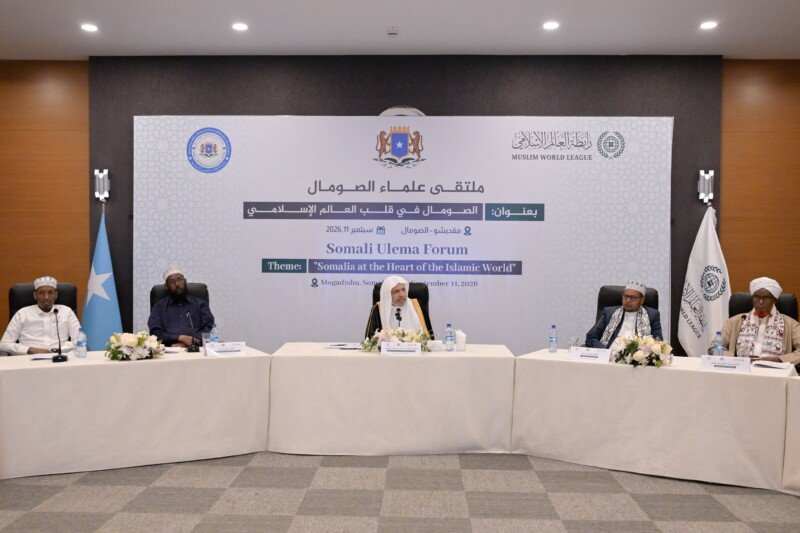
MOGADISHU — The Secretary-General of the Muslim World League and Chairman of the International Union of Muslim Scholars, Sheikh Dr. Mohammed bin Abdulkarim Al-Issa, met with prominent Somali scholars in Mogadishu in what was described as a rich scholarly and intellectual gathering.
An accompanying forum was held under the title “Somalia at the Heart of the Islamic World.” The attendees commended the meeting and the extensive discussions, which focused on confronting extremist ideas that are alien to the sound Sharia methodology of the Somali people, and the importance of mobilizing efforts to raise awareness of their dangers and means of prevention.
The scholars praised the content of Al-Issa’s speech, which included a solid Sharia and intellectual approach along with important proposals to bolster scholarly and intellectual efforts in confronting extremism. The meeting concluded with an agreement on a joint project that includes a number of qualitative initiatives and programmes to enhance scholarly and intellectual cooperation between the Muslim World League and Somali scholars.
A Broader Push Against Extremist Ideology
The gathering is part of a wider effort by Somali religious authorities and international Islamic institutions to counter the ideological underpinnings of Al-Shabaab and other militant groups. Al-Issa also delivered the Friday sermon and led prayers at the Grand Mosque in Mogadishu in the presence of senior officials and scholars, addressing a range of legal and intellectual issues related to Somali affairs.
Earlier this year, more than 300 Islamic clerics from Somalia and the diaspora issued a fatwa denouncing religious extremism in all its forms and urging public support for the government’s offensive against Al-Shabaab and other terror groups. The 14-point declaration branded Al-Shabaab, ISIS and like-minded groups as enemies of Islam, stating their extremist ideology had no religious basis.
Somalia’s government has also partnered with the Islamic Military Counter Terrorism Coalition to launch the Peace Journalists initiative, a strategic media programme aimed at strengthening national capacity to counter extremist rhetoric, hate speech, and terrorist propaganda in the digital space. Defence Minister Ahmed Moallim Fiqi said countering terrorism required responsible media discourse alongside military operations [citation:16].
The Ministry of Information has shut down 82,000 social media pages in 2026 allegedly used by terrorist groups to spread extremist propaganda, with Director General Abdullahi Hayir Duale describing the ideological front as a key part of the government’s broader counterterrorism strategy.
The government has also submitted a bill to parliament seeking to establish a Somali Ulema Council, which would unite religious scholars, strengthen their role in society, and address religious misinformation and extremist ideologies.
Critical Note
The meeting between the Muslim World League and Somali scholars reflects a recognition that military operations alone cannot defeat Al-Shabaab. The group’s ability to recruit and regenerate is rooted in ideological narratives that require a counter-narrative grounded in credible religious scholarship. Engaging institutions like the Muslim World League provides the government with access to influential religious voices that can challenge extremist interpretations.
Yet the effectiveness of this approach depends on whether religious engagement is implemented as a genuine long-term strategy or merely as a rhetorical complement to military operations. Somalia’s counter-extremism efforts have at times been criticized for lacking a coherent ideological component, with military campaigns prioritized over community-based prevention. The government must ensure that partnerships with religious institutions translate into sustained programmes that address the underlying drivers of radicalization, including poverty, lack of opportunity, and weak governance.
There are also concerns about the politicization of religious discourse. The government must be careful to avoid using religious institutions to advance narrow political agendas or to silence legitimate dissent. A credible counter-extremism strategy requires that religious engagement be authentic, inclusive, and grounded in the principles of moderation and tolerance that the Muslim World League claims to promote.
Recommended Reading On ftlsomalia.com
Credit: Source link