

More Iron Ore, Missing Taxes and Profits | News
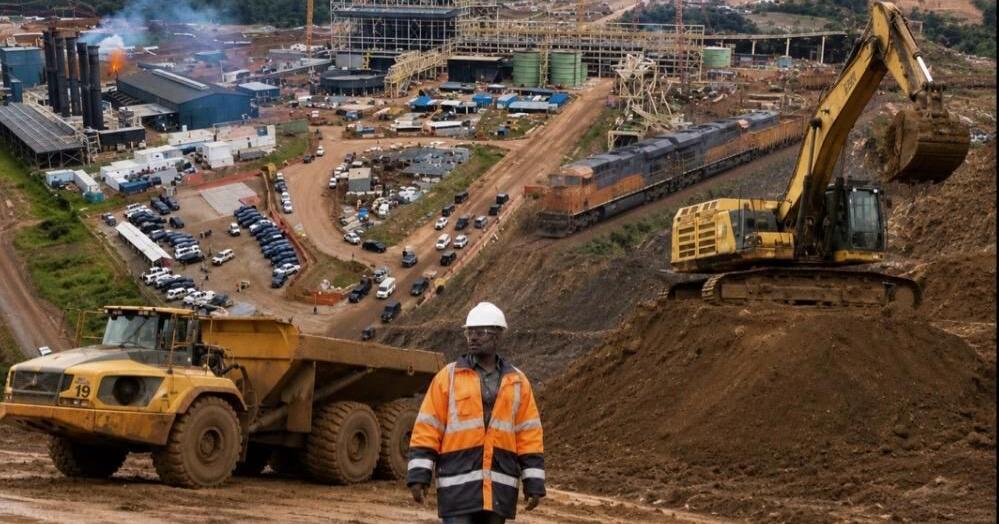
Deep in the rainforest of Nimba County, heavy excavators work around the clock tearing high-grade iron ore from the earth at Tokadeh Mountain. From there, heavily loaded freight trains rumble along a 250-kilometer rail corridor to the Atlantic port of Buchanan, where bulk carriers load raw metal bound for global steel mills.
Operationally, the Liberian concession of ArcelorMittal—the Luxembourg-headquartered global steel conglomerate—has never been more productive. According to official corporate filings submitted to the U.S. Securities and Exchange Commission (SEC), ArcelorMittal Liberia extracted a record 7.7 million tons of iron ore during the first six months of the year, an 87.8% surge over the 4.1 million tons produced in the same period last year.
|
KEY EXTRACTION METRICS (SEC FORM 6-K) • H1 2025 Iron Ore Production: 4.1 million Tons • H1 2026 Iron Ore Production: 7.7 million Tons (+87.8% YoY) • Full-Year 2026 Target Shipments: 18.0 million Tons • Long-Term Phase II Capacity Target: 20.0 to 30.0 MTPA |
With full-year shipments guided to 18 million tons and a multi-billion-dollar expansion underway to push annual capacity to 20 million tons (and eventually 30 million tons), Liberia has swiftly emerged as the single largest engine of growth in ArcelorMittal’s global raw-material portfolio.
Yet, behind these booming extraction metrics lies a persistent financial mystery. While ArcelorMittal’s public disclosures provide detailed accounting of physical tonnage, capital expenditures, and local operational bottlenecks, they omit a critical set of financial figures: How much revenue and net operating profit is the Liberian operation generating on Liberian soil?
An examination of ArcelorMittal’s financial filings, concession agreements, and international tax frameworks reveals a striking asymmetry in corporate disclosure—one that underscores long-standing concerns regarding natural resource extraction, transfer pricing, and fiscal transparency in developing nations.
The Disconnect: Costs Disclosed, Revenue Hidden
In its interim financial report filed on July 31, ArcelorMittal reported that external sales across its global Mining segment rose to $766 million for the first half of the year, up from $588 million during the same period in the prior year.
The company explicitly credited its Liberian operations as the primary engine driving these increased volumes. Concurrently, when explaining why the Mining segment’s overall operating income dropped 31.3% to $308 million, corporate management pointed directly to costs incurred in West Africa, citing “higher freight and operating costs and higher depreciation related to the Phase 2 expansion in Liberia.”
|
DISCLOSED BY ARCELORMITTAL ✓ Exact Physical Output (7.7 Mt) ✓ Full-Year Target Shipments (18 Mt) ✓ Revised CapEx Budget ($1.8 Billion) ✓ Local Depreciation & Freight Drag |
WITHHELD FROM PUBLIC FILINGS ✗ Stand-Alone Liberia Revenue ($) ✗ Site-Level C1 Cash Cost per Tonne ✗ Liberia-Only EBITDA & Net Profit ✗ Realized Transfer Pricing Benchmarks |
This reporting method creates a structural contradiction. ArcelorMittal isolates Liberia when highlighting physical volume achievements and when accounting for capital expenditures, logistics costs, and depreciation drag. But when it comes to reporting standalone revenues, cash operating costs (C1 costs per ton), or net operating margin, Liberia’s financial identity is blended into the company’s consolidated worldwide results.
This was not always the case. In disclosures covering previous fiscal years, ArcelorMittal publicly noted that Liberia generated roughly $200 million in EBITDA on shipments of approximately 10 million tons. As production nearly doubles, that site-level financial clarity has vanished from interim reporting.
Inside the $1.8 Billion Expansion
The lack of standalone financial metrics comes at a pivotal moment for Liberia’s economy. ArcelorMittal is currently executing its Phase II expansion project—the largest Foreign Direct Investment (FDI) in post-war Liberian history.
According to SEC filings, the capital cost for Phase II was revised upward from $1.4 billion to $1.8 billion. The investment includes key industrial assets across the country:
▪ A state-of-the-art iron ore concentrator at Tokadeh to process lower-grade ore into high-value sinter feed and concentrate.
▪ Upgraded heavy-haul rail infrastructure stretching from Nimba County to the coast.
▪ A refurbished multi-user deepwater berth and automated material-handling systems at the Port of Buchanan.
▪ A $200 million upfront signature payment made to the Liberian government following the ratification of the updated Mineral Development Agreement (MDA).
The company’s filings confirm that commissioning is advancing rapidly, with full project completion across all processing lines expected by the third quarter of 2026.
Transfer Pricing and Fiscal Risk
Why does site-level financial obscurity matter to the public and policymakers?
ArcelorMittal is a vertically integrated global industrial giant. Rather than selling all of its iron ore on the open spot market, significant volumes extracted from Liberian soil are transferred internally to feed ArcelorMittal’s own steel manufacturing plants in Europe and Asia.
When an integrated company operates across international borders, the price assigned to internal shipments—known as the transfer price—determines where profits are officially booked. Without standalone reporting on average realized prices per tonne and intercompany sales adjustments, economists and civil society groups argue it is impossible for independent observers to verify whether Liberian iron ore is being transferred at true international market benchmarks (such as the Platts 62% or 65% Fe Index) or priced internally to shift taxable margins to low-tax jurisdictions.
Furthermore, under standard corporate accounting, loading a $1.8 billion capital investment and accelerated equipment depreciation onto local balance sheets drastically reduces local net taxable income. While Liberia collects its statutory 4.5% gross royalty on physical exports, corporate income tax payments can be effectively deferred for years as capital expansion costs absorb operating profits.
A Call for Sovereign Accountability
ArcelorMittal operates in West Africa under a long-term framework extending through 2050, governing finite natural resources owned by the Liberian public.
Corporate entities frequently group operations into broad geographical divisions for administrative convenience. However, legal experts and governance advocates maintain that concessions involving sovereign natural assets require a higher standard of site-level reporting.
If a multinational company can measure physical extraction down to the decimal point on a monthly basis, it possesses the underlying site-level financial accounting. For Liberia—a country working to build sustainable public revenue from its mineral wealth—true transparency requires that revenue figures, operating expenses, and net profit margins be disclosed with the exact same precision as the physical ore leaving the country’s shores.
Summary Table: Official Reporting Indicators (H1 2025 vs. H1 2026)
|
Disclosed Indicator |
H1 2025 |
H1 2026 |
YoY Change / Status |
|
AML Iron Ore Production |
4.1 Mt |
7.7 Mt |
+87.8% Surge |
|
Global Mining Output |
16.7 Mt |
19.8 Mt |
+18.6% Increase |
|
Liberia Share of Output |
~24.5% |
~38.9% |
+14.4 Percentage Pts |
|
Full-Year Shipment Target |
— |
18.0 Mt |
Guided Target |
|
Phase II CapEx Budget |
$1.4 Billion |
$1.8 Billion |
+$400M Revision |
|
Mining Segment Sales |
$588 Million |
$766 Million |
+30.2% (Consolidated) |
|
Liberia Standalone Revenue |
Disclosed |
Not Disclosed |
Aggregated in Segment |
Credit: Source link