

Olara Otunnu Seeks U.N. Top Job, Bringing Mixed Record on Israel
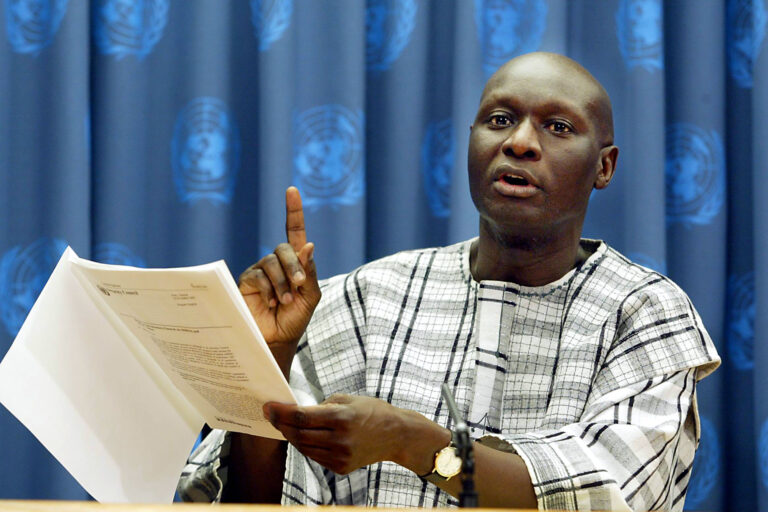
KAMPALA, Uganda (AP/VINnews) — Ugandan statesman Olara Otunnu has entered the race to become the next secretary-general of the United Nations, bringing decades of diplomatic experience — and a record that includes strong criticism of Israeli policies toward Palestinians as well as condemnation of Palestinian terrorism.
Subscribe to our Daily Roundup Email
Backed by Uganda, Otunnu is traveling to New York to meet with delegations and engage in discussions with the U.N. General Assembly and Security Council, said Adonia Ayebare, Uganda’s permanent representative to the United Nations.
Otunnu, 75, is a veteran of the U.N. system who served as Uganda’s representative to the world body from 1980 to 1985 and was president of the Security Council in 1981. He later served as Uganda’s foreign minister and, from 1997 to 2005, was U.N. under-secretary-general and special representative for children and armed conflict.
His record on the Israeli-Palestinian conflict dates back to his years on the Security Council. As Uganda’s representative, Otunnu participated in Security Council proceedings concerning the territories occupied by Israel.
As the U.N.’s top official dealing with children in armed conflict, he repeatedly criticized Israeli actions that he said harmed Palestinian children. In 2002, Otunnu urged Israeli authorities to fully comply with international humanitarian and human rights law and the Convention on the Rights of the Child. He cited restrictions affecting Palestinian schools and access to health care.
At the same time, Otunnu took an unequivocal position against Palestinian terrorism. In a 2003 Security Council debate, he said suicide bombing was “entirely unacceptable” and called on Palestinian authorities to prevent children from participating in the conflict. He specifically noted that children had been used as suicide bombers and that children had also been killed in suicide attacks.
That record has made Otunnu’s position more complicated than a simple pro-Israel or anti-Israel label. He has criticized Israel over its treatment of Palestinians and called for adherence to international humanitarian law, while also explicitly rejecting suicide bombings and the involvement of Palestinian children in violence.
Otunnu’s international career began long before his U.N. appointment. Educated at Oxford University and Harvard Law School, he became an outspoken opponent of Idi Amin’s government and later emerged as one of Uganda’s leading diplomats.
In 1997, then-U.N. Secretary-General Kofi Annan appointed Otunnu as his special representative for children and armed conflict. During his eight-year tenure, he helped establish international mechanisms for monitoring and reporting violations against children in war and pushed for stronger protections for child soldiers. The U.N. credits him with helping establish the framework that eventually led to Security Council Resolution 1612 and its monitoring system.
Otunnu won the Sydney Peace Prize in 2005 for his work protecting children affected by armed conflict.
He had previously been considered for the secretary-general’s post in 1997, but Uganda’s government opposed his candidacy. Kofi Annan ultimately won the position.
Otunnu later returned to Uganda and unsuccessfully ran for president in 2011. He has remained largely outside frontline politics since then.
“Even though the U.N. is now occupied with a number of issues across the board, the most important single mandate for the U.N. remains the issue of peace and security,” Otunnu told reporters last week.
He also points to his role in developing the informal “straw ballot” system used by the Security Council to narrow candidates for secretary-general. The procedure became known as the “Otunnu Formula” after it was first used during the 1981 selection of Javier Pérez de Cuéllar.
Otunnu’s late entry makes him a potential dark-horse candidate in a crowded field. Other candidates include Senegal’s Macky Sall, Chile’s Michelle Bachelet, Argentina’s Rafael Grossi, Costa Rica’s Rebeca Grynspan, Ecuador’s Maria Fernanda Espinosa and Guyana’s Carolyn Rodrigues Birkett.
The secretary-general is nominated by the 15-member Security Council, where the United States, Russia, China, Britain and France hold veto power, and must then be approved by the 193-member General Assembly.
The next secretary-general is expected to begin the five-year term Jan. 1.
Follow VINnews for Breaking News Updates
Credit: Source link