

MEPC 85: Greek shipowners back Liberia-Panama proposal ahead of IMO talks
The Union of Greek Shipowners (UGS) wants emission targets determined by what the bunker market can actually supply, ahead of IMO talks on 1 September.
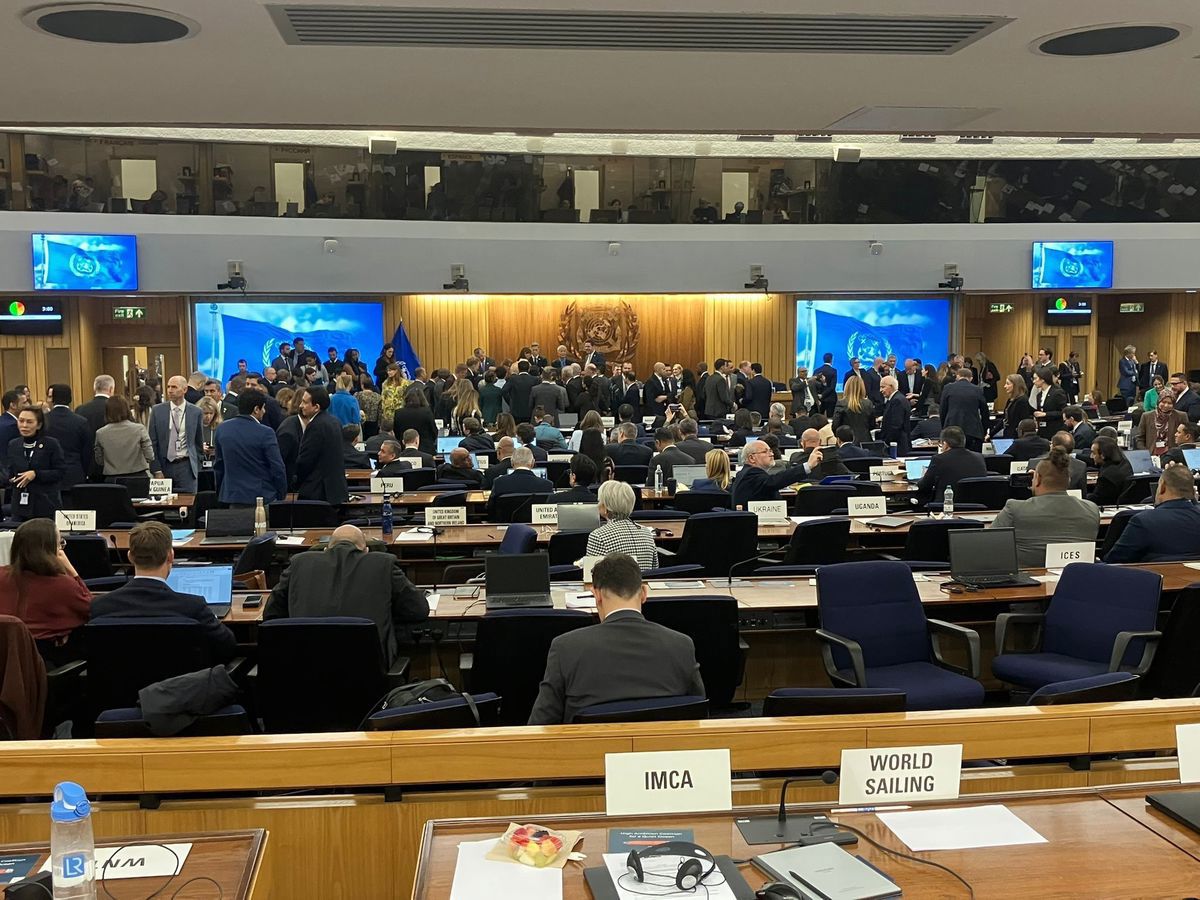
IMAGE: Delegates at the IMO’s Marine Environment Protection Committee’s Extraordinary Session (MEPC ES.2), which ran between 13-17 October 2025 in London. Flickr of the IMO
The UGS said the currently approved NZF has “significant weaknesses” and called for a global framework that combines emissions reductions with economic viability.
It argued that global shipping regulations need to take greater account of whether alternatives to conventional fuels can be supplied in sufficient volumes and at viable prices.
Against this backdrop, it has backed the Panama-Liberia approach as a “balanced and pragmatic foundation” for further negotiations, arguing that it better reflects practical constraints around alternative marine fuel supply and cost.
It also welcomed the proposal’s greater emphasis on vessel energy efficiency, arguing that efficiency improvements will remain particularly important while suitable alternative fuels are either unavailable or prohibitively expensive.
Liberia submitted the proposal to MEPC 85 alone, building on a proposal by Argentina, Liberia and Panama considered at MEPC 84. It would remove GHG pricing from the framework and instead set GHG Fuel Intensity (GFI) reduction targets based on the affordability, availability and scalability of low-emission fuels. The trajectory would be reviewed for revision every five years.
It would rely on surplus units (SUs) as the sole compliance mechanism. Ships performing better than their GFI target could generate units that other vessels could use, while units could also be banked or borrowed from up to two consecutive years.
The UGS also pointed to Japan’s proposal as recognising some of the challenges surrounding future fuel supply.
Japan has put forward a basis for discussion seeking to soften GFI reduction targets from 2030 onwards while replacing payments into the Net-Zero Fund with a “direct contribution” mechanism.
Instead of purchasing remedial units, shipowners could either buy surplus units to cover non-compliance or contribute directly to projects proposed by member states and approved by the MEPC.
“Ambitious targets, however, need to remain realistic, and go hand in hand with solutions that reflect technological capabilities and the realities of the global market,” said UGS president Melina Travlos. She argued that the industry’s green transition needs a “single, functional and truly workable global framework”.
The Liberian proposal received support from several IMO member states, including Oman, Kuwait, Jordan, Somalia, Yemen and Tunisia, during MEPC 84 discussions. But several other member states and climate groups, including Opportunity Green, have strongly opposed removing GHG pricing.
Proposals by Tuvalu, ACSA-UK, Brazil and Liberia will now be debated at the IMO’s intersessional GHG working group meetings in September and November, before delegates consider the framework at MEPC 85 from 30 November to 3 December.
If member states agree on a final text, the amendments could then be formally adopted at MEPC ES.2, expected to reconvene on 4 December.
Meanwhile, Japan’s proposal was submitted on 20 July, which was after the 30 May deadline for circulating draft amendments six months before MEPC 85. Member states could choose to waive that requirement and proceed with adopting the NZF at MEPC ES.2, or delay adoption to a later session, such as in 2027.
By Konica Bhatt
Please get in touch with comments or additional info to news@engine.online
Credit: Source link