

Melnyk: Russia Already Losing as Putin Wages Ballistic Terror
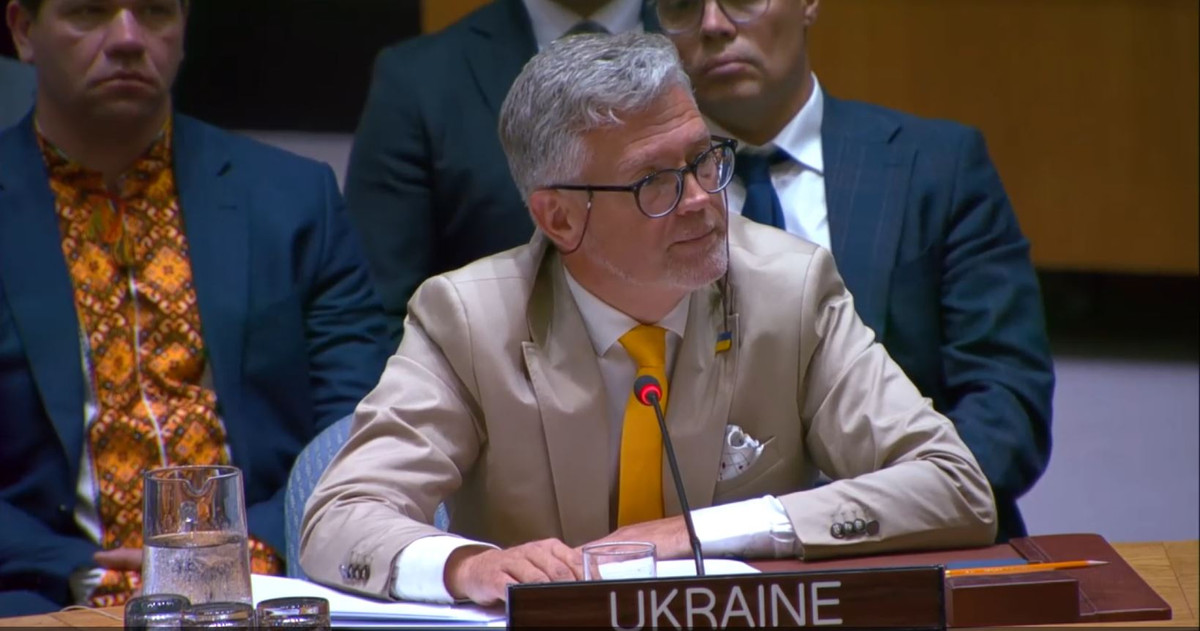
Russia is already losing the war it launched against Ukraine and will ultimately be defeated, Ukraine’s Permanent Representative to the UN Andriy Melnyk told the Security Council on Monday, accusing Russian leader Vladimir Putin of unleashing an unprecedented campaign of “ballistic terror” against Ukrainian civilians.
Speaking at a Security Council meeting marking Ukraine’s 35th Independence Day, Melnyk delivered a forceful attack on both Moscow and what he described as the international community’s failure to take effective action to stop Russia’s war.
JOIN US ON TELEGRAM
Follow our coverage of the war on the @Kyivpost_official.
“Despite all the barbaric attacks against civilians in Ukraine, Russia is already losing and will ultimately lose this war,” Melnyk said.
He pointed to growing pressure on Russia’s economy from the enormous costs of the war, Western sanctions and Ukraine’s expanding ability to strike Russian oil, gas and other infrastructure supporting Moscow’s war effort.
Melnyk cited the recent departure of Andrei Klepach, chief economist at Russian state development corporation VEB.RF, after the economist publicly warned about Russia’s ability to sustain a prolonged economic war of attrition against Ukraine.
Russia’s federal budget deficit reached about 5.8 trillion rubles in the first four months of 2026, already significantly exceeding the government’s original 3.8-trillion-ruble target for the entire year, Melnyk said.
Other Topics of Interest
UK, Ukraine Sign New AI Defense Agreement
The partners will test projects including fiber-optic sensors to protect military sites and low-power AI chips for drones.
Russian Finance Ministry figures showed oil and gas revenues falling by nearly 40% year-on-year between January and April.
According to Melnyk, Russia lacks the resources to sustain a prolonged war of attrition as its battlefield losses, financial burden and material costs continue to mount.
At the same time, he accused the Kremlin of exaggerating tactical advances to create the impression of continuous military success.
Ukraine defends strikes on Russia’s war infrastructure
Melnyk also rejected Moscow’s accusations over Ukrainian strikes inside Russia, arguing that infrastructure serving Russia’s military campaign can constitute a legitimate military objective under international humanitarian law.
He referred specifically to Article 52, paragraph 2, of Additional Protocol I to the Geneva Conventions, which defines the circumstances under which an object can qualify as a military objective.
“The same legal test applies to Russia’s dual-use infrastructure,” Melnyk said.
“Ukraine’s position is absolutely clear: our armed forces only target military objectives that contribute to Russia’s war effort, never civilians.”
He said Ukraine acts in exercise of its inherent right to self-defense and in accordance with the principles of necessity, proportionality and distinction.
“Ukraine takes all feasible precautions to minimize civilian harm,” he said.
“The only person responsible for any damages, for any casualties in Russia, is Mr. Putin alone.”
Melnyk said this represented a fundamental difference between the conduct of Ukraine and Russia, accusing Moscow of continuing to spread “lies” at the Security Council that Ukrainian civilians are being killed because of failures by Ukraine’s own air defenses.
‘Deliberately genocidal, barbaric nature’
As evidence of Moscow’s conduct, Melnyk pointed to a recent Russian attack on Kryvyi Rih, where he said a drone intentionally struck the city’s largest supermarket despite there being no military objective nearby.
When rescuers arrived at the scene, he said, Russia launched a second drone against those responding to the initial strike.
“At least 16 civilians were killed and more than 100 injured, including 23 children,” Melnyk said.
“This is the deliberately genocidal, barbaric nature of Russia’s war against the Ukrainian people.”
Ukraine, he said, is marking the 35th anniversary of its independence with “mixed emotions.”
“On the one hand, we feel an extraordinary sense of happiness that for 35 years now Ukrainians have had the blessing of living in a free and sovereign state,” Melnyk said.
“For us, it is truly a gift from God, but it is also the result of the struggle of generations of Ukrainians over the course of centuries – generations who dreamt of, fought for, and sacrificed for the fundamental right to live freely in their own independent country.”
Statehood and independence, he added, “are not some abstract formalities.”
“They are our greatest national value, the very foundation of our existence as a people.”
But the anniversary comes, Melnyk said, during “the most barbaric phase of Russia’s war of annihilation against our nation.”
He noted that July 2026 was the deadliest month for Ukrainian civilians since the first months of Russia’s full-scale invasion, while Ukraine continues to face critical shortages of air defense systems and interceptors.
Putin’s ‘ballistic terror’
Melnyk reserved some of his strongest language for Russia’s intensified use of ballistic missiles against Ukrainian cities.
“Putin has unleashed the most cynical and the most brutal campaign of ballistic terror in modern human history, deliberately targeting ordinary people across Ukraine,” he said.
The Ukrainian envoy described the speed and destructive force of ballistic missiles, emphasizing the extremely limited amount of warning civilians receive before impact.
“For those beneath its murderous trajectory, there is no time to react and almost no warning,” he said.
“What arrives from the sky is more than a missile; it is a deadly mass of explosives descending with enormous kinetic energy.”
Melnyk pointed specifically to Russia’s Iskander-M ballistic missile, which he said can carry a warhead of up to 700 kilograms, climb to an altitude of roughly 50 kilometers and descend toward its target at speeds reaching 9,000 kilometers per hour.
He then turned from the military characteristics of the weapon to his own experience under Russian attack.
“Believe me, believe me, I know what I’m talking about. I just arrived from Kyiv,” Melnyk said.
During his stay, he said, the Ukrainian capital came under repeated nighttime ballistic missile attacks.
“I can assure you, it is a truly terrifying feeling when you simply have no time to reach a bomb shelter.”
The time between an air raid warning and a ballistic missile hitting a residential building in Kyiv can be measured in only a few minutes, he said.
“All that remained for me and my family, my parents-in-law, was to hide in the corridor of our apartment, praying that the missile would not hit our building.”
Melnyk compared the experience to “the most atrocious form of Russian roulette imaginable.”
“In Putin’s distorted version, the gun is a ballistic missile and the target is a peaceful city,” he said.
“God spared us during those horrifying attacks. But many other Ukrainians were not so fortunate.”
On one of the nights following his arrival, Melnyk said, Russian missiles killed 17 civilians in Kyiv alone.
“And it is against this hellish reality that Ukrainians are marking the 35th anniversary of the restoration of our independence today.”
‘What a disgrace’
Melnyk then turned his criticism directly on the international community and the UN Security Council.
“Distinguished members of the Council, all this resembles the most appalling and abhorrent theater of the absurd imaginable in history,” he said.
“Day and night, Ukraine, a great European nation, is being brutally destroyed before the eyes of the entire international community by Russian ballistic missiles and killer drones.”
Yet, he said, the international community appears capable only of convening Security Council meetings and condemning Russian actions.
Some countries, he added, “choose instead to hide behind abstract formulas,” avoiding even naming Russia as the state that launched the invasion.
“What a disgrace that to this day the UN Security Council has failed to take effective action to hold Russia to account and to prevent a daily genocide of the Ukrainian people carried out in plain sight of the world,” Melnyk said.
Ukraine values keeping Russia’s war on the Security Council agenda, he said, but condemnations alone cannot intercept Russian missiles or stop Moscow’s war machine.
“Only decisive action – not words, not even the strongest words – can stop this deadly Russian war machinery.”
‘Most painful and far-reaching sanctions’
Melnyk called on the Security Council to impose sweeping sanctions on Russia, particularly against companies involved in producing weapons used to attack Ukraine.
“It is time for the Security Council to impose the most painful and far-reaching sanctions against Russia, foremost against those enterprises which produce deadly weapons, so that Mr. Putin is compelled to stop this war,” he said.
He also demanded action over Russia’s use of its position as a permanent member of the Security Council to block measures directed against Moscow.
“And it is time to put an end to Russia’s abuse of its veto power as a fig leaf, as an excuse for inaction,” Melnyk said.