

Liberia Flexes Diplomatic Muscle at UN | News
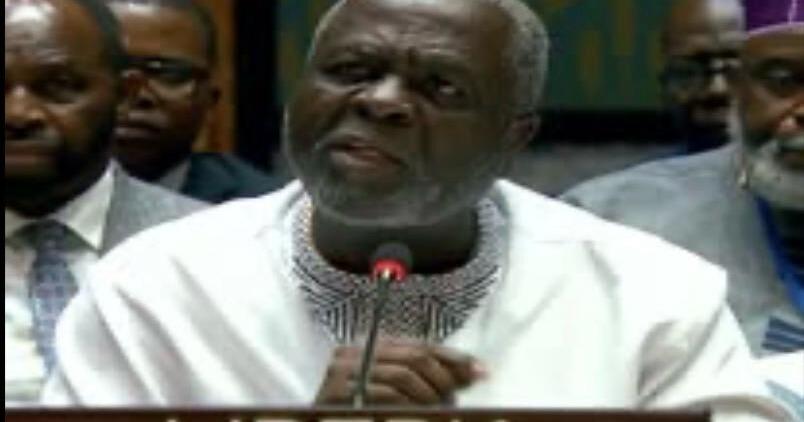
Liberia’s Permanent Representative to the United Nations, Ambassador Lewis G. Brown II hosted a lunch for Secretary General António Guterres and the ten elected members of the Security Council, known as the E10.
The lunch was an exercise of Liberia’s coordinating role itself, an opportunity to bring the Secretary General into direct dialogue with the elected members on the substantive issues before the Council this month, rather than a purely social gathering on the sidelines of Council business.
Liberia has held the coordinating role for both the A3 and the E10 since August 1, a dual role that has placed Liberia at the center of nearly every major file on the Council’s agenda and given Ambassador Brown the standing to convene precisely this kind of engagement with the Secretary General.
The lunch brought together representatives of Bahrain, Colombia, the Democratic Republic of Congo, Denmark, Greece, Latvia, Liberia, Pakistan, Panama, and Somalia, the ten non-permanent members who make up the E10. Three of those countries, the Democratic Republic of Congo, Liberia, and Somalia, also sit on the E10 as the A3, a distinct body in its own right that speaks specifically for Africa within the Council, even as its members remain part of the wider E10.
Denmark holds the Council presidency for August, and Ambassador Christina Markus Lassen has kept the month’s formal calendar focused but full, with mandated meetings on South Sudan, Yemen, Libya, the Occupied Palestinian Territories, the Democratic People’s Republic of Korea, Syria, and counterterrorism, alongside two signature events: an open debate on the Council’s working methods held August 19, and a high-level open debate on conflict and hunger, titled Food Under Fire, set for August 25. Council members have also been watching Ukraine, the standoff over the Strait of Hormuz, and the aftermath of the closure of the UN peacekeeping force in Lebanon at the end of this year, any of which could pull an unscheduled session onto the calendar with little notice.
It is against that backdrop that Liberia’s coordinating role has mattered most. On the Middle East, Ambassador Brown addressed the Council’s 10,207th meeting on August 17 to present Liberia’s own position on the situation in the region, warning that prospects for a two-state solution are rapidly diminishing amid continued violence, Palestinian displacement, and Israeli settlement expansion. He recalled Liberia’s 1947 vote for General Assembly Resolution 181, the original partition proposal, framing the country’s concern as rooted in a long-standing commitment rather than a passing position.
Two days later, at the August 19 open debate on working methods, Brown spoke on behalf of the entire E10, calling for the Council’s governing framework, Note S/2024/507, to be strengthened with time-bound arrangements for subsidiary body leadership, after two consecutive years in which agreement on sanctions committee chairs was delayed.
He argued that elected members, who together make up two-thirds of the Council, should be brought into the drafting and negotiation of resolutions from the outset, including through shared penholder ship arrangements that are currently concentrated among the five permanent members.
As its own distinct body, the A3 carries a different set of files, chiefly Libya, South Sudan, and the broader question of African ownership of peace and security matters on the continent, including the Democratic Republic of the Congo’s own eastern conflict and the AU-led response to instability in the Sahel and the Horn of Africa.
The A3’s collective posture in recent years has leaned toward political solutions over externally driven sanctions, an emphasis diplomats expect to continue as the Democratic Republic of Congo, Liberia, and Somalia coordinate their positions through Liberia this month.
The coordinating arrangement carries added weight because of what comes next. In December, Liberia will hold the Council presidency for the first time since 1961, with President Joseph Boakai expected to chair high-level sessions during that month.
Diplomats in New York have pointed to August, with its crowded mix of country-specific briefings, a working methods debate, and a signature event on hunger and conflict, as a rehearsal of sorts for the far larger task of setting and running the Council’s full program of work in December.
Today’s lunch fits that pattern. By convening the Secretary General and the full E10 around the same table, Liberia used its coordinating role to facilitate direct dialogue on the month’s issues, from the Middle East to working methods to the African files, rather than leaving those conversations to separate, uncoordinated channels.
Liberian officials have already flagged the coordinating role, and engagements like todays, as consequential both for the immediate work of August and for the presidency still to come in December.
Credit: Source link