

Leaked Files Reveal Uganda’s Secret Drone Deals with Israel
As a reader-funded independent news outlet, we operate free from the influence of governments, advertisers, and corporate backers. This is essential to our mission: to report on what matters most, beholden only to the truth. In that spirit, we made a commitment to ensure that our journalism is free for everyone, not locked behind a paywall. But that means we rely on the voluntary support of our community of readers. Please consider making a tax-deductible donation to support our work today.
Uganda’s parliament last month authorized an unprecedented deployment of Ugandan soldiers to Gaza as part of an international force proposed by President Donald Trump’s Board of Peace.
“The President of the Republic of Uganda is ready to deploy in the Gaza Strip,” Defense Minister Kiryowa Kiwanuka told lawmakers in a parliamentary debate about the deployment, saying a formal status-of-forces agreement would be negotiated after parliamentary approval. The vote on the measure came after Israel said that troops from “friendly countries” could participate in the mission.
The Ugandan government has so far offered no clear public explanation for why it volunteered for the mission, what role its soldiers would play, or what Kampala expects in return. The proposal has raised questions from members of the country’s parliament, including opposition lawmaker Hassan Kirumira, who asked during the debate, “On which side is our army going to fight?’”
The decision to send Ugandan troops did not emerge in a vacuum, but comes amid a rapidly expanding security relationship between Tel Aviv and Kampala that included the 2022 signing of a formal defense-cooperation agreement between the two countries.
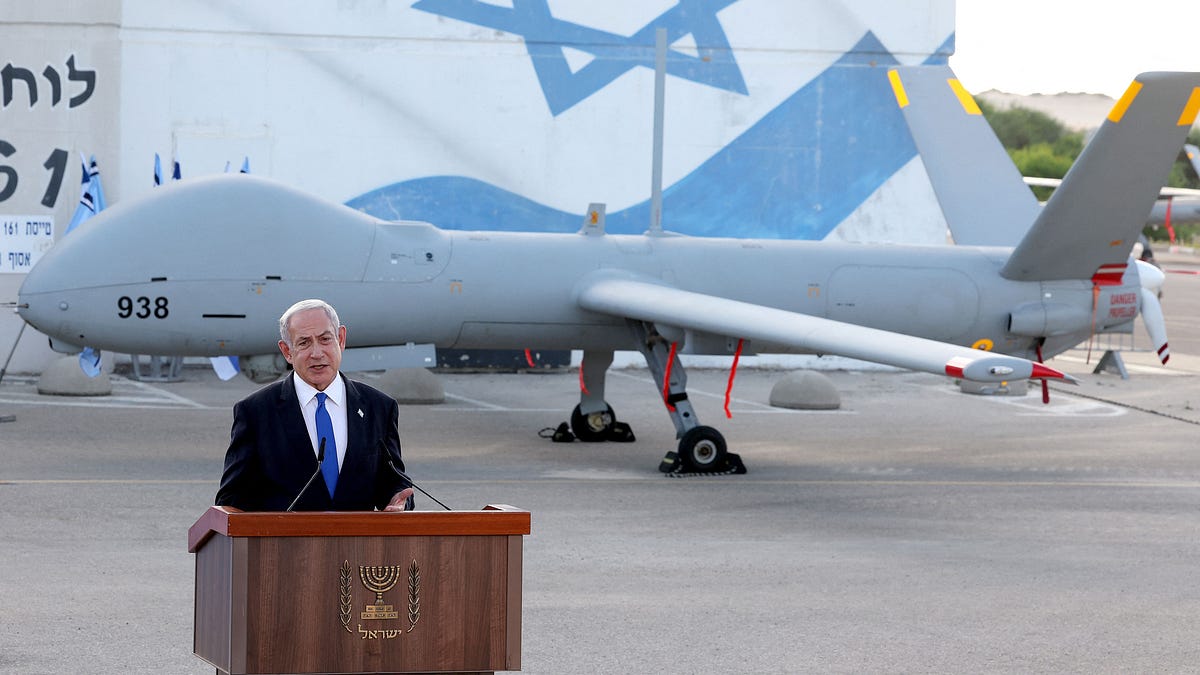
Internal documents reviewed by Drop Site News reveal for the first time the details of a years-long program by Israeli weapons manufacturer Elbit Systems, the country’s largest weapons maker, to equip the Ugandan military with an expanding fleet of Hermes surveillance drones, as well as a suite of advanced surveillance systems intended for use by Uganda’s Military Intelligence and elite Special Forces Command (SFC)—a branch of the country’s security establishment tied to the family of President Yoweri Museveni, and his son Muhoozi Kainerugaba.
Details of the relationship come from an archive of hacked emails and documents from Elbit executive Vered Haimovich, a former Israeli military officer who became vice president of Elbit Systems’ UAV Systems Business Unit in January 2021. The archive was published by Distributed Denial of Secrets and released by Handala, an online hacking group believed to be tied to the Iranian Ministry of Intelligence. Drop Site conducted cryptographic verification on emails contained in the archive as well as verifying non-public material it contained.
In response to a request for comment, an Elbit spokesperson said, “Elbit Systems does not comment on business matters relating to its customers. The materials presented do not accurately reflect the company’s business activities.”
The Ugandan government did not respond to questions.
Uganda’s ownership of Elbit’s Hermes 900 was first publicly documented in February 2022, when Kainerugaba posted footage of Ugandan soldiers inside an aircraft hangar singing and clapping in front of the drone on social media with the comment “Ugandan special forces warming up for another mission in Operation Shujaa!” a reference to Uganda’s military intervention in the Democratic Republic of Congo.

Later reports claimed that the country operated “at least two dozen” of the aircraft supplied in 2019, though no details or corroboration were provided. In August 2024, a drone bearing Ugandan markings crashed in eastern Congo and was later identified by a United Nations Group of Experts report as a Hermes 900.
Despite prior evidence of military cooperation between Israel and Uganda, details about the exact nature and scale of the cooperation between Elbit and Kampala, including the scale of cooperation on the Ugandan drone program, have not previously been disclosed.
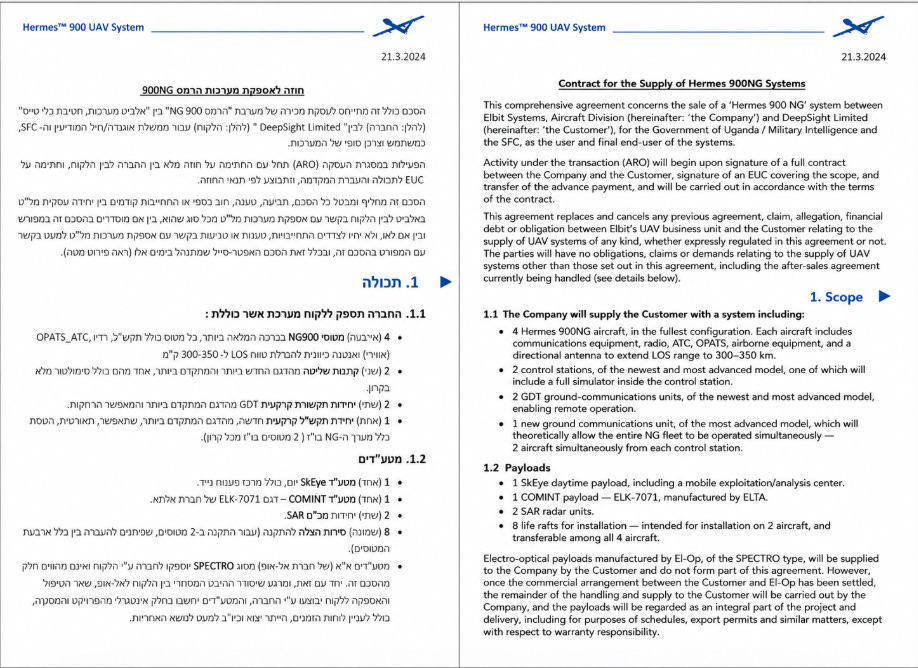
The records contained in the email archive identify lucrative contracts for the sale of military surveillance systems and other equipment from Elbit to Uganda, including a signed $52.1 million package for four Hermes 900 aircraft and supporting infrastructure dated March 2024. The documents, marked as confidential, also reveal other intelligence and weapons systems offered by Elbit to Ugandan Military Intelligence and the SFC in particular—an elite branch of the security services involved in the protection of the Museveni family and formerly commanded by Kainerugaba himself, the country’s current military chief.
The systems offered included advanced surveillance equipment capable of monitoring large areas continuously, intercepting communications, and producing radar images at night and through cloud cover. The documents also point to the previous sale of Israeli loitering munitions—also known as suicide drones—and other equipment used to carry out offensive operations.
In recent years, Uganda has become one of Africa’s most active military powers. Ugandan forces currently operate on missions in Somalia, the Democratic Republic of Congo, and South Sudan.
In 2025, Uganda deployed special forces to support South Sudanese President Salva Kiir’s government—an operation in which Ugandan forces provided aerial support during “repeated attacks that resulted in the killing and maiming of civilians, including children suffering severe burns consistent with incendiary bombs,” according to a United Nations inquiry.
Uganda’s relationship with Israel has continued to grow closer since the reestablishment of ties between the two countries in a 1994 normalization agreement signed by Museveni, who has been president since 1986.
Just days before the August 6 parliamentary vote approving the deployment of Ugandan troops to Gaza, Kainerugaba unveiled a monument at Entebbe airport to Yonatan Netanyahu, the older brother of Israeli Prime Minister Benjamin Netanyahu, who was killed while commanding a 1976 hostage-rescue operation at the airport.
In a since-deleted social media post, Kainerugaba suggested that the decision to build the statue in honor of Netanyahu had been divinely inspired. “For the last 4 years, My God Jesus Christ has appeared to me in dreams and visions. He told me to build a monument to Yoni Netanyahu in Entebbe. And not to fear the world. He is stronger than the world!” he wrote.
In February 2022, when Kainerugaba posted the footage on social media showing Ugandan soldiers with the Hermes 900, the revelation that Uganda’s military was operating the aircraft came as a surprise to many defense analysts. A report in the military intelligence publication Janes quickly identified the drone as the Hermes 900, describing it as a “previously undocumented” Ugandan capability provided by Israel.
Despite the revelation, little reliable information existed about when Kampala obtained the Hermes aircraft, or the number it had in its possession. Open-source information also indicated that Elbit had also provided mortars and other munitions used by Ugandan forces during the conflict in the Democratic Republic of Congo.
The correspondence and documents contained in the email archive indicate that Elbit was not simply a hardware supplier but an active partner over several years with Kampala in building an integrated surveillance architecture, constructing drone bases, and developing the infrastructure to carry out offensive strikes.
A September 2021 Elbit pricing sheet labeled “Uganda” describes a $16.1 million package that included two new Hermes 900 aircraft, maintenance for an additional Hermes 450 already in-country, ground-control systems, training assistance, as well as additional support with maintenance and spare parts that raised the overall price to $18.4 million.
Later that month, according to another document, Elbit and Yamasec Ltd., an aviation and security contractor operating in Uganda, signed what they called an “alignment” agreement settling disputes surrounding three earlier contracts, which revealed more details about the timing and scope of the relationship between Elbit and Uganda.
Yamasec did not respond to a request for comment.
The alignment document indicates that the Ugandan program began with Elbit providing a refurbished Hermes 450 system—an older model of the aircraft—contracted in January 2019, followed by two more refurbished systems in 2020 and 2021.
Under the agreement settling disputes over three earlier deals, Elbit was to deliver one refurbished and two new Hermes 900 aircraft, supply two new Hermes 450s, and upgrade the entire fleet’s control trailers and communications links. Shipping terms specified delivery of the requested systems and aircraft to Entebbe, Uganda.
Additional documents in the archive suggest that the agreements continued to expand in later years to include more significant expansions of Uganda’s capabilities.
A signed eight-page March 2024 contract outlines details for a $52.1 million deal to sell four Hermes 900 drones equipped with Elbit’s SkEye wide-area surveillance system and accompanying ground-based surveillance systems. The document notes that $14.2 million had already been transferred to Elbit from Uganda in 2021, and would be credited toward expansion of the deal.
In addition to specifying the terms for expanding drone capabilities, the contract also includes references to other weaponry and surveillance equipment that Elbit was providing to Uganda under separate contracts, including a AES-210 electronic-intelligence system awaiting installation in Uganda, as well as a SkyStriker system operated by the Ugandan military. SkyStriker is Elbit’s signature loitering munition—a reference to a remotely operated weapon outfitted with a warhead designed to search for and strike targets with precision by crashing into them.
The contract for the expanded cooperation was signed by a company named DeepSight Limited as Elbit’s direct customer, while identifying the Government of Uganda, Military Intelligence, and the SFC, as the end users.
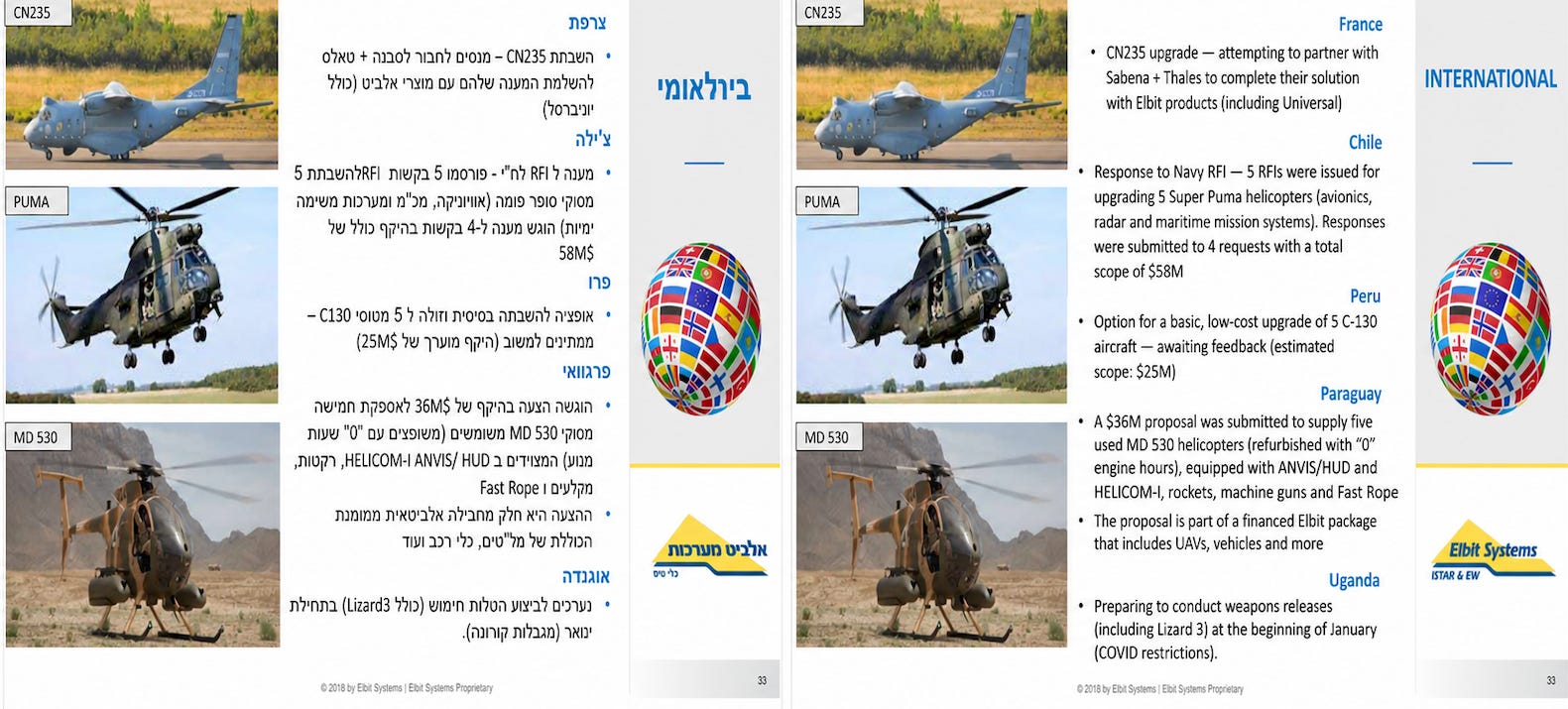
The archive also contains evidence that Elbit was preparing to provide more advanced offensive weapons upgrades to Uganda. A management presentation circulated internally at the beginning of January 2022 states under the heading “Uganda” that the company was “preparing to conduct weapons drops (including Lizard 3) at the beginning of January,” subject to Covid restrictions. Lizard 3 is an Elbit laser-guidance kit that the company markets to help “convert general-purpose bombs into precision-guided weapons.”
In addition to extensive sales of weapons and surveillance systems, the documents suggest Elbit was providing Uganda with help developing physical bases to operate the Hermes 900 drones and accompanying ground-based infrastructure. A July 2021 contract in the archive contains information on an order for three ground-based OPATS units for a drone base—equipment intended to automate the takeoff and landing of drones—and prices a spare-parts package to support Ugandan operations at a second base.
The basing infrastructure also appeared to set the stage for ongoing charges to the Ugandan government for support from Elbit for their military operations, while also giving a picture of the pace of expansion of the Hermes 900 fleet. Under “future options,” the same document lists a $2.3 million Hermes 900 spare-parts package to support the additional base and anticipated future maintenance charges for two existing aircraft beginning in November 2022 and a fleet of three to five aircraft beginning a year later.
Despite the enthusiasm on both sides of the deal to expand the relationship, the emails also reveal serious operational problems in deploying Israeli military equipment in Uganda.
In an email message accompanying the signed 2021 alignment agreement, a representative from Yamasec told Elbit representatives that a Hermes 900 ground-control trailer had flooded and that operations had been halted as a result. “This is simply unreasonable—it is supposed to be milspec,” they wrote, using an abbreviation to denote military standards.
Despite the complaints and alleged shortcomings in fulfilling the contracts, Yamasec proposed more deals to purchase equipment from Elbit, including a proposal to connect the entire Hermes drone fleet to a proposed intelligence center capable of processing and analyzing the information collected by the aircraft and helping Ugandan security forces “close loops”—military terminology for turning raw data into operational intelligence to carry out attacks.
The communications do not indicate whether the delivery of the requested systems and supporting infrastructure took place.
Yamasec’s involvement in the deal is also notable because the company has previously been accused of transferring military equipment that listed Uganda as its contractual end-user to the government of South Sudan. In a 2018 report, the conflict monitoring organization Conflict Armament Research identified aircraft acquired through a network of entities connected to Yamasec and used in Uganda that were subsequently placed into South Sudanese military service.
That report found that, “a group of related companies owned and operated by Israeli, Ugandan, UK, and U.S. citizens based in Uganda” had acquired aircraft for Uganda, and that “one of these companies, Yamasec, then supplied these aircraft to the SPLA (Sudan People’s Liberation Movement), together with training and crew, adding that an “Israeli-Ugandan citizen who owns Yamasec Ltd” had been personally involved in the acquisition of at least one aircraft. The alleged transfers took place prior to a 2018 United Nations-imposed arms embargo on South Sudan.
The expansion of Uganda’s military role in the region and increased ties with Israeli defense manufacturers comes as some of the same security agencies listed as customers in the Elbit deal have faced scrutiny over human rights abuses.
In December 2021, the U.S. imposed Global Magnitsky sanctions on Abel Kandiho, then commander of Uganda’s Chieftaincy of Military Intelligence—one of the security agencies listed as an end-user of Elbit equipment in the available contracts.
The U.S. Treasury statement announcing the listing said that Kandiho and other military intelligence officers had arrested, detained, and physically abused Ugandans because of their political views, nationality, or criticism of the government, describing beatings, sexual abuse, and electrocution during interrogations.
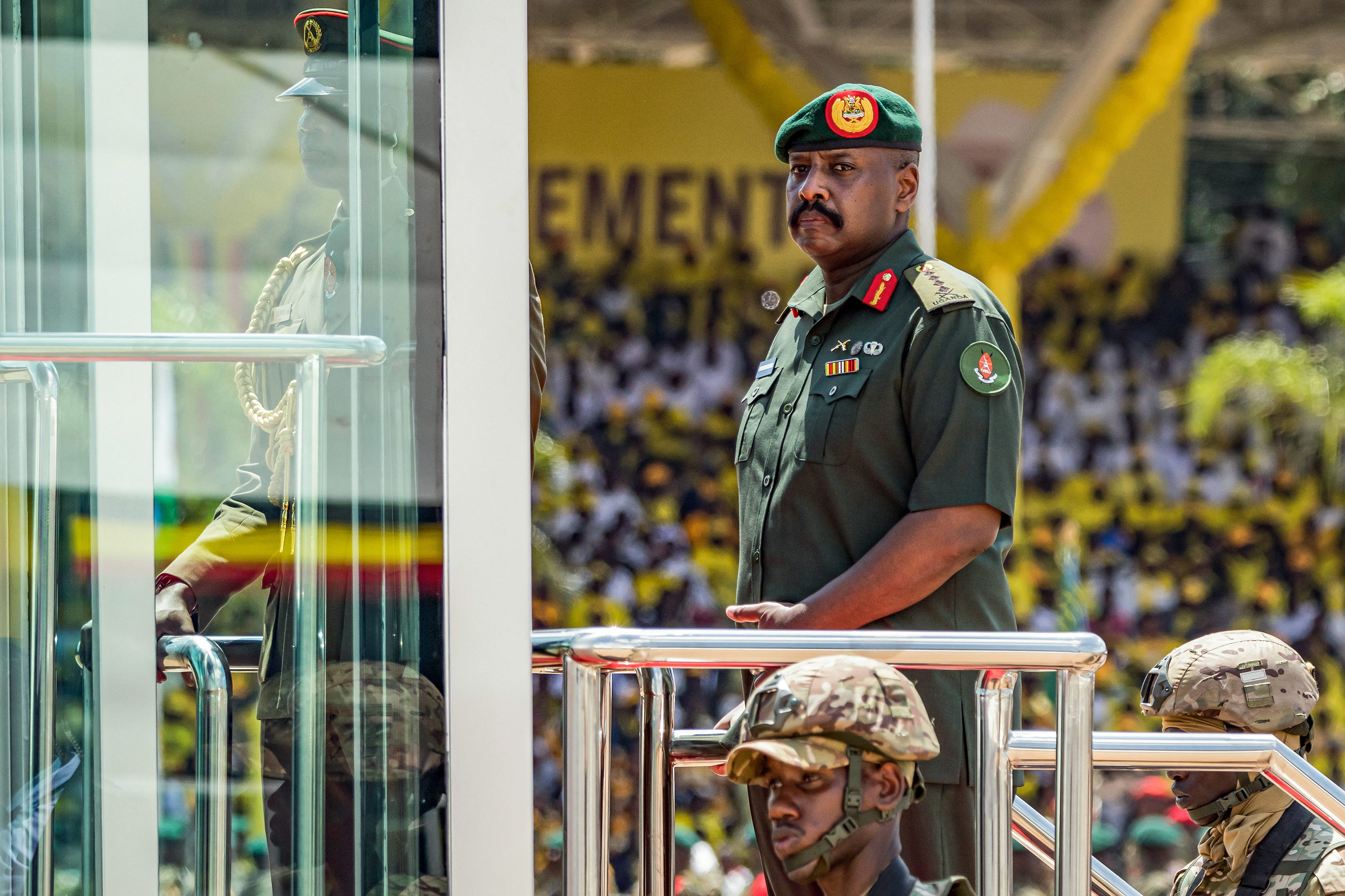
The SFC, also listed as an end-user of the weapons and surveillance equipment provided by Elbit, is one of the country’s most politically sensitive security agencies and is associated with the protection of Museveni and his family. Kainerugaba, Museveni’s son and presumed successor, commanded the SFC before rising to lead the entire military.
That support for the SFC and the Museveni family seems to have paid political dividends in Tel Aviv’s relations with Kampala.
In recent months, Kainerugaba has been increasingly vocal about Ugandan support for Israel, even threatening to attack Israel’s enemies on its behalf. “We want the war in the Middle East to end now. The world is tired of it,” he wrote in another social media post in March of this year shortly after the start of the Israeli-U.S. war against Iran. “But any talk of destroying or defeating Israel will bring us into the war. On the side of Israel!”
Israel has had a complex relationship with Uganda over the past several decades. Israel trained and equipped the Ugandan military after the country gained independence in 1962, while the country’s future military dictator Idi Amin received Israeli military training and maintained close relationships with Israeli advisers.
After Amin took power in a 1971 coup, Israel initially backed his government. But the following year Amin severed relations with Tel Aviv after Israel rejected his requests for Phantom fighter aircraft to use in a conflict against Tanzania, turning instead to Libya for military and financial support, and attempting to refashion himself as a supporter of the Palestinian cause.
Relations between Tel Aviv and Kampala reached their lowest point during the 1976 Entebbe hostage crisis, and were only reestablished by Museveni in 1994. Security, intelligence, and military cooperation have deepened since then, culminating in the renewed defense-cooperation agreement in 2022.
The support that Elbit has provided to the SFC commanded by Kainerugaba, and its role in shoring up the dynastic power of the Museveni family, offers some additional insight into the increasingly vociferous support that the country’s leadership has offered Tel Aviv, which could soon include the deployment of Ugandan troops to the Gaza Strip.
At the early August ceremony unveiling the monument to Yonatan Netanyahu at Entebbe airport, Kainerugaba honored the Israeli commando and brother of the current prime minister who died in the raid that also killed several dozen Ugandan soldiers, while praising Kampala’s expanding relationship with Tel Aviv.
“Monuments are more than stone and bronze,” Kainerugaba said. “They preserve memory, teach history, and inspire future generations. This monument, therefore, carries significance far beyond commemorating one brave individual.”
Credit: Source link