

Kiir warns against foreign pressure on South Sudan
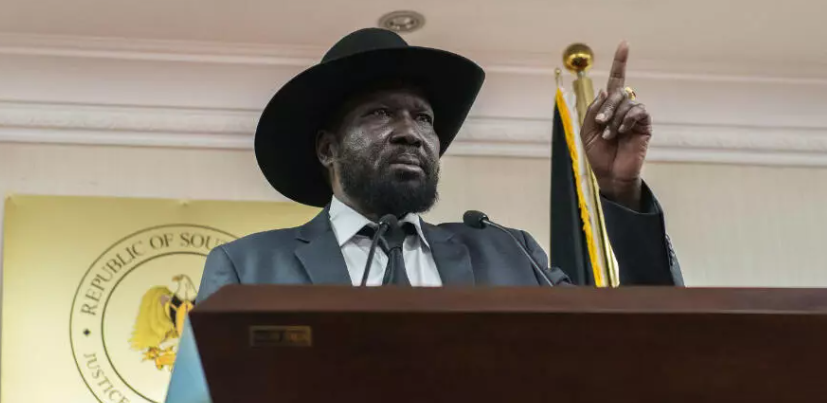
President Salva Kiir’s office said on Thursday that South Sudan would resist what it described as external direction of its political affairs, insisting that elections and reforms must be driven by South Sudanese institutions.
In a statement issued by the Office of the President, Kiir’s administration welcomed international support for the country’s peace process and development but said foreign partners should not dictate political outcomes.
“Partnership does not mean accepting directives from other countries,” the statement said, adding that South Sudan’s political decisions belong to its people and institutions.
The statement comes as South Sudan remains in a prolonged political transition following the 2018 peace agreement, with the government saying it is committed to holding elections in December and moving towards a permanent political order.
The presidency said the implementation of the Revitalized Peace Agreement remains important but should not become the basis for what it called “perpetual transition”.
“South Sudan has made significant progress and must now move toward a democratic process that allows citizens to choose their leaders,” it said.
Election Push
The statement portrayed elections as a matter of national sovereignty and said citizens should be allowed to choose their leaders through a democratic process.
It did not, however, set out specific measures to address concerns raised by critics over the conditions needed for credible elections, including political space, security-sector reform and the implementation of outstanding provisions of the 2018 peace agreement.
The government has previously maintained that elections should proceed in December 2026 despite delays in implementing some elements of the peace deal.
Kiir’s office also warned against outside criticism of South Sudan’s judicial system, saying courts should be allowed to complete proceedings without external political pressure.
“Judicial processes should not be pre-judged from outside the courtroom,” the statement said.
The comments come as the government faces scrutiny over judicial proceedings, including the trial of First Vice President Dr. Riek Machar, and the broader rule of law. The presidency said reforms should strengthen existing institutions rather than replace or dismantle them.
Security Reform
On security-sector reform, the president’s office said efforts to professionalise and unify the country’s security institutions must be carried out through South Sudanese institutions and in accordance with national laws and political agreements.
“The goal is a professional, unified and nationally representative security sector—not one dictated from outside,” it said.
Security-sector reform is a key part of the peace agreement and has faced delays and political disagreements, particularly over the unification and deployment of forces.
The presidency also acknowledged the need for stronger public financial management, transparency and accountability, while arguing that South Sudan should retain control over its economic policy and natural resources.
Foreign Support
The statement specifically praised Germany for its humanitarian and development assistance, while saying international support should strengthen South Sudanese institutions rather than prolong political uncertainty.
Kiir’s office also named the United States, Japan, Norway, Britain and Canada among countries whose continued support it welcomed.
But the presidency said international engagement should be based on “mutual respect, partnership and sovereignty”.
South Sudan is currently under pressure from regional and international actors to implement the peace agreement and ensure an inclusive political process. Opposition groups have questioned the government’s approach to general elections, with the SPLM-IO rejecting a proposed dialogue led by Kiir and calling instead for peace talks under neutral regional or international mediation.
Kiir and members of parliament were elected in April 2010, one year before the country split from Sudan. Elections have never been held in South Sudan as an independent country.
“The measure of peace should not be how long South Sudan remains in transition, but whether it can move toward a stable political order in which its people freely determine their future,” the president’s office said.
The statement did not identify any particular foreign government or organisation that had issued directives to South Sudan, nor did it specify which recent international interventions prompted the government’s response.
It said South Sudan wanted peace, reform and democracy but would pursue them through a process “owned by the South Sudanese people”.