

Judge Gbeneweleh Demands Return to Law | Legal
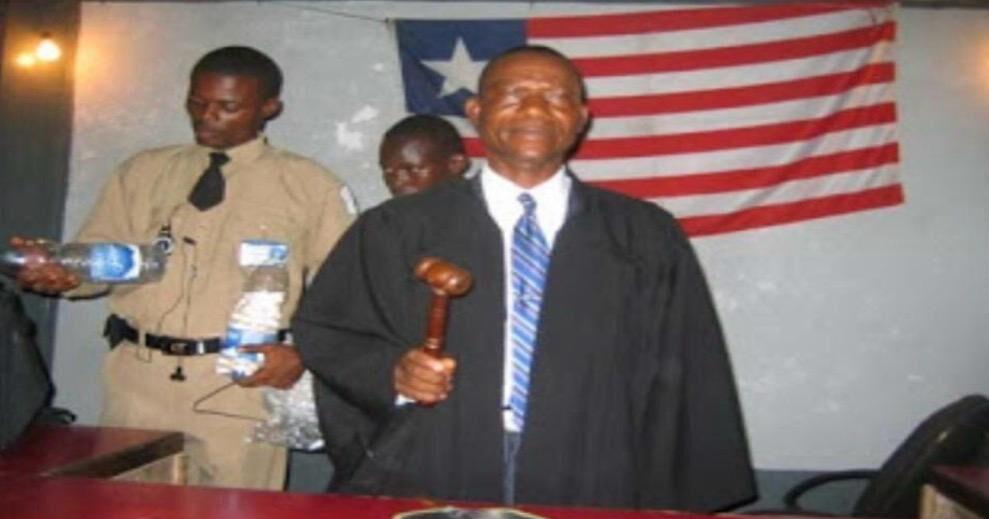
In a charge that transcended routine court formalities and struck at the heart of Liberia’s governance crisis, His Honor Peter W. Gbeneweleh, Resident Judge of the 12th Judicial Circuit Court, on Monday opened the August Term of Court, A.D. 2026 in Barclayville with a sweeping judicial manifesto on justice, integrity and the rule of law.
Before a packed courtroom of magistrates, lawyers, jurors, county officials and traditional leaders, Judge Gbeneweleh declared that the legitimacy of the Liberian judiciary rests on one principle alone: fidelity to the Constitution of Liberia.
The address, described by lawyers present as unusually blunt and constitutionally grounded, comes as public trust in the judiciary remains fragile amid persistent complaints of delayed justice, bribery at magisterial courts, and political interference in judicial decisions.
“To Say What the Law Is”
Judge Gbeneweleh anchored his entire August Term Charge on the doctrine of judicial duty and judicial review, invoking the 1803 dictum of former Chief Justice of the United States, John Marshall, that “it is emphatically the province and duty of the judicial department to say what the law is.”
He argued that Marshall’s principle is domiciled in Liberian law under Articles 2, 26, and 65 of the 1986 Constitution.
Article 2 makes the Constitution the supreme law; Article 26 guarantees equal protection and access to justice; and Article 65 vests judicial power exclusively in the Supreme Court and subordinate courts, mandating them to interpret and enforce the law.
“Judges are not political actors. We are not agents of the Executive. We are not extensions of any party,” Gbeneweleh declared. “The legitimacy of our courts does not rest on the power of the gavel or the authority of the robe. It rests solely on our fidelity to the law.”
The statement carries direct political implications. Under Liberia’s tripartite system, the judiciary is constitutionally co-equal to the Executive and Legislature. Legal scholars say Gbeneweleh’s reminder was a tacit rebuke of what many see as creeping executive influence over county-level justice and the weaponization of courts for political ends.
Justice as a Moral Duty
In a fusion of legal and moral reasoning, the Judge invoked Proverbs 21:3 – “To do what is right and just is more acceptable to the Lord than sacrifice” – to argue that judicial duty is not merely technical, but ethical.
“It behooves us as judges and magistrates to do what is right and fair in the discharge of our judicial functions,” he said.
He stressed that righteousness in judgment requires “active, daily pursuit,” particularly when judging the poor, the vulnerable, and persons without political godfathers – the very class most exposed to extortion and denial of justice.
The Four Political Pillars of the Court
In the most politically significant portion of his charge, Judge Gbeneweleh defined the role of the court in a fragile democracy like Liberia’s in four pillars:
1. Promoter of Justice for the protection of fundamental rights;
2. Arbiter for the peaceful settlement of conflicts and disputes;
3. Sanctioning Authority for the lawful punishment of violators; and
4. Guarantor of Equality before the law.
Without these functions, he warned, the constitutional promise of a peaceful, stable, and investment-friendly Liberia collapses.
“Respect for the judiciary is not personal loyalty to judges. It is respect for the Constitution itself,” he noted. “Again, let us respect our court and build a peaceful and prosperous Liberia through our commitment to the rule of law.”
Analysts view the remarks as aligned with, but also challenging to, the Boakai Administration’s ARREST Agenda, which lists Rule of Law as a central pillar. The message: rule of law cannot be a presidential slogan; it must be a judicial practice insulated from politics.
Magistrates Warned: You Are The Mirror
In his sharpest admonition, Judge Gbeneweleh turned to magistrates across Grand Kru’s five judicial districts – from Sasstown to Buah.
Describing the magisterial court as “the mirror through which the true image of the judiciary is perceived,” he reminded them that they handle over 70% of all cases in Liberia. For the ordinary citizen, justice is not what the Supreme Court says in Monrovia; it is what a magistrate does in Barclayville.
He ordered magistrates to exercise honesty, fairness, neutrality, and above all, courage, especially where bribery and external pressure are most prevalent.
“The greatest test of our integrity is not in high-profile cases, but in the small case of the poor man whose only protection is the law,” he said.
The warning is legally enforceable. Under the Judiciary Law and the Code of Judicial Conduct, magistrates are subject to discipline, suspension, and removal for impropriety, corruption, and political partisanship.
To Jurors and Staff: Duty, Not Business
Judge Gbeneweleh commended the clerical and support staff of the 12th Circuit for their performance during the May Term, A.D. 2026, urging diligence in tackling the county’s persistent case backlog, including land disputes, sexual offenses, and aggravated assault.
To the empaneled petit and grand jurors, he issued a constitutional reprimand:
“Your presence here is in accordance with our law to aid the court as triers of fact. Thus, you are here to render civil duty to your Country and the people of Liberia, but not for financial gain.”
The caution comes amid nationwide concerns over jury tampering and the commercialization of jury service.
After delivering his charge, Judge Gbeneweleh, invoking the judicial power vested in him by the Constitution and Statutes of the Republic of Liberia, formally declared:
“With the power in me vested, I hereby declare the August Term of Court, A.D. 2026 open for the transaction of business. AND IT IS HEREBY SO ORDERED.”
The August Term opens at a critical moment. International partners, including the EU, UN, and U.S., have tied continued justice sector support to demonstrable reforms in judicial independence and anti-corruption enforcement.
In Grand Kru, at least, the bench has spoken plainly: Peace is not merely the absence of war. It is the presence of justice.
Credit: Source link