

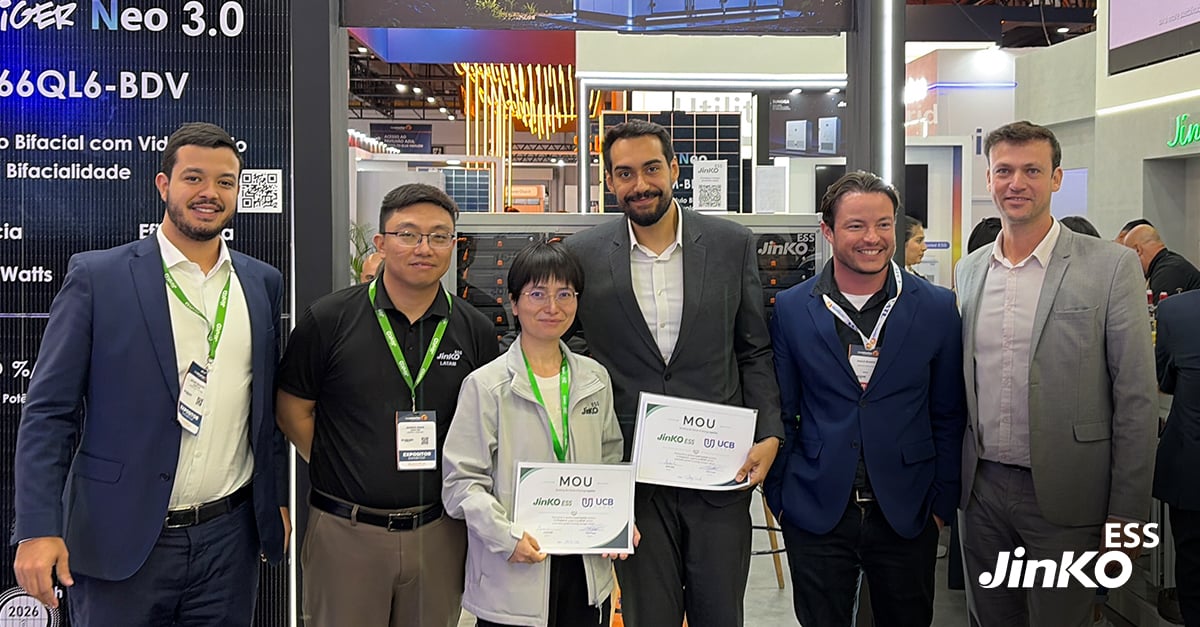
Jinko ESS has announced the signing of a Memorandum of Understanding with UCB Power to explore cooperation opportunities related to the local industrialization of battery energy storage systems (BESS) in Brazil.
The initiative seeks to combine Jinko ESS’s technology, portfolio and international experience with UCB Power’s industrial capabilities, technical knowledge and local presence, the collaboration potentially enabling certain solutions to meet local content requirements and qualify for projects that require locally manufactured equipment.
The agreement comes at a strategic moment for Brazil’s power sector, as energy storage systems become increasingly important for enhancing grid flexibility and reliability, reducing transmission and distribution constraints and enabling greater integration of renewable energy sources.
One of the collaboration’s primary areas of focus will be assessing opportunities associated with Brazil’s Capacity Reserve Auction (Leilão de Reserva de Capacidade – LRCAP). The potential inclusion of BESS solutions in this mechanism reinforces the need to develop a supply chain capable of supporting large-scale energy storage projects and meeting the specific requirements of the Brazilian market.
The first industrialization route under consideration will be developed at UCB Power’s facility in Extrema, Minas Gerais. The companies may also evaluate additional production alternatives in the future, depending on market demand, project requirements and market conditions. Local industrialization could also expand access to financing mechanisms available in Brazil, including credit lines from the Brazilian Development Bank (BNDES), provided that the products and projects meet the applicable criteria and requirements.
As part of its strategy for large-scale projects, Jinko ESS is preparing SunTera G3, a containerized energy storage solution with a capacity of 6.25 MWh. The system uses 587 Ah cells, increasing energy density without changing the container’s external dimensions. This solution forms part of the industrialization strategy being considered for Brazil and is currently in the final stage of its certification process.
Although the LRCAP represents a significant near-term opportunity, the collaboration could also contribute to the development of other energy storage applications associated with grid stability and flexibility, the reduction of transmission and distribution constraints and the integration of renewable energy sources.