

Is the CIA’s Moscow visit a sign of a coming Russian provocation in the Baltics?
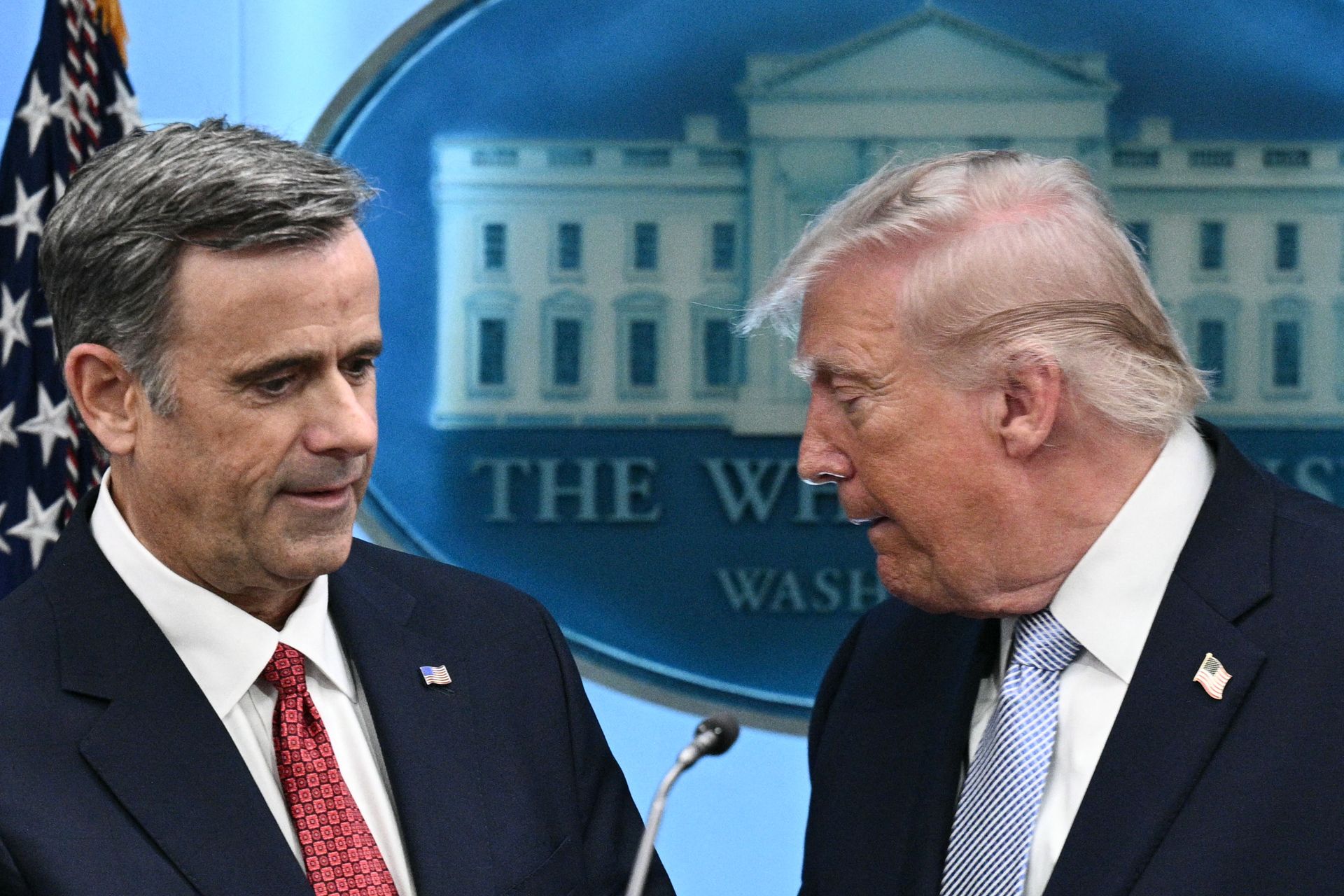
U.S. President Donald Trump (R) cedes the podium to CIA Director John Ratcliffe (L) as they speak about the conflict in Iran in the James S. Brady Press Briefing Room of the White House on April 6, 2026, in Washington, D.C. (Brendan Smialowski / AFP / Getty Images)
One can only speculate about the real purpose of the CIA director’s unexpected visit to Moscow.
The fragments fed to the media may be accurate, partly accurate, or deliberately misleading.
Washington’s reasons for talking to Russia extend far beyond Ukraine and the Baltic states, although the latter matter more immediately as they are NATO allies. Moreover, Moscow’s global activity gives Washington many other issues to address.
Russia’s power and reach have diminished since its full-scale invasion of Ukraine, but Russia still operates across multiple theatres.
Most importantly, it belongs to a new axis of revisionist authoritarian states. Its partnership with China has become increasingly asymmetric, to Beijing’s advantage. North Korea has provided Russia with troops, missiles, and ammunition, while Moscow has returned the favor with air-defense equipment, electronic-warfare systems, and missile-performance data.
Any Russian assistance that accelerates North Korea‘s nuclear or missile capabilities is something Washington cannot treat lightly.
Iran began supplying Russia with Shahed drones early in the war. This cooperation may now be running both ways. Russia has shared information useful for striking U.S. assets in the Middle East, and U.S. intelligence has been investigating whether Moscow also assisted attacks on CIA facilities; the latter remains unconfirmed.
American soldiers have died in Iranian attacks, which makes Russian assistance a direct challenge to the United States, even if President Trump tries to play down the wider political implications. His administration has also threatened severe secondary sanctions against countries that keep Iran economically connected — a warning that plainly reaches Russia.
If the CIA director went to Moscow to warn Russia against action in the Baltic region, that should be read positively.
It would indicate, first, that Washington knows what Moscow may be considering and, second, that it is prepared to respond.
The rhetoric of Trump, Pete Hegseth, and Elbridge Colby about reducing America’s role in Europe must be taken seriously. Yet current U.S. military activity on NATO’s eastern flank does not suggest that Washington considers the Russia threat irrelevant.

In August, a large U.S.-led NATO exercise around Kaliningrad combined American and Norwegian fighters, electronic-warfare and surveillance aircraft, aerial refueling, Polish ground forces, and NATO command-and-control assets. The United States still wants — and is still able — to operate strategically in the region.
A separate warning may concern Russia’s hybrid escalation against Europe. U.S. defense companies have an extensive industrial and supply-chain presence across the continent. If Moscow expands sabotage against European defense production and logistics, vital American interests will inevitably be affected.
What, then, could Russia gain from a limited, brief attack on a NATO member? The common assumption is that Moscow might test Alliance unity: if NATO failed to respond collectively under Article 5, Russia could claim the Alliance no longer functions. This, however, overlooks the military and political reality on the eastern flank.
Norway, Finland, Estonia, Latvia, Lithuania, and Poland border Russia, and their defense cooperation is exceptionally close. They will not wait passively for a lengthy political process under Article 5 to unfold in Brussels while Russian forces cross the border.
They have been monitoring developments in Russia and will activate readiness measures, including mobilizing the defense forces reserves, before an attack. Estonia, for instance, practices snap mobilization annually — and this process takes hours, not weeks.

The front-line states would not act alone either. Sweden has already deployed fighters and contributed a warship to protect Finnish territory, and has also declared readiness to help repel any territorial aggression. In Estonia, British and French forces are integrated with Estonian formations and command structures. Britain has also redesigned and strengthened its contingent around Estonia’s terrain, incorporating lessons from Ukraine.
Since July 1, 2026, the German-Netherlands Corps has held NATO’s tactical land-command responsibility for Estonia and Latvia. Latvia hosts a Canadian-led multinational brigade, with Ottawa increasing its troop presence to 2 600. Lithuania hosts Germany’s 45th Armored Brigade, now building towards full operational capability in 2027. Poland combines formidable national forces with a major U.S. presence.
Could Article 5 still face political friction? Of course. But the defense of the eastern flank would not begin only after a ceremonial consensus has been reached in Brussels.
National forces would react immediately; Allied troops are already present on the ground; regional commands and reinforcement plans are in place. An attack would involve Britain, France, Canada, Germany, the Netherlands, and the United States from the outset — and many more Allies would follow.
Russia has far more to lose than to gain.
Diverting forces from the front line in Ukraine would give Kyiv an opportunity it would quickly exploit. An attack on NATO would also consolidate Europe on a scale Moscow has worked hard to prevent by handing hesitant governments a strong argument to boost defense spending and support for Ukraine. Countries farther from Russia would suddenly see the threat with new, greater clarity.
Ukraine, meanwhile, would become an indispensable partner in the fight. NATO member states and Ukraine do not share identical command-and-control systems, so integrating the operational picture would be difficult. Yet practical battlefield cooperation would develop rapidly.
Far from breaking NATO, a limited Russian attack would likely produce the opposite result: a more united Alliance, a better-armed Europe, and a stronger Ukraine.
Editor’s note: The opinions expressed in the op-ed section are those of the authors and do not purport to reflect the views of the Kyiv Independent.