

Iraq to place armed factions’ weapons under state control: What we know so far – Shafaq News
Shafaq News
Iraq’s ruling
Shiite Coordination Framework (CF), the political alliance that dominates the
country’s government, formally tasked Prime Minister and Commander-in-Chief of
the Armed Forces Ali al-Zaidi on Monday with taking the necessary measures to
bring all weapons under state control. This was followed by several of Iraq’s
most powerful Iran-aligned armed factions announcing steps toward disengagement
from the Popular Mobilization Forces (PMF) and transferring their weapons and
personnel to state authority.
Consolidating
weapons under exclusive state authority is the first pillar of al-Zaidi’s
government program, a commitment that, in most countries, would be procedural,
but in Iraq represents the central unresolved dilemma of the post-2003
political order. The program does not dissolve the PMF. It commits to enhancing
the force’s combat capabilities while formally defining its responsibilities
within the military structure according to law.
The PMF is a
state-sanctioned paramilitary umbrella formally incorporated into Iraq’s
security apparatus following the mobilization against ISIS after 2014. Many of
its constituent factions have simultaneously operated under the banner of the
Islamic Resistance in Iraq, maintaining independent command structures, funding
channels, and a declared alignment with Iran’s regional network.
Factions In,
Factions Out
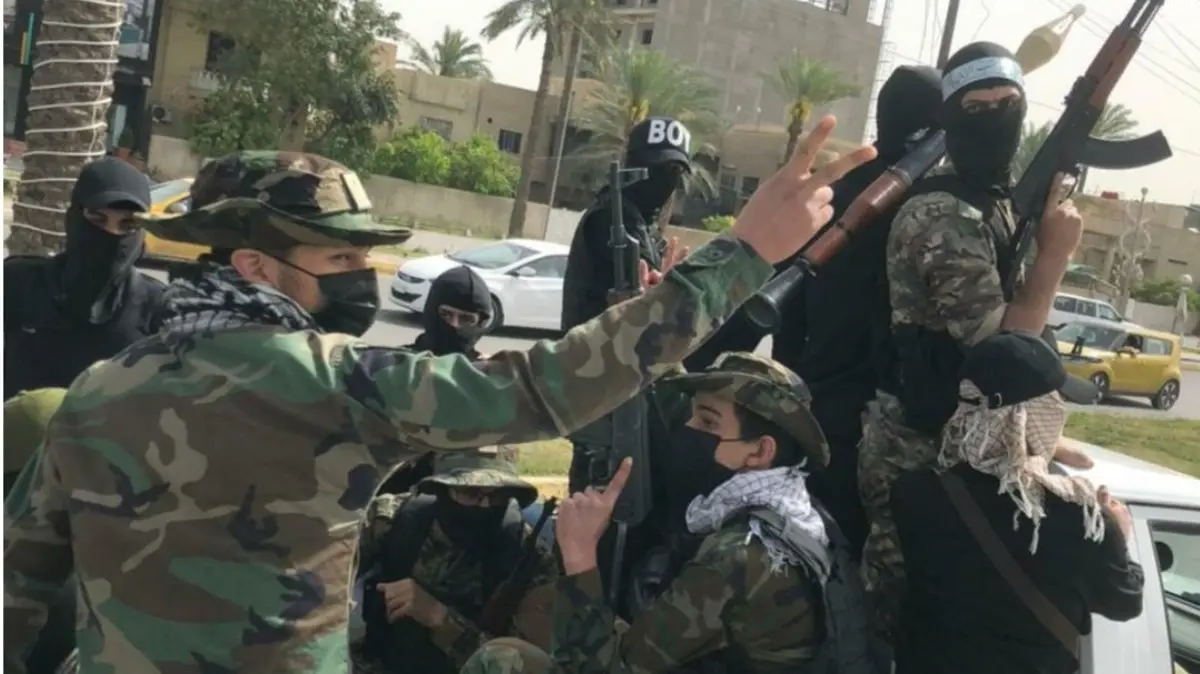
Two of the most
consequential announcements came from Asaib Ahl al-Haq (AAH) and Kataib al-Imam Ali, both Iran-aligned armed groups that operate brigades inside the PMF while
retaining independent organizational identities.
AAH announced
the formation of an internal central committee to implement its disengagement
from PMF structures and the transfer of its weapons, personnel, and equipment
to the state authority. The group said the decision was taken in alignment with
the call of the supreme religious authority, Ayatollah Ali al-Sistani, in
response to the national position of the Coordination Framework, and in
affirmation of a declaration made by AAH Secretary-General Qais al-Khazali on
December 13, 2017, calling for the severance of armed faction ties with the PMF
and the consolidation of weapons under the state. AAH currently operates
Brigades 41, 42, and 43 within the PMF.
Kataib Imam Ali
similarly announced it would sever its organizational ties with the PMF and
begin procedures to place weapons under state control, describing the move as
compliant with the CF’s position and consistent with its national commitments.
Ansar Allah
al-Awfiya and Kataib Sayyid al-Shuhada issued statements expressing support for
restricting weapons to state authority but stopped short of announcing any
concrete steps toward implementation.
The catalyst
was a decision by Muqtada al-Sadr, leader of the Patriotic Shiite Movement and
one of Iraq’s most influential Shiite clerics, to place Saraya al-Salam —the
armed wing of his movement— under state control. Al-Zaidi welcomed the move
publicly, describing it as a step that would strengthen Iraq’s security
institutions in performing their constitutional duties, and called on other
armed factions to follow through.
Read more: Why Iraq’s PMF disarmament is a different battle from Lebanon’s Hezbollah
The Holdouts
Kataib
Hezbollah and Harakat al-Nujaba rejected disarmament outright, conditioning any
discussion of limiting weapons to the state on the restoration of Iraq’s full
sovereignty, the security of the country, and the prevention of foreign
interference. Ashab al-Kahf, one of Iraq’s prominent clandestine armed groups,
rejected any political calls for factions to surrender their weapons,
dismissing arguments invoking the supreme Shia religious authority in support
of disarmament as false.
Kataib Sayyid
al-Shuhada took a more qualified position. Its spokesperson, Kazem al-Fartousi,
told Shafaq News the group supports al-Zaidi in managing the state and
maintaining stability but opposes disarmament at the current stage, arguing
that the faction’s weapons are tied to ongoing threats facing Iraq rather than
being personal arms.
The
Government’s Framework
The CF and
al-Zaidi agreed in May to establish a committee tasked with overseeing the
disarmament of armed factions. A government source told Shafaq News that some
political forces and armed groups had shown greater flexibility regarding
efforts to place all weapons under state control, adding that any handover
process would be implemented according to a specific timetable.
Another source
said that al-Zaidi separately proposed a plan to the United States that would
link the expansion of US-led service and investment projects in Iraq to efforts
to restrict weapons to state control and facilitate the disarmament of armed
factions, a political source told Shafaq News.
On the
financial side, Iraq’s government plans to seek the release of frozen state
funds held in the United States and several European countries to finance the
integration of more than 800,000 armed faction members into the PMF and other
security institutions, another source told Shafaq News.
Political
forces within the CF have also asked international mediators to provide
concrete guarantees that armed factions will not be targeted during efforts to
dissolve them and integrate their members into state security institutions. The
proposed guarantees include assurances that the factions will not be attacked or
targeted during the process, and that the dissolution and integration steps
will not be tied to a fixed timeline, as the initiative is intended to remain
an internal Iraqi process.
Us Pressure And
The September Deadline
Washington has
applied sustained pressure on Baghdad to bring all weapons under state
authority. The US State Department dismissed a prior Iraqi attempt to link
disarmament to the future of the US-led Global Coalition in Iraq, urging
Baghdad to dismantle “Iran-backed militias.” A Department spokesperson told
Shafaq News earlier that these groups engage in violent and destabilizing
activities in Iraq, adding that their actions drain the country’s resources and
act against its national interests.
Baghdad and
Washington finalized an agreement last year setting a roadmap for the full
withdrawal of American forces by September 2026. The approaching deadline has
compressed the timeline for any settlement on the weapons file.
Expert
Assessment
Iraqi experts
who spoke to Shafaq News urged caution. Legal expert Mohammad Jumaa noted that
Iraqi law, including the Weapons Law and Penal Code, criminalizes the
possession or use of arms outside state authority, stressing that any weapon
outside the state’s structure is illegal, whether licensed without official
permission or entirely unlicensed.
Strategic
analyst Ahmad al-Sharifi argued that dismantling armed factions in Iraq is
blocked by entrenched power-sharing and the dominance of the Shiite Coordination
Framework, which backs the current government, saying that the government, as a
product of that framework, cannot make decisions that run counter to its
interests or Iran’s preferences.
Al-Zaidi’s
government program frames the weapons file as non-negotiable. Whether the
committee the CF has mandated him to lead can translate that commitment into
verified transfers —across factions with divergent interests, independent
finances, and regional patrons— remains, as of the date of this report,
unconfirmed.
Read more: Iraq’s armed factions and the disarmament debate: Why unity masks deep divisions