

Iraq oil minister details Hormuz talks, production outlook – Shafaq News
2026-08-08T11:30:21+00:00
Shafaq News- Baghdad
Iraq’s Oil Minister Basim Mohammed Khudair confirmed on
Saturday that the country is currently producing 2.7 million barrels of oil per
day, with exports ranging between 1.5 and 1.7 million barrels daily, revealing
that talks are underway with Iran to allow Iraqi oil exports through the Strait
of Hormuz, though no agreement has yet been implemented.
Despite challenges linked to the strait, the ministry has
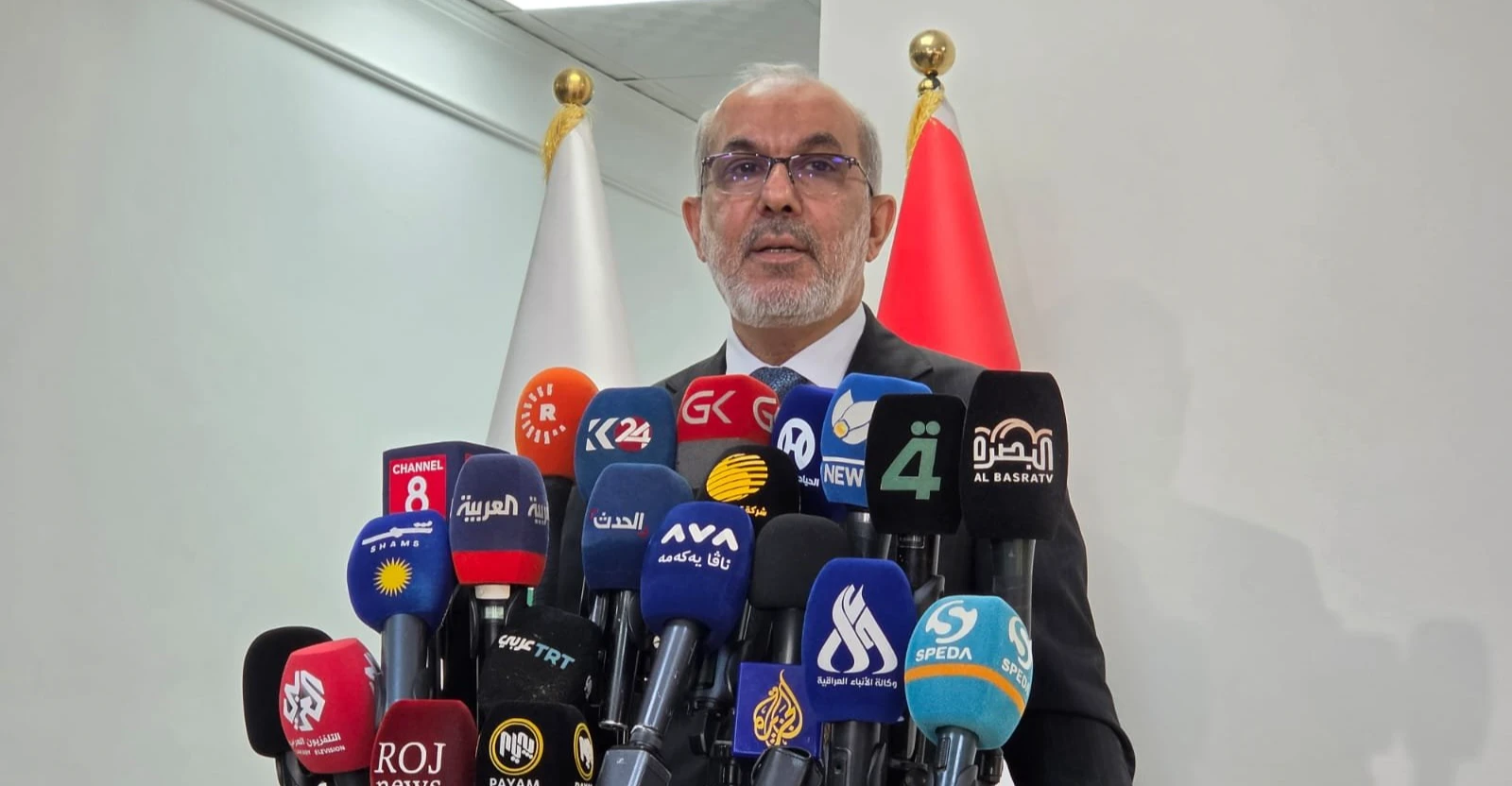
managed to secure oil products for citizens, Khudair said at a press
conference, adding that the ministry is working to develop the oil industry,
increase production and exports, build infrastructure, boost investment, and
attract global companies to optimally invest in oil and gas.
He noted that exploration teams affiliated with the ministry
are conducting surveys in several provinces to offset depleted reserves,
explaining that the ministry is pursuing two parallel tracks on the gas file:
ending gas flaring and investing in gas fields. “Iraq spends large sums on
gas, so we are working to invest in it, with 14 contracts awarded to global
companies for this purpose.”
Khudair said his recent visit to the United States marked “a
new chapter of cooperation with global companies,” stressing that the presence
of American firms in Iraq “reflects the attractiveness of the country’s
investment environment.”
Global companies are capable of training Iraqi personnel and
contributing to infrastructure development, as well as attracting large numbers
of workers, Khudair stated, noting that the ministry signed memoranda of
understanding and contracts covering seven provisions, including two contracts
for developing fields and investing in associated oil and gas, alongside an
annex to the Qurna-2 agreement and the Nasiriyah project and four blocks.
The minister also added that three memoranda of understanding
signed with American companies would provide significant investment capacity, pointing
also to a step related to an export project through the port of Aqaba.
The Basra-Fishkhabour pipeline project will be built under a
build-operate-transfer (BOT) system, with a company handling construction and
operation under an investment arrangement, according to the minister. Current
oil output cannot reach previous levels, he said, but exports could return to
prior volumes once the war ends.
On the oil agreement with Turkiye, Khudair said the deal had
been renewed with certain conditions, while Ankara had proposed limiting the
arrangement to oil transport with Iraqi participation in some projects, clarifying
that the planned quantity of 700,000 barrels cannot be supplied through Kirkuk.
Regarding the oil and gas file in the Kurdistan Region of
Iraq (KRI), Khudair confirmed the existence of a tripartite agreement between
the federal government, the region, and oil companies, which can be amended
through negotiation. The ministry does not differentiate between citizens in
Kurdistan and those in any other province, he stressed. “The KRI file requires
extensive dialogue, with continued negotiation essential to reaching solutions
that serve the national interest.”
Read more: Iraq-US investment deals depend on implementation, experts say