

Iran’s New Weapon: Group Prosecutions of Protesters Send Dozens Toward the Gallows
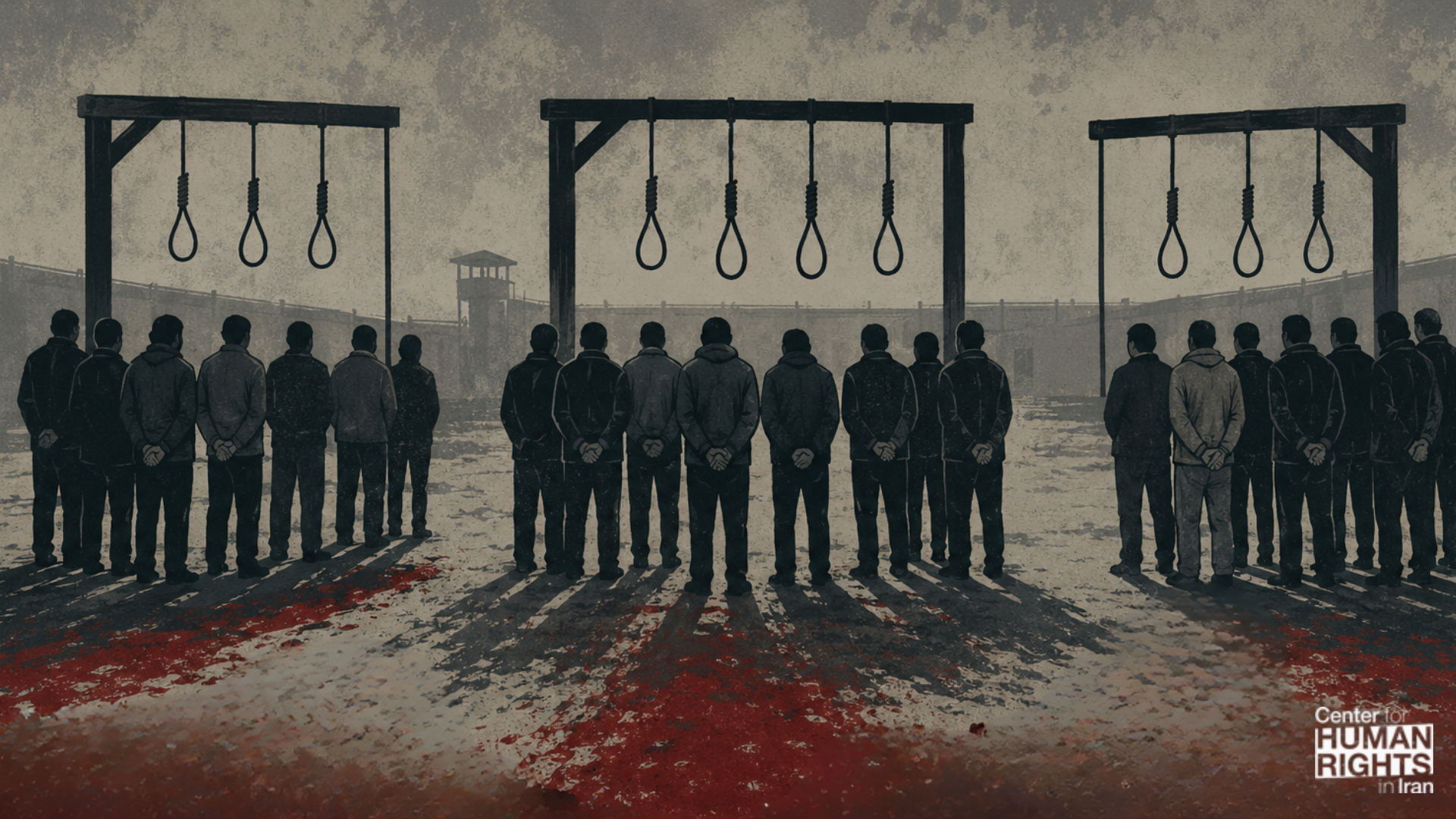
Protesters are being tried collectively, in fast-tracked prosecutions that deny defendants individual trials and due process and end in death sentences and executions
August 12, 2026 — In an extraordinary escalation of post-protest repression, Iranian authorities have sentenced dozens of protesters to death in group prosecutions that have been fast-tracked through the country’s Revolutionary Courts, with defendants collectively receiving multiple death sentences in grossly unfair proceedings that violated even the most basic international standards of due process and fair trial rights.
This use of group prosecutions is at the heart of a rapidly emerging state strategy to punish participants in the January 2026 protests and deter future protests. In cases examined by the Center for Human Rights in Iran (CHRI), dozens of defendants have now been prosecuted collectively rather than individually, denied meaningful access to independent legal counsel and case files, and subjected to torture and coercion to obtain forced “confessions.” Courts have refused to examine evidence favorable to defendants while relying on disputed testimony and other evidence obtained under coercive circumstances. The result is a system designed to produce convictions and executions.
At least four defendants in the mass cases examined here have already been executed—including two executed in public—and the others face an immediate risk of execution. Juveniles and women are among those sentenced to death or facing capital charges.
“We have not seen group prosecutions of protesters on anything approaching this scale in Iran in many decades, said Esfandiar Aban, Director of Research at CHRI. “The Islamic Republic is reviving an extraordinarily repressive judicial practice and applying it systematically to the people who participated in the January protests.”
“The purpose is clear: to transform the judicial system into an instrument for punishing an entire movement and to make the next generation of protesters understand the price of dissent,” Aban said. “This is about exacting vengeance and instilling fear.”
Key Findings:
- Defendants are being tried collectively, preventing courts from meaningfully examining each person’s individual conduct, evidence, and defense.
- Multiple death sentences are being imposed on individual defendants, creating multiple pathways to execution and making the punishment difficult to escape.
- Evidence favorable to defendants is ignored or excluded, while coerced testimony is used as evidence to convict.
- Defendants are denied meaningful access to independent lawyers and case files, leaving them unable to mount an effective defense.
- Torture and coercion are used to obtain alleged “confessions,” some of which have been broadcast on state television.
- Juveniles and women are among those facing the death penalty, including a 16-year-old currently facing capital charges in Esfarayen.
The lack of transparency surrounding these cases has heightened fears that the death sentences could be carried out without warning or notification to the families, especially since this has already been done with several individuals executed after the January protests.
CHRI urgently calls on governments and all relevant UN bodies to take immediate action:
- Demand an immediate moratorium on all executions in Iran, with serious diplomatic and economic consequences for non-compliance.
- Demand an immediate annulment of all death sentences issued in political cases.
- Demand the immediate release of all individuals detained for peaceful protest or political expression.
- Raise these demands in all negotiations with the Islamic Republic.
“Group prosecution on this scale is a profound assault on due process because the collective treatment of defendants makes meaningful individual defense impossible,” Aban said.
“When dozens of people are processed together, the court can avoid confronting the evidence and defenses specific to each individual, and that is precisely what makes these proceedings so dangerous,” Aban added.
Pakdasht: Twelve Defendants Swept into a Collective Death Sentence Case
Among the most alarming group cases are those in Pakdasht, Tehran Province; Alikhani Square and Shohada Square in Isfahan; and Esfarayen in North Khorasan Province.
During the nationwide protests in January 2026, severe clashes broke out between protesters and government forces in Pakdasht, Tehran Province. A fire broke out at the Seyyed al-Shohada Mosque during the unrest, killing two Basij members.
Following the incident, multiple protesters were arrested and prosecuted before the Tehran Revolutionary Court, presided over by Judge Iman Afshari. Twelve people are defendants in the present case, five of whom have reportedly received multiple death sentences. One of those sentenced to death is a woman. In the copy of the Supreme Court ruling that CHRI obtained, the names of the other defendants have been redacted, and for their security, we cannot disclose their identities.
Ahad Shokouhian, the third defendant, has been issued three death sentences. Iran’s Supreme Court has rejected his appeal.
Shokouhian was arrested on January 15, 2026, during the protests in Pakdasht and transferred to Khorin Prison in Varamin. He was subsequently transferred to Ghezel Hesar Prison in Karaj in late June 2026.
The 38-year-old flower-market worker is the sole breadwinner for his family. He had been caring for his 80-year-old mother and his brother, who has a disability. Shokouhian also suffers from severe asthma, a condition confirmed by Iran’s Legal Medicine Organization, the official forensic authority under Iran’s judiciary that provides expert witness reports for the country’s courts.
A source close to Shokouhian told CHRI that his physical condition made it impossible for him to have carried out the strenuous acts alleged against him, including helping to break down the mosque door.
The source told CHRI:
“This case has 12 defendants. The first through third defendants received a general death sentence. In practice, the circumstances were such that each individual’s case was not examined separately. They all received death sentences, with the difference being that the first defendant was sentenced to death four times, while the others received fewer death sentences. For example, Ahad Shokouhian, the third defendant, was sentenced to death three times.”
The source also described serious restrictions on Shokouhian’s access to legal counsel. His first lawyer was state-appointed and, according to the source, was not even based in Tehran and attended only one hearing. A second, privately retained lawyer followed the case more closely but was denied access to the case file until after the Supreme Court had reviewed it.
“Mr. Shokouhian initially had a court-appointed lawyer. The lawyer was not even based in Tehran and essentially only handled administrative matters, coming to Tehran for just one hearing. His second lawyer was privately retained and, because he was based in Tehran, followed the case more closely. Even he had no access to the case file or its details until it was referred to the Supreme Court. After the Supreme Court sent the case back to the Pakdasht branch, the lawyer was finally able to study the file carefully and submit a request for retrial. Before that, there was no access.”
According to the source, the 12 defendants were not individually assessed during the proceedings, a severe violation of due process and fair trial rights.
The source also said Shokouhian’s lawyer believes the available evidence demonstrates his client’s innocence, but that the court ignored the evidence.
Information received by CHRI indicates that the Supreme Court has rejected the appeals against the death sentences of the first three defendants.
“Be My Voice”: A Prisoner’s Plea as Execution Looms
In a recent audio recording from Ghezel Hesar Prison, Shokouhian appealed to human rights defenders and the international community to help save his life.
He said he had joined the January protests, like many other people, because of the country’s severe economic conditions.
Shokouhian said that on January 8, he spent less than two minutes helping other protesters attempt to open the door of a building where they believed people were trapped. He said he only later learned that the building was a mosque.
He maintains that he never entered the mosque and played no role in the fire. According to Shokouhian, CCTV footage from the mosque confirms his account.
Nevertheless, he said, the judge and prosecutor ignored the footage and sentenced him to death for allegedly damaging the mosque and causing the deaths of two people in the fire. Shokouhian called on the judicial authorities to review the CCTV footage.
“I ask all the people of Iran and the international and human rights communities to be my voice so that the execution of an innocent person can be prevented,” he said. “I am going through extremely difficult moments in prison. Every moment I fear the execution of my sentence and worry about the fate of my family.”
Alikhani Square: Three Hearings, Twelve Death Sentences, Four Executions
The Alikhani Square case in Isfahan is among the most serious group execution cases arising from the January protests. According to the Committee for Monitoring the Situation of Detainees, an independent civil society initiative tracking arrests and detention in Iran, the entire judicial process consisted of only three one-hour hearings.
At least 12 defendants were sentenced to death. The following four have already been executed:
- Erfan Esfandiari
- Gol-Mohammad Mohammadi (an Afghan national)
- Abolfazl Sepahi Badjani
- Amirhossein Safari Hosseinabadi
Another defendant, Alireza Sepahi, Abolfazl Sepahi’s cousin, was scheduled to be publicly executed alongside him on the morning of July 28, 2026. Before the execution, however, he suffered a stroke and was transferred to the hospital. He was returned to prison shortly afterward and remains at imminent risk of execution.
Alireza and Abolfazl Sepahi were reportedly arrested on January 10, violently and during a shooting. Other defendants were reportedly pressured to confirm allegations that Alireza Sepahi had participated in the killing of security personnel in videotaped interrogation sessions, which were then broadcast by Iranian state TV.
Official accounts have described the victims as members of the security forces and alleged that they were killed with knives and stones before being set on fire.
The case was heard by Branch One of the Isfahan Revolutionary Court, presided over by Judges Mohammad Barati Darcheh and Mohammad Tavakoli. The same branch previously handled the House of Isfahan case during the 2022 Woman, Life, Freedom protests, which resulted in the executions of Majid Kazemi, Saleh Mirhashemi, and Saeed Yaghoubi. Those cases were also characterized by gross violations of due process and fair trial rights.
The Alikhani Square case initially involved 59 detainees. At least twenty-three were sentenced to between five and ten years in prison, despite reports by the Committee to Follow-Up on the Situation of Detainees that they had no role in the incident.
At least twelve defendants—all of them in their twenties—were ultimately sentenced to death, several receiving multiple death sentences:
- Alireza Sepahi, born in 2001 — four death sentences
- Abolfazl Sepahi, born in 2003 — three death sentences
- Alireza Raeisi, born in 2004 — two death sentences
- Ghaem Hosseini, born in 2005 — two death sentences
- Gol-Mohammad Mohammadi, born in 2002 and an Afghan national — two death sentences
The Supreme Court upheld the sentences on July 9, 2026.
“Protesters are being swept into collective cases, denied basic rights, subjected to torture and forced confessions, and then sent to the gallows. This is a state campaign to crush dissent and terrorize an entire population,” said Aban.
“Among those being fed into this machinery are young people who dared to take to the streets. Some were barely adults; one defendant was only 16 when the alleged events occurred. The Islamic Republic is telling an entire generation that demanding change can cost them their lives,” Aban said.
Esfarayen: Nine Defendants, Including a 16-Year-Old, Face Capital Charges
In Esfarayen, North Khorasan Province, severe clashes broke out between protesters and government forces on January 8, 2026. A police station was set on fire, and Ali-Akbar Hosseinzadeh, the city’s prosecutor, was killed.
Nine people, including a 16-year-old boy, remain detained in connection with the case without a final judicial decision.
According to information obtained by CHRI, the detainees include Mohammad Azari, Reza Rezapour, Hossein Mehrangiz, Sajjad Shamsaei, Ali Babari, Amirhossein Nazarzadeh, Sajjad Sangsafidi, Mostafa Rajabalizadeh, and 16-year-old Amirhossein Sarban.
The adults are being held in Esfarayen Prison, while Sarban is being held at the Juvenile Correction and Rehabilitation Center in Bojnord. The detainees have reportedly been subjected to torture and pressure to extract forced confessions. State television has broadcast the alleged confessions of at least two of them.
All of them, including the 16-year-old boy, face charges that can carry the death penalty, including moharebeh (“enmity against God”), efsad fel-arz (“corruption on earth”), intentional murder, participation in intentional murder, deliberate destruction of property, arson, incitement, disrupting public order, and undermining national security.
Their case is being examined by Branch One of the Bojnord Revolutionary Court. They have also been denied effective access to independent lawyers and full access to their case files.
A person familiar with the protests told CHRI that many residents of Esfarayen had little previous experience with street protests and they initially attempted to protect themselves from pellet fire by wearing cardboard beneath their clothing and covering their faces to avoid identification.
But on January 8 and 9, many protesters stopped covering their faces because they believed that international support was imminent and they wouldn’t need to protect themselves; as a result, many were quickly identified and arrested, the source told CHRI.
A person familiar with the protests told CHRI:
“Unfortunately, in small cities like Esfarayen, people generally have little experience with street protests, and many participants came from surrounding villages. In the days before January 8 and 9, the protests were mostly peaceful. If security forces fired at people, they generally used pellet guns. People gradually learned to wear cardboard under their clothes to reduce injuries from pellets and covered their faces with hats or masks because it is such a small city. But on January 8 and 9, after Reza Pahlavi called for protests and said reinforcements were on the way, many people believed the situation was about to change and went into the streets without covering their faces. They were quickly identified and arrested. Many of the young people arrested in connection with this case now face the possibility of severe sentences.”
“The gallows have become an instrument for restoring fear after the January uprising,” said Aban. “These executions are meant to send a message to the people of Iran: challenge us and you can be put to death. “The authorities want every family in Iran to understand that dissent can end not only in prison, but at the gallows.”
Shohada Square: 16 Defendants, Including Two 20-Year-Old Twin Sisters, Face Capital Charges in a Case Marred by Torture
Another major mass case is unfolding from Isfahan’s Shohada Square, where 16 defendants are facing serious charges that could result in death sentences.
On July 20, 2026, the Human Rights Activists News Agency (HRANA) reported that a hearing involving all 16 defendants was held inside Dastgerd Prison in Isfahan. Judges Morteza Barati and Mohammadreza Tavakoli attended the hearing, along with a prosecutor’s representative identified by the surname Kheirallahi.
The case is formally registered with Branch Five of the Isfahan Revolutionary Court but is being heard by judges from Branch One.
Most of the defendants face charges including moharebeh (“enmity against God”) through carrying cold weapons (a non-firearm), destruction of public property treated as moharebeh, assembly and collusion, and propaganda against the state. Two defendants face charges of aiding and abetting moharebeh and the destruction of public property.
Among the defendants are 20-year-old twin sisters Romina and Taraneh Rahimi.
According to HRANA, the case stems from events near several shoe stores in Shohada Square. Most of the defendants were owners or employees of those businesses.
Three brothers—Milad, Mehrdad, and Ali Boueiri—are among the defendants. Milad owned one of the shoe stores, where his two brothers and mother also worked. Taraneh Rahimi and Ahmadreza Saeidi were employees at the same store.
During the hearing, Saeidi told the court that he had been tortured during interrogation. He reported that the case investigator personally used an electric stun gun on his neck and genitals.
Two people died in the Shohada Square area during the January 2026 protests: one was identified as an IRGC member and the other as a homeless civilian.
However, according to HRANA, the indictment does not specifically accuse the defendants of involvement in either death. The prosecution has instead focused on charges including moharebeh (“enmity against God”), destruction of public property, assembly and collusion, and propaganda against the state.
HRANA reported that no evidence was presented during the hearing specifically establishing the defendants’ involvement in the deaths. It also reported that the location where the IRGC member died was separate from the area where several defendants worked, and that no connection between the defendants and the incident resulting in his death had been established.
From Protest to the Gallows: A Systematic Pipeline of Repression
The cases in Pakdasht, Alikhani Square, Esfarayen and Shohada Square reveal a clear pattern in the judicial response to the January protests: collective prosecution, denial of counsel and case files, torture and forced confessions, disregard for exculpatory evidence, death sentences, and, increasingly, execution.
Defendants are being prosecuted in large groups, often on vague national-security charges carrying the death penalty. In many cases, defendants have received multiple death sentences, without access to independent lawyers throughout the entire process, and in proceedings that have been completed in only a handful of short hearings that fail to meet the most basic standards of due process.
At the same time, defendants and their families face severe restrictions in obtaining information about their cases, while independent lawyers have been denied access to case files. Reports of torture and forced “confessions” used as evidence to secure convictions, as well as the refusal to consider evidence for the defense, reflect the utter lawlessness of these proceedings.
Just since March 19, 2026, Iranian authorities have executed more than 47 individuals on politically motivated charges, including at least 26 protesters arrested during January protests. The use of the death penalty to suppress dissent has not been seen on this scale in Iran since the regime’s massacre of prisoners in the 1980s.
“These cases expose a brutal assembly line of repression: arrest the protesters, extract a confession, deny them a meaningful defense in group trials, impose a death sentence, and execute them. It is a system designed to produce convictions and executions,” said Aban.
On July 23, 2026, the UN’s Independent International Fact-Finding Mission on the Islamic Republic of Iran (FFMI) said in a statement:
“The Mission is gravely concerned by Iranian authorities fast-tracking capital punishment cases that are related to the protests and national security issues. These concerns deepened on 15 July, when, following a directive of the Head of the Judiciary, Gholam-Hossein Mohseni-Eje’i to expedite proceedings, Tehran Prosecutor General Ali Salehi announced that all cases related to the hostilities in June 2025 and those that began on 28 February 2026, as well as the protests that started on 28 December 2025, had been finalized and referred to the courts. This announcement raises serious fears of further death sentences and executions.”
“The Islamic Republic is turning its courts into execution chambers for protesters,” said CHRI’s Aban. “After killing thousands of people during the January 2026 protests, the authorities are now using the judiciary to finish the job—fast-tracking protesters in groups through sham trials and sending them to the gallows.”
“But the authorities want the executions to do more than kill the people on death row,” Aban added. “They want every execution to reverberate through Iranian society, to make parents afraid for their children, to make young people afraid to protest and to convince the public that resistance is futile. That is the political purpose of these executions,” said Aban.
This report was made possible by donations from readers like you. Help us continue our mission by making a tax-deductible donation.