

Iran-US war latest: Trump says Hormuz is a ‘very functioning Strait despite the odd rocket or drone’ in bizarre rant

Pentagon’s Nato review preparing troop options for Hegseth
The Pentagon will draw up at least four options for the future of US troop deployments in Europe by 6 November, months before a review of the roughly 80,000 US forces stationed across the continent is due to be completed.
The review has raised concern among Nato allies that president Donald Trump could push for major troop cuts and punish European countries he believes failed to support the US-Israeli war against Iran.
A Pentagon document seen by Reuters says the options will examine different US force levels and deployments, as well as allies’ support on basing, overflight, defence spending and other areas.
The US military’s top general in Europe is due to join a key briefing with Pentagon policy chief Elbridge Colby by September 18, when options for Defence Secretary Pete Hegseth are expected to be shaped.
The Trump administration has repeatedly said Europe must shoulder more of Nato’s defence burden, with Hegseth accusing some allies of “free-riding”.
European officials remain sceptical of the review and fear Washington may have already decided to reduce its military footprint.
The Pentagon says the review will produce a “spectrum of options”, from maintaining current deployments to significantly reducing US forces in Europe.
Shweta Sharma27 August 2026 08:45
Iranian president says US and Israel started war, urges neighbours to stay out of conflict
Iranian president Masoud Pezeshkian said Iran did not start the war in the region but “stood firmly against the aggressors”.
“The US and the Zionist entity launched a war on Iran,” he said.
Pezeshkian was speaking at the 40th International Islamic Unity Conference in Tehran.
He also reiterated Iran’s position that neighbouring countries should not allow their territory to be used for attacks against Iran.
“No Muslim country should pursue its security in the insecurity of its neighbours,” the president said in remarks quoted by state media.
“No Muslim country’s territory should be used against another Muslim nation,” he added.
Pezeshkian also called for stronger economic ties among the 57 members of the Organisation of Islamic Cooperation, saying greater trade within the group could help strengthen Muslim economies.
Shweta Sharma27 August 2026 08:30
ICYMI: Iran claims there is a $10 million bounty on Barron Trump
Iranian state media has claimed there is a $10 million bounty on Barron Trump, Donald Trump’s 20-year-old son, according to a new report nearly six months into the US war with Iran.
Footage broadcast on Channel 3, which is linked to Iran’s Islamic Revolutionary Guard Corps, was titled “Where and how should we kill Barron Trump?” Euronews reported Monday.
It reportedly displayed the location of his university, as well as Secret Service positions and escort vehicles, while claiming his whereabouts were “fully monitored.”
Brendan Rascius27 August 2026 08:12
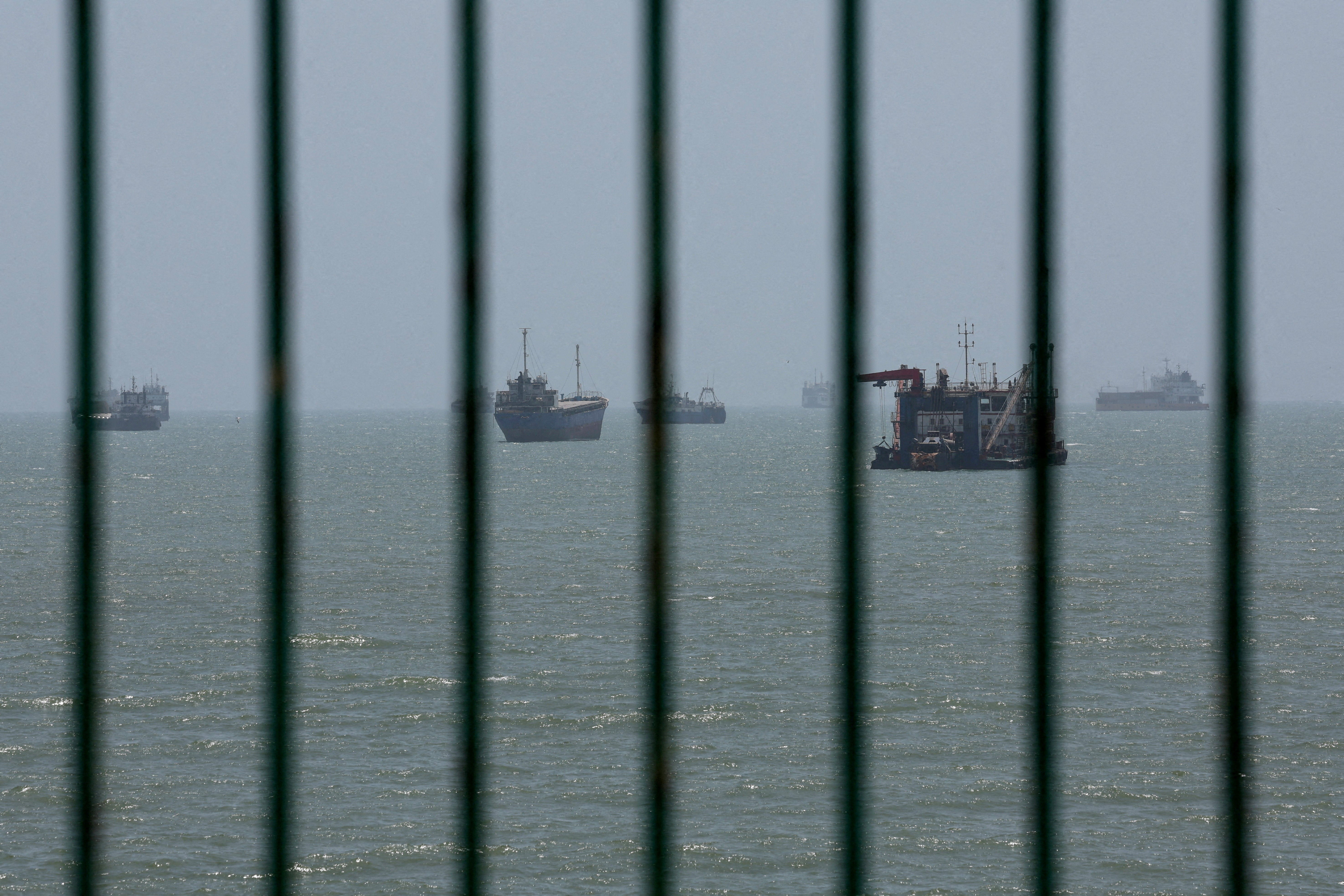
Shipping traffic through Strait of Hormuz remains weak
Traffic through key Gulf waterways remained subdued amid continued diplomatic and political tensions between Washington and Tehran, according to shipping data cited by Reuters.
Kpler data showed cargo vessel sailings through the Strait of Hormuz edged up on Wednesday from Tuesday, but remained well below the 10-day average.
Shweta Sharma27 August 2026 08:06
Six consequences of six months of US-Israeli war on Iran
Six months into the US-Israeli war on Iran, the conflict has become a costly stalemate, with no clear path to an end. Here are six major consequences:
1. Trump is paying a political price
Trump’s approval rating has fallen from 40 per cent to 33 per cent since the war began, and only 31 per cent of Americans now approve of the conflict. Rising fuel prices and the war are also creating headaches for Republicans ahead of the midterms.
2. Global economy is shaken, but remains resilient
Disruption to the Strait of Hormuz sent energy prices soaring and forced the IMF to cut its global growth forecast to 3% this year. But the impact has been less severe than feared, partly because economies are now less energy-intensive.
3. Iran is wounded, but not defeated
Iran has suffered major military and economic losses but retains missiles and drones and has kept the Strait of Hormuz severely disrupted. Food inflation reached 128 per cent year-on-year in July, deepening the economic crisis.
4. The Middle East is less secure
Iranian attacks have hit US military and diplomatic facilities in Gulf states and disrupted air travel. Shipping disruptions and higher insurance and transport costs have further strained regional economies.
5. Iran’s nuclear programme is delayed, but not eliminated
US and Israeli strikes damaged key Iranian nuclear facilities and killed scientists, potentially pushing back its ability to produce weapons-grade material. But the whereabouts of hundreds of kilograms of highly enriched uranium remain unclear.
6. US military readiness is under strain
The US has lost aircraft and used large quantities of precision munitions and missile interceptors. Assets have been shifted from Europe and the Indo-Pacific to the Middle East, raising concerns about America’s ability to respond elsewhere.
Shweta Sharma27 August 2026 08:00
Inside the Israeli military policy to ‘justify’ lethal actions in deadly attacks on civilians in Gaza
The Israeli military uses a de facto policy of “retrospective incrimination” for high-profile attacks that kill a large number of civilians without a clear military objective in Gaza, including deliberately counting Palestinians as “terrorists” even when unarmed, a soldier has revealed.
Shweta Sharma27 August 2026 07:30
Watch: Hegseth refuses to rule out US strikes against Iran
Rachel Dobkin27 August 2026 06:47
Iran says no final deal reached with Oman over Strait of Hormuz – report
Iran and Oman are still negotiating the details of an agreement over the Strait of Hormuz, a senior Iranian source said on Wednesday, contradicting an earlier claim by Iran’s Revolutionary Guards that the two countries had agreed on how to divide control of the strategic waterway and its revenues.
The Islamic Revolutionary Guard Corps said Iran and Oman had reached an understanding on their respective shares of the strait’s waters and revenues. But the senior Iranian source said no final agreement had been reached, adding that talks were continuing.
The IRGC also said the strait would remain closed unless the United States met Tehran’s conditions under an interim ceasefire agreement reached in June before it unravelled. Iran has demanded an end to the US blockade of its ports, compensation and the removal of sanctions.
Iran and Oman have held talks for weeks over managing traffic through the strait, a crucial global energy chokepoint that handled about one-fifth of the world’s oil and liquefied natural gas shipments before the war began in February.
Most shipping through the waterway has since been disrupted, pushing global energy prices higher as Iran and the US seek to exert control over the channel through separate blockades.
The conflicting statements leave the status of any Iran-Oman agreement unclear, with negotiations apparently continuing over the details of a possible accord.
Shweta Sharma27 August 2026 06:30
Trump says ‘no time schedule’ for return to US-Iran negotiations
US president Donald Trump has said he has “no time schedule” for when the US-Iran talks will take place to end the conflict.
“I have no time schedule, none. I’m not in a hurry. I have no time schedule at all,” Trump told Al Jazeera on Wednesday.
“We are winning very big,” Trump said. “They’ve got massive inflation, their economy is falling apart, they’re treating their people very badly, they are killing many, many protesters. I have no time schedule; whatever it takes.”
Trump said the economic measures and military strikes together were “effective” in the conflict when asked what has worked better.
Shweta Sharma27 August 2026 05:50
Sailor who jumped from USS Lincoln to face disciplinary action
A sailor who jumped from the aircraft carrier USS Lincoln this month in what his wife described as a suicide attempt is facing disciplinary action from the US Navy.
According to documents reviewed by MS NOW, formerly MSNBC, the sailor has been accused of malingering and being absent without leave, offences that could result in the loss of half his pay.
“I think they’re insane for doing this to people who need mental help,” his wife told the US media outlet.

Asked why it was pursuing disciplinary action against a sailor following a suicide attempt, a US Navy official told MS NOW that the service was committed to the wellbeing of every sailor and that seeking help was a sign of strength.
The Lincoln’s deployment was extended repeatedly during the war on Iran, prompting concerns over the strain on its crew from prolonged periods at sea and deteriorating conditions aboard the carrier. A group of Democratic senators has called for hearings into the deployment.
The USS George Washington aircraft carrier arrived in the Middle East earlier this month to relieve the Lincoln.
Shweta Sharma27 August 2026 05:40