

Iran News in Brief – August 27, 2026
THIS PAGE WILL BE UPDATED WITH THE LATEST NEWS
UPDATE: 7:00 AM CEST
PMOI Resistance Units Echo The ‘No to Executions’ Call Across Iran’s Streets
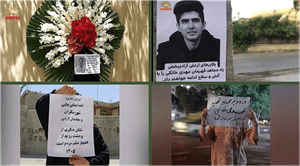
Facing domestic chaos and a paralyzing fear of nationwide uprisings, the Iranian regime has accelerated its execution machine as its primary survival tactic. In a powerful display of defiance against this state-sanctioned terror, PMOI Resistance Units and freedom-loving youth have launched widespread campaigns across Iranian cities to support the “No to Executions Tuesdays” campaign, which just marked its 135th week across 61 prisons. These activities explicitly demanded the cancellation of death sentences and emphasized standing against suppression while continuing the struggle for freedom.
The Resistance Units are successfully bridging the gap between political prisoners and the streets, proving that the regime’s strategy of intimidation is failing to silence the Iranian public.
Resistance Units in cities including Isfahan, Arak, Varamin, Ahvaz, Sanandaj, Rasht, and Mashhad carried out activities such as installing posters, writing graffiti, holding photo calls, and distributing protest messages. In Sanandaj, activists held placards reading, “From Kurdistan to Tehran, everyone is against executions,” while Rasht and Mashhad saw “No to executions” messages.
By publicly honoring recently executed PMOI members, the Resistance Units are shattering the regime’s propaganda, highlighting the true identities of these highly educated martyrs whom the regime attempts to smear with false charges.
Victims at Home: Report on 15 Women Killed in One Month

Victims at Home: Report on 15 Women Killed in One Month: The roots of the tragedies of violence against women in Iran cannot be reduced to individual or family prejudices.
The misogynistic laws of the clerical regime portray men as the absolute owners of women’s lives and blood. Under the regime’s penal code, a father, as the legal guardian of a murder victim, is exempt from qesas, or retributive punishment. Article 1105 of the Civil Code, meanwhile, defines the leadership of the family as an exclusive prerogative of men.
Under this system, the testimony of two women is equivalent to that of one man, and a woman subjected to severe domestic violence must prove that her life is at risk in order to obtain a divorce. Such efforts are often ignored by regime judges until a killing occurs. The result is a legal framework that effectively gives men license to retaliate against women in response to social or family pressures.
These anti-women laws have contributed to a shocking upward trend in so-called honor killings. Data compiled from state media by the Women’s Committee of the National Council of Resistance of Iran reveal the depth of the tragedy.
Warning Against the Normalization of Executions in Iran

The escalating wave of executions in Iran is raising concerns not only about the lives being taken, but also about the regime’s broader effort to make executions appear routine and inevitable.
A social media user recently shared a video message warning Iranians against allowing what could be an even greater tragedy than the executions themselves: the normalization of death as a tool of government.
“The danger is not only execution,” the message explains. “More dangerous is that the clerical regime wants to repeat executions and their daily news coverage until executions become psychologically normalized in society, causing people to become indifferent to the news.”
The warning highlights a critical dimension of the regime’s repression. By repeatedly exposing the public to reports of executions, authorities may hope that outrage will eventually give way to exhaustion and indifference.
Iran’s Forgotten Regions: Poverty at Home While Regime Funds Flow Abroad

In parts of Iran, poverty has reached a level where basic infrastructure and essential public services remain out of reach for entire communities. In Sistan and Baluchestan and Bushehr, particularly in rural areas, residents continue to face conditions that would be difficult to imagine in a country with Iran’s vast natural resources and wealth.
Reports published even by Iranian state-affiliated media have documented some of these conditions. In one report by the Iranian Labor News Agency (ILNA), a local resident points to a rudimentary structure and explains that it serves as the community’s bathroom. Images and reports from Zahedan, the provincial capital of Sistan and Baluchestan, have likewise highlighted severely inadequate roads and urban infrastructure.
These are not isolated shortcomings. They offer a glimpse into a much broader crisis of poverty, underdevelopment and deprivation affecting millions of Iranians.
Perhaps the most striking example comes from a community where a river effectively separates residents from essential services.
Iranian Workers’ Wages Collapse to Around $80 a Month as Inflation Deepens Poverty
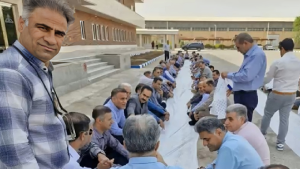
The collapse of Iran’s currency has pushed the basic monthly wage of Iranian workers to roughly $80, exposing the dramatic erosion of purchasing power and the deepening poverty confronting millions of working families.
According to a report published by the Iranian Labor News Agency (ILNA) on Tuesday, September 3, the basic wage for workers in the current Iranian year stands at 16.625 million tomans. At an exchange rate approaching 200,000 tomans to the U.S. dollar, the wage is worth only about $83.
For a married worker with one child, total monthly earnings including allowances reach approximately 24.9 million tomans, equivalent to only about $122 at an exchange rate of 205,000 tomans per dollar.
The figures become even more striking when compared with the cost of living.
Britain Supports US Sanctions Against Tehran

Britain supported U.S. efforts to reach a diplomatic solution regarding Iran while simultaneously increasing pressure on the Iranian regime.
John Healey, Britain’s finance minister, said London supports Washington’s approach to reaching a diplomatic solution while welcoming the latest U.S. measures to increase pressure on Tehran, including broader sanctions announced on Monday.
He also called on the Iranian regime to end what he described as destabilizing activities across the region, including actions related to the Strait of Hormuz.
Meanwhile, U.S. Treasury Secretary Scott Bessent said recent remarks by Iranian regime officials demonstrate the impact of Washington’s pressure.
Tehran and Muscat Agree on Clearing Mines in Strait of Hormuz After Trump Announcement
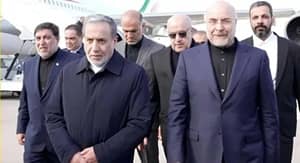
After U.S. President Donald Trump announced that mine clearance in the Strait of Hormuz had been completed, the Iranian regime and Oman also announced that they had reached an agreement to carry out a joint mine-clearance project in the strait. The creation of a temporary passage, arrangements for ships to transit, and the reopening of the waterway were left to further technical negotiations.
A joint statement by Tehran and Muscat was issued on August 25, following a meeting in Tehran between Badr Albusaidi, Oman’s foreign minister, and Abbas Araqchi, the Iranian regime’s foreign minister.
The proposed framework includes the creation of a joint temporary passage for ships and the implementation of a joint project to clear mines from the Strait of Hormuz.
In the statement, the implementation of the joint mine-clearance project is the only issue on which the two countries have reached an agreement. The creation of a temporary passage is part of the proposed framework and has not yet been finalized.
Iran: Ehsan Faridi, a 22-Year-Old Student, at Risk of Execution

Ehsan Faridi is from Tabriz and was born in the Iranian year 1382, corresponding to 2003–2004. Before his detention, he studied manufacturing engineering at the Technical Faculty of the University of Tabriz. He was described as 22 years old in the latest available reports, although his exact date of birth is unknown.
He was first arrested on 8 March 2024 and released on bail on 18 March. In connection with that detention, he faced the charge of “propaganda against the state” and received a six-month prison sentence. On 18 June 2024, while attending Branch 15 of the Tabriz Prosecutor’s Office, Faridi was rearrested and transferred to Tabriz Central Prison.
The labels applied to the allegations changed at different stages from “attempted moharebeh” and moharebeh (enmity against God) to efsad-e fel-arz (corruption on Earth). Early reports also referred to alleged membership of the People’s Mojahedin Organization of Iran, while later reporting identified efsad-e fel-arz as the basis of the death sentence. Branch 3 of the Tabriz Revolutionary Court, presided over by Judge Hassan Fathpour, imposed the death sentence. According to counsel, the lawyers were not given full access to the case file and the evidence underpinning the judgment has not been made public.
Berlin: PMOI Supporters Continue Sit-In, Honor 1988 Massacre Victims, Call for Democratic Iran
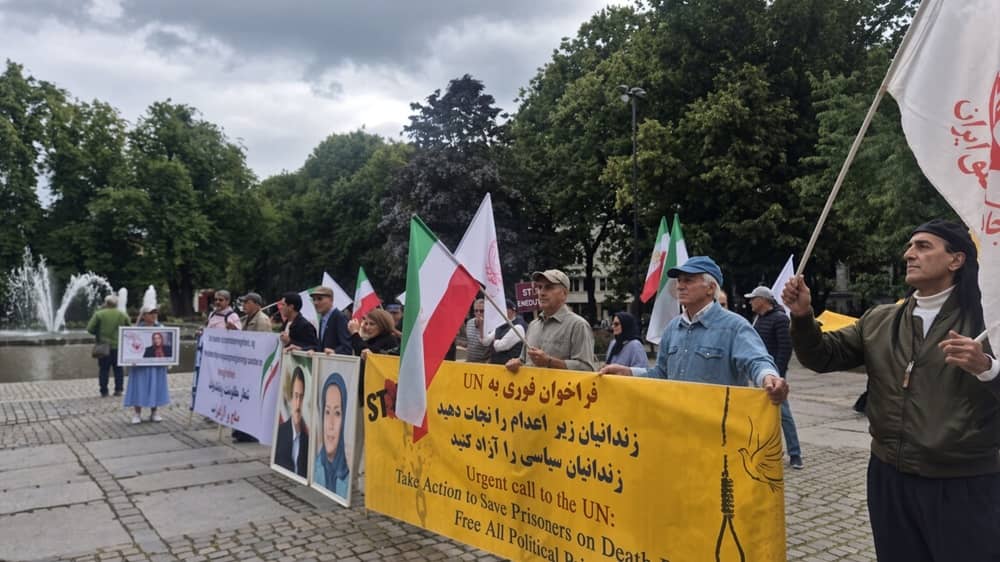
Berlin, Germany — August 25, 2026: Supporters of the People’s Mojahedin Organization of Iran (PMOI/MEK) are continuing their sit-in protest outside the Iranian regime’s embassy in Berlin. Launched on February 28, the ongoing demonstration is a response to the regime’s widespread human rights abuses and escalating executions. The demonstrators are also calling for the closure of the embassy, which they accuse of serving as a center for espionage and terrorist activities.
During the protest, they paid tribute to the memory of more than 30,000 political prisoners who were executed by the clerical regime during the 1988 massacre, while reaffirming their determination to continue their struggle against the regime until Iran achieves freedom.
Brussels Rally Honors 1988 Massacre Victims, Urges End to Executions in Iran
Brussels, Belgium – August 22, 2025 — Supporters of the Iranian Resistance (NCRI/PMOI) held a rally and photo exhibition in Brussels to commemorate the victims of the 1988 massacre, when more than 30,000 political prisoners were executed in the summer of 1988 following orders by Ruhollah Khomeini. Photographs of the victims were displayed alongside documentation of the killings of protesters in Iran’s uprisings, including executed protesters arrested during the January 2026 uprising and political prisoners, including MEK members executed this year.
Demonstrators condemned the Iranian regime’s use of executions as a tool of repression. They called for an end to state violence, regime change, and the establishment of a democratic republic in Iran. They also demanded the immediate abolition of the death penalty and the release of all political prisoners.