

Investigation: Europe pays Libya’s Haftar to curb migrant flows despite rights abuses
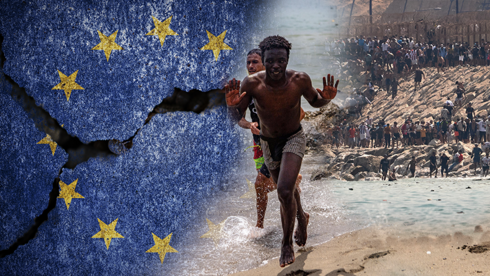
To halt that trend, Brussels and European governments appear willing to do almost anything to prevent new refugees and migrants from entering, alongside efforts now gaining momentum to speed up the deportation of those who have already arrived.
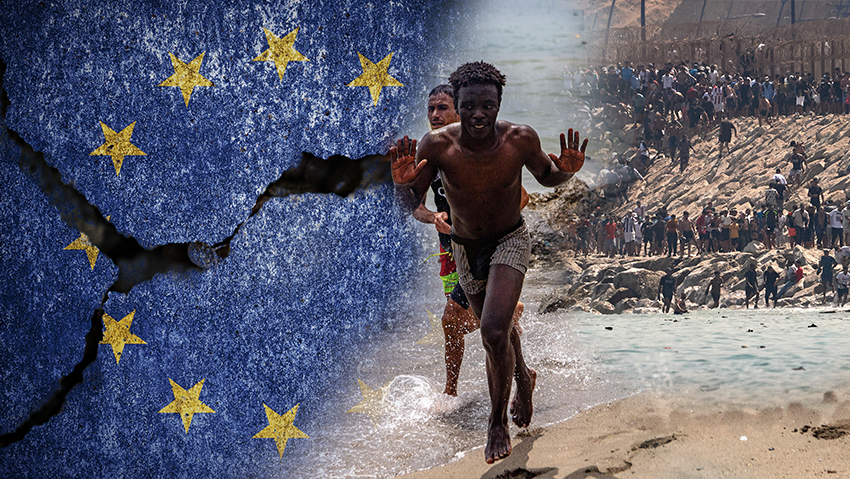
According to the investigation, Haftar is effectively using migrants as leverage against Europe and, in the words of the German magazine, has managed to “blackmail” it into funding his forces to stop those trying to cross the sea to Europe. These are, according to the report, the same migrants who are thrown into detention camps in territory under his control, where they are tortured and abused and required to pay ransom for their release before continuing their journey to Europe.
Libya has been deeply divided politically since 2011, when the regime of dictator Moammar Gadhafi, who ruled the country for 42 years, was overthrown and he was later lynched on camera. Gadhafi’s fall raised hopes that Libya would move toward democracy, but instead the country descended into a brutal civil war and was torn apart by armed militias and terrorist organizations.
From 2014 onward, Libya found itself divided between two rival governments: one in the west, based in the capital, Tripoli, and recognized by the United Nations, and another in the east, with Benghazi as its unofficial capital. Each government was backed by different militias and foreign powers. The Tripoli government received support from Turkey and Qatar, while the Benghazi-based government was backed by Egypt, the United Arab Emirates, Russia and France.
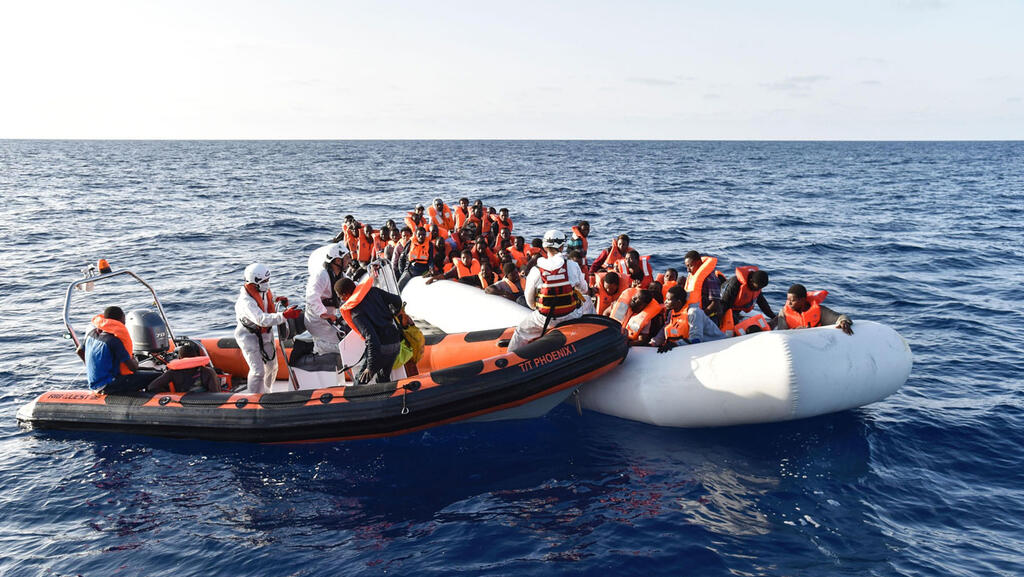
Migrants rescued from a boat that sailed from Libya and sank near Italy in the past decade
(Photo: AFP)
At the head of eastern Libya’s power structure rose Gen. Khalifa Haftar, a Libyan-American who had served as a senior officer in the Libyan military during the early years of Gadhafi’s rule but defected in the 1980s during the war between Libya and Chad. He later spent more than two decades in the Washington area, a period during which he was widely believed to have cooperated with the CIA, before returning to Libya in 2011 to join the uprising against Gadhafi.
Since 2014, his forces have taken control of vast areas of eastern and southern Libya, including key oil fields and export terminals. In April 2019, Haftar’s forces launched an offensive on Tripoli, the seat of the western government. Many at the time believed he could complete the takeover of Libya, but after 14 months the operation ended in failure.
The European Union does not recognize Haftar’s government, and diplomatic ties, including those concerning migration, had until now been conducted only with the internationally recognized government controlling western Libya. But according to the Der Spiegel investigation, that policy is changing, with the EU in practice granting a degree of legitimacy to the eastern government through contacts aimed at stopping migrant flows from areas under its control.
Eastern Libya lies only a few hundred kilometers from Crete or Sicily, and until 2024 almost no refugee boats arrived from there. But that year, 5,000 refugees reached Crete, and last year the number jumped to 20,000.
To stop that flow, the EU reached an agreement under which it will fund and equip Haftar’s men, conduct training and exercises with them — some of which have already begun — and build command-and-control centers and radar stations to stop refugees at sea, according to Der Spiegel, which based its investigation on internal documents it obtained.
The magazine described the move as an “EU surrender” and sharply criticized Brussels, pointing to similar cases in which Europe had made itself dependent on authoritarian rulers in order to stop migrants from reaching the continent.
“The result is a partnership that is not only morally questionable but also appears anything but stable,” Der Spiegel wrote. “Much as it has done in Morocco and Tunisia, the EU is making itself dependent on an autocrat who has every incentive to pressure his northern neighbors with new departures. Driven by Greece and Italy, the reporting shows, the Europeans are entering into a pact with a man they already suspect will attempt to blackmail them.”
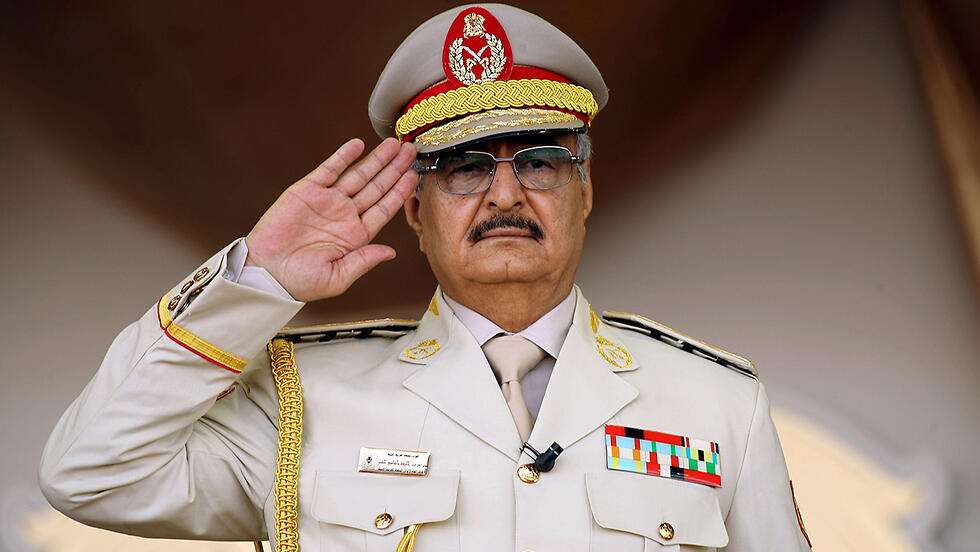
Gen. Khalifa Haftar, who is ‘playing Europe’
(Photo: AFP)
The Haftar family, the magazine reported, views migration above all as a business opportunity.
Wolfram Lacher, an expert at the German Institute for International and Security Affairs, or SWP, said they profit both from migrants leaving Libya and from preventing them from leaving.
Migrants are held in detention camps in Libya that have for years been the subject of reports of torture and abuse. While such camps exist in both western and eastern Libya, almost nothing happens in Haftar-controlled territory without the ruling family’s knowledge.
“The Haftars control the escape route to Crete however they see fit,” Lacher said, adding that sometimes they open the route and sometimes they close it. Their main concern, he said, is not obtaining better equipment from the EU but political recognition.
According to Der Spiegel, the European Union is well aware of the game Haftar is playing. Even so, Brussels appears to see no alternative.
The investigation said that in early July, Nicola Orlando, the EU ambassador to Libya, described a meeting with senior figures in Haftar’s regime during private talks with European diplomats.
According to a summary of the discussion obtained by the magazine from the German Foreign Ministry, Orlando said Haftar and his family were using migrants “as a means to an end and as a business model.” He said departures for Crete had risen sharply, but added: “The EU has so far had nothing to offer eastern Libya; hopefully that will change.”
Der Spiegel noted that the ambassador was referring to Operation IRINI, a naval mission launched by EU countries in 2020 following Haftar’s attempt to seize Tripoli. Under the mission, ships and aircraft were deployed to the Mediterranean to enforce a U.N. arms embargo imposed years earlier and intended to prevent weapons smuggling to Libya’s rival governments.
Now, after the U.N. mandate for the operation formally expired, the European Union is reshaping it to suit its own interests, according to the investigation.
Under the new framework, Operation IRINI is expected to equip Haftar and train his personnel. Internal documents obtained by Der Spiegel show plans for joint exercises at sea, and the EU also intends to establish a maritime rescue coordination center in Benghazi. A new radar station is to be installed for that purpose. The goal is to detect and stop more migrant boats.
But Der Spiegel noted that EU reports do not mention that the practical result would be to forcibly return migrants to the same detention camps from which they had first been forced to buy their freedom by paying ransom.
“The EU cannot afford hesitation,” Operation IRINI commander Marco Casapieri of Italy wrote, according to the report. Otherwise, he warned, “migratory pressure” would increase.
Brussels’ fear of retaliatory measures by Haftar, including a surge in migrant departures from Libya, also led it to reject a request by the internationally recognized government in western Libya to step up monitoring of oil smuggling in the region, activity from which militias under Haftar’s control are among the main beneficiaries.
According to the investigation, internal Brussels documents made the reason for rejecting the request clear: fear of “retaliatory measures” by Haftar, including “massively increased influx of migrants from Libya.”
According to the investigation, Haftar’s personnel began a first training course as early as September 2025 in the southern Italian port city of Taranto. Another course was held in Thessaloniki, Greece.
Participants in the courses are expected to join IRINI vessels for 10-day periods at a time. The program is expected to cost at least 3 million euros, according to the report, and participants will also receive training in areas including gender issues and “respect for human rights.”
Officially, the European Union says the agreement is solely with the coast guard of eastern Libya’s government. But Der Spiegel reported that at least some of those coast guard members are in fact members of the Tareq Bin Zeyad militia, better known by the initials TBZ, a brutal militia controlled by Haftar’s son Saddam.
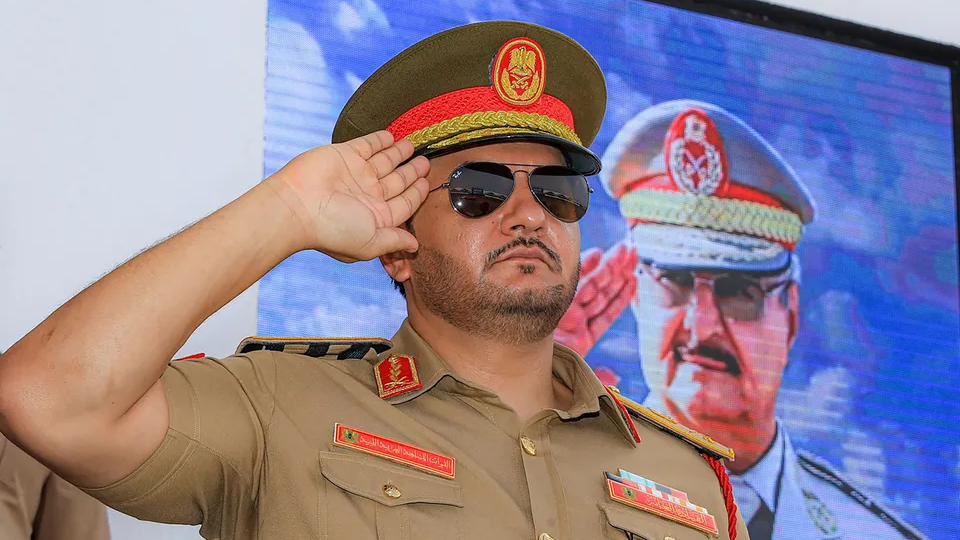
Saddam Haftar, the general’s son who controls the brutal TBZ militia
(Photo: Media office of Khalifa Haftar / AFP)
The European Union denied to the magazine that it had any dealings with the militia. But sources who spoke with Der Spiegel said at least two participants in the training course in Thessaloniki were in fact members of TBZ.
Jalel Harchaoui, an expert on eastern Libya at the Royal United Services Institute in London, told the magazine that Saddam Haftar had placed the militia under what is called the “Coastal Security Apparatus.” In practice, however, its members still see themselves as part of TBZ, he said, and many continue to display their affiliation openly.
Two participants in the Thessaloniki course even posted photos of themselves and their comrades in uniform on social media. One wrote: “TBZ, the family.” The other added the caption “TBZ” to his photo, followed by two flame emojis.
In response to the investigation, Greece’s Foreign Ministry said the courses held on its territory also cover international and European law, but it did not answer questions about ties between members of the Libyan coast guard and TBZ.
When one of the two participants was asked about the connection, he insisted he was not a member of TBZ. In a Facebook message, he wrote that he did not even know what the initials meant. When asked why he had used the abbreviation himself, he replied, according to the magazine: “Fuck you!”
Lacher, the SWP expert, said the European distinction between the coast guard and militias was unconvincing. “Everyone knows that real power in eastern Libya lies in the hands of the Haftar sons,” he said. “And that means units like TBZ.” The idea that regular units exist with no connection to Gen. Haftar or his sons is simply wrong, he said.
The main thing, it seems, is that Europe will not have to get its own hands dirty with the migrant problem.
Credit: Source link