

INTERVIEW: The Next Two Years Will Decide the Future of Uganda Airlines — Girma Wake
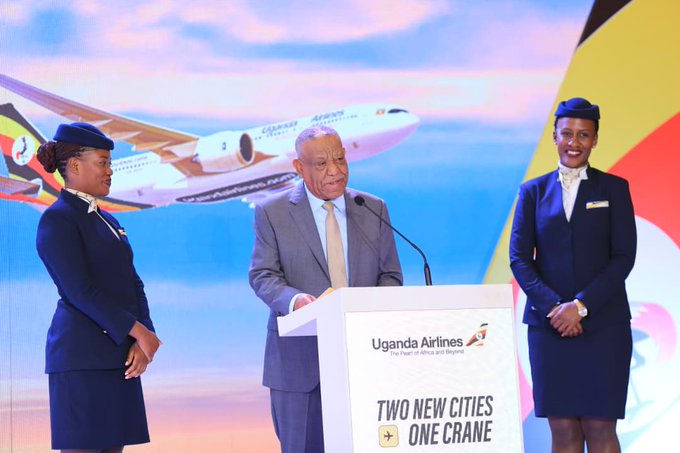
Uganda Airlines is entering a critical phase of its growth, with management seeking to improve operational reliability, restore grounded aircraft, strengthen regional connectivity and prepare for a planned fleet expansion beginning in 2032.
In a recent interview during the launch of two new routes (Kigali and Accra), Uganda Airlines’ Chief Executive Officer, Ato Girma Wake, spoke about the airline’s recent operational improvements, the financial impact of grounded aircraft, plans for new routes, competition from international carriers, the use of leased aircraft and preparations for the arrival of eight new aircraft.
Girma said the airline has significantly reduced avoidable delays since February, while efforts are underway to build traffic ahead of the arrival of new aircraft. He also acknowledged that profitability remains a challenge, particularly on some regional routes, but argued that stronger connectivity through Entebbe could unlock new passenger and cargo markets.
Below is the interview:
Q: Since you took over at Uganda Airlines, what measurable achievements and quick wins have been recorded under your leadership, particularly in operational efficiency, fleet availability, schedule reliability, staff restructuring and financial performance?
Girma: I came here in February, and since then I have been working with the team at the airline and the Board to improve the situation, particularly schedule reliability. We have made significant progress over the last four or five months.
I can only remember one cancellation during that period. The team is working very hard to ensure that our aircraft depart on schedule. There are times when, despite whatever we do, we encounter circumstances beyond our control. For example, if weather closes an airport, you cannot control nature, so there will inevitably be some delays.
But generally, avoidable delays have been reduced tremendously.
On streamlining the schedule, we previously had flights coming from destinations such as Mumbai, London and Dubai that were not connecting efficiently to onward flights. We have now changed that.
All our wide-body flights arriving from outside the country will connect with outgoing flights at Entebbe, allowing us to interchange traffic between incoming and outgoing flights. That has improved connectivity and, gradually, should also improve the airline’s financial performance.
So far, however, we have not seen the financial improvement we wanted. That is largely because almost 60 percent of our capacity was grounded due to aircraft-related problems.
We managed to keep one of the CRJ aircraft flying, but another is still grounded. One of our CRJ aircraft is also grounded. We have had to bridge the gap by wet-leasing aircraft from other airlines to maintain our schedule.
Because of that, our financial performance has not yet reached where we want it to be. But once the grounded aircraft return to service—possibly by January, with one CRJ expected back within the next two weeks—we expect the financial position to improve.
Q: How much financing does the airline need to address the current operational challenges, particularly the grounding of aircraft?
Girma: Basically, what we need now is a solution that allows us to maintain the schedule while our aircraft are undergoing maintenance.
We have three engines that need to be completely overhauled in Singapore. That work will be done at the expense of the engine manufacturer, not at our cost. Since we acquired the aircraft, we have been paying for maintenance every month as we operate them.
So, the money we require is not really for that maintenance. The maintenance will be covered because we already have an agreement with the manufacturer and the insurance company.
What we need is financing to lease other aircraft while ours are being maintained so that we can maintain our schedule.
That money is being handled through the normal budgetary system of the Ministry of Finance, and they are doing a very good job.
Q: Let’s talk about the airline’s expansion into new markets. How do you assess the Nigeria route?
Girma: Today, we are operating flights to Nigeria. Unfortunately, even though Nigeria is the most populous country in Africa and generates a lot of traffic for airlines, the route has not picked up as much as we wanted.
It, therefore, needs support to become viable, and Accra provides that support.
We believe that once our schedule becomes reliable and we operate a regular type of aircraft, Nigerian traffic will increase significantly. Eventually, it will be possible to separate Nigeria and Ghana because both are strong markets and can support independent flights.
For now, however, operating them together allows us to build traffic.
Nigeria has significant traffic to India and Dubai. When we make those connections available, we will capture that traffic.
And it is not only about passengers. No Nigerian passenger travels without baggage, and there is also cargo. If you operate a narrow-body aircraft to Nigeria, you will not make a significant impact. You have to operate a wide-body aircraft so that you can carry passengers, cargo and baggage together.
That is how we will make the route strong. The reason it is not strong today is that we are not providing that capacity. As soon as we get the appropriate aircraft, we will provide it.
Q: What about competition on the routes you are entering?
Girma: Competition is actually good.
People make the mistake of assuming that when there are more flights, it becomes more difficult for airlines to operate. It is not true. When you have more frequency, you generate more traffic.
Frequency generates traffic.
If you operate one flight a week, very few people will travel. But the moment you make it daily, you will see many more people travelling. That is the psychology of travel.
So, having two airlines competing on a route can benefit both airlines. Traffic will grow. People who are not travelling today will travel when they see fares coming down and frequency increasing.
Nobody dominates any sector.
You have airlines such as Emirates, Air France and Qatar Airways dominating much of the African traffic. In Uganda, Ethiopian Airlines may dominate certain markets because of its four daily frequencies, but that does not mean there is no business for Uganda Airlines.
There is business.
When you think about traffic, you have to cover the region. If you fly from here to a nearby destination with a few empty seats, the loss is not significant. But if you fly from here to London with several empty seats, the loss is much bigger.
So, you have to collect traffic from Kigali, Kinshasa and other regional markets and bring it through Entebbe.
By building a structure that allows people to connect through Entebbe, we will improve the airline’s financial position. Short-haul sectors can also generate good revenue per flight hour.
Q: You are launching new routes at a time when profitability remains a key challenge in the airline industry. What commercial and market analysis informs these decisions, and what cargo and revenue targets have you set for the new destinations?
Girma: You don’t set targets by individual destination. You set a target for the airline and then determine how each market will contribute to achieving it.
For example, the daily flight to Kigali should not be expected to make a profit in the first year, or even necessarily in the first two years. When you enter a new market, you have to give it two or three years to develop.
That is the period during which you build the market. By the third year, you should be able to make a profit. If you are not making a profit by the third year, then there is a problem.
But you cannot expect immediate profits in the first year.
Q: Uganda Airlines’ performance on some regional routes has not been very strong. What went wrong?
Girma: The performance has not been very good, but that is not because there is no market. It is because we did not handle the traffic properly.
The number of people travelling directly between Zimbabwe and Uganda, or between Zambia and Uganda, is limited. The only way you can make those routes work is by allowing passengers from those countries to connect through Uganda to destinations such as London.
There is significant traffic there, but our schedule was not good enough to allow us to capture it.
That is why the market did not develop.
Now, when you provide connections to London, Dubai and Mumbai, the traffic will feed into the network. I have handled these markets for many years. There is a market, and it can be profitable, but we did not handle the traffic correctly.
The same applies to Johannesburg. You should not expect that route to make money with the current aircraft.
Even if you go 100 percent full and return 100 percent full, you can still lose money because it is not the right type of equipment for that route.
We are putting the right equipment in place. Once we introduce the 737-800, that should improve profitability.
The current aircraft is not designed for that type of operation. It is better suited to routes such as Kigali, Bujumbura and Nairobi.
We are using it across many routes, but we will change that.
Q: How is Uganda Airlines going to ensure that its eight-aircraft expansion programme stays on course, despite changes in the aviation industry?
Girma: First of all, these aircraft are not coming tomorrow.
The first 737s are expected in 2032, while the 787 wide-body aircraft are expected in 2033.
What we do between now and 2032 is what will help us build the traffic. We have to prepare the market now so that when those aircraft arrive, we have a ready market for them.
How do we do that?
We are trying to use dry leases.
A dry lease means we lease an aircraft for five or six years, but we use our own crew, our own maintenance and our own insurance, and operate it under our own registration.
That helps reduce costs.
Wet-leasing is at least three times more expensive. For the cost of one wet-leased aircraft, you can potentially operate three dry-leased aircraft.
So we will reduce our costs while, at the same time, developing the capacity within the airline to manage the eight aircraft that are coming.
At the same time, we will build traffic in preparation for those aircraft.
What we do over the next two years will determine the future of this airline.
If we do it right, the future is bright. If we don’t, it will be difficult.
Q: You have invested resources in opening new routes and acquiring aircraft, but there has been concern about the level of marketing support for those routes. How do you address the imbalance between Ugandans travelling out of the country and passengers coming into Uganda?
Girma: I don’t have the exact ratio at hand, but I can tell you that many Ugandans are travelling.
However, Uganda Airlines was not created simply to fly Ugandans. It was created to fly Ugandans as well as passengers from other countries.
That is the only way the airline can grow.
Q: When do you expect the airline to resume flights to the affected destination?
Girma: As soon as the situation is declared safe.
If Ugandans, or anybody travelling from Uganda, have to spend 21 days outside the country before they can travel to Dubai, how would we operate?
Once the situation is resolved, we will go back. Hopefully, by then, the situation on the ground will be peaceful.
We have no control over that.
Q: You mentioned that the airline currently flies to Kigali four times a week. Will that increase?
Girma: Yes. Gradually, it will increase.
The more frequently you fly, the better it is for the market.
Q: When will the fourth flight be restored?
Girma: As soon as the CRJ comes back into service.
Q: As Uganda Airlines prepares to recruit a substantive Chief Executive Officer, what governance and institutional reforms have been put in place to ensure continuity, strengthen accountability and position the airline for sustainable growth?
Girma: Instead of simply hiring people from everywhere, we want to recruit university graduates and take them through rigorous training.
An already bent tree is difficult to straighten. It is better to take young people and plant the type of seeds we need in them so that they can eventually lead the airline where it wants to go.
That will take time.
Until those people are ready, we will continue looking at the market and employing competent people.
Q: How will this talent-development programme work with universities and aviation schools?
Girma: We are recruiting students and supporting them through training.
For the eight aircraft that we are bringing in, we need to develop the human capacity to operate them.
We are establishing working relationships with schools and universities so that we can train people according to the needs of the airline.
It takes many years to develop that kind of capacity, so we have to start now.
That is how we will prepare the people who will eventually operate and manage the airline.
Credit: Source link