

Inside the Sahel’s War Economy: How Juntas and Jihadists Tax the Same Fuel Trucks
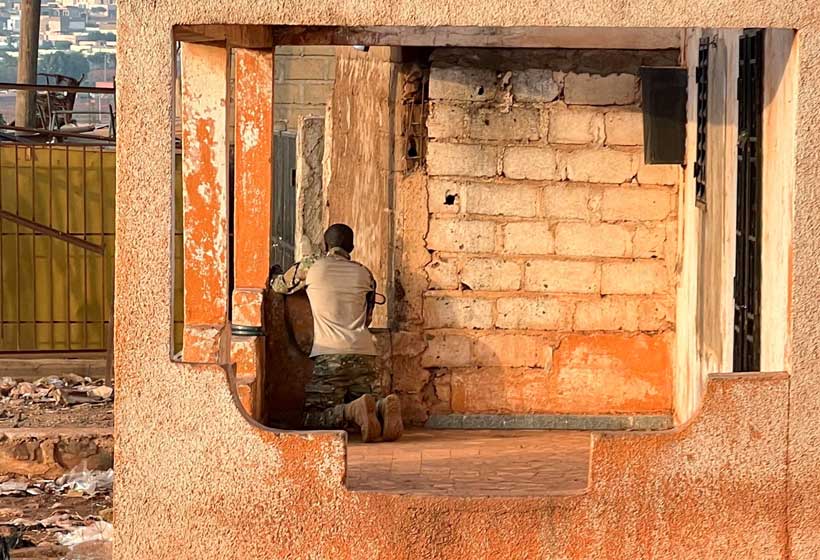
Ten months into al-Qaeda’s blockade of Bamako, the fuel still arrives. Since JNIM’s spokesman announced the campaign on 3 September 2025, the group has destroyed more than 300 tankers on the highways from Senegal, Ivory Coast and Guinea that carry 95% of Mali’s imported fuel. Yet by July 2026, over 1,000 tankers had reached the capital anyway, escorted by Russia’s Africa Corps and, increasingly, Turkish drones. Petrol that cost $25 a litre before September now costs $130. Somewhere between “blockade” and “a thousand tankers delivered under fire” is the real story: this was never a siege built to starve a capital. It is a toll booth, and the jihadists manning the checkpoints and the junta managing the convoys are both taking a cut of the same barrels.
France’s Operation Barkhane, which had at least contested jihadist freedom of movement on the highways, finished withdrawing from Mali in August 2022 and from Niger by the end of 2023. The United States shut its last base in the region, the drone facility at Agadez, in September 2024. Neither departure was replaced with equivalent capacity: Russia’s Africa Corps numbers only around 1,000 personnel in Mali and functions mainly as a convoy-escort and regime-protection force, paid for in mining concessions and gold-refining deals rather than a Western-style aid budget. Into the resulting vacuum has moved not open war for territory but a functioning informal economy — three trafficking corridors linking more than 150 hubs across the region, 37 of which researchers classify as “armed economic capitals,” where state officers and insurgents extract rent from the same commodity flows rather than fighting to control them exclusively.
The blockade did not start as an attack on Bamako. It started as retaliation: Mali’s junta had banned fuel sales in rural areas specifically to cut off JNIM’s own supply, and JNIM’s response was to make sure no fuel reached the junta’s capital either without JNIM’s permission. That is the tell. This is not a war over territory — it is a fight over who gets to tax a pipeline neither side can afford to destroy, because both sides need the same diesel to move troops, generators and vehicles.
Look at what the “fix” actually built. Escorted convoys now mean Bamako’s fuel arrives protected by Russian and Turkish assets that the state pays for — funded in part by the same gold-refining and mining concessions Mali handed Moscow in exchange for security. Truckers report paying fighters directly to move trucks through the most dangerous stretches: a jihadist toll, collected in cash, on top of whatever the state charges to escort the same vehicle the rest of the way. What does arrive gets rationed to military and government facilities first, and the surplus resurfaces on the black market at roughly five times the pre-blockade price — an arbitrage margin that specifically rewards whoever controls the queue, typically officials and intermediaries with one foot in the formal fuel-distribution system and one in the smuggling networks that move around it. Researchers studying the wider region call this a “symbiosis between state and criminality,” and Mali’s convoys are that symbiosis in miniature: one truck, two tolls, both collected on the way to the same depot.
Stay ahead of the geopolitical week.
MD Briefing delivers expert analysis across five global fronts — the Indo-Pacific, energy, geoeconomics, European security, and the Middle East — every Monday morning. Free.
The same model runs on gold, which long predates the fuel blockade. Artisanal sites such as Boungou and Nampala generate millions in unregulated output sold on through Togo, Ghana and Dubai, taxed informally by armed groups and formally licensed, in other locations, by juntas now selling concessions to Russian-linked buyers — often the identical commodity, moving through the identical border points, taxed twice by two different authorities that otherwise claim to be at war. Cattle follow the same pattern further east: livestock stolen in Burkina Faso and Niger is laundered through informal cross-border markets, with armed groups imposing pastoral taxes that function exactly like the checkpoint fees on a fuel tanker, while kidnap-for-ransom operations — typically $5,000 to $20,000 a victim — supply the cash liquidity that keeps the whole system moving between harvests of gold, cattle and diesel. Analysts now warn the region’s incipient lithium rush is being built on the same chassis, with armed groups already applying the tested playbook — tax the miners, tax the traders, tax the road — to a mineral nobody was extracting five years ago.
None of this requires a single command structure or a formal alliance between juntas and jihadists; it requires only that both sides find it more profitable to tax the same flow than to destroy it. That is what makes the informal economy durable in a way that neither side’s stated war aims are. A commander who burns every tanker on the Kayes road forfeits his own cut along with everyone else’s; a junta that fully secures the road removes the scarcity premium that funds Africa Corps’ presence and the officials skimming the black-market spread. Both sides have found it easier to fight over the toll rate than to end the toll.
The honest objection is that lumping juntas in with the jihadists they are fighting overstates the symmetry. It does, in one respect: a junta can in principle use resource revenue to eventually rebuild a state monopoly on force, while JNIM’s business model requires perpetual instability to keep the tolls flowing and has no comparable exit. But that political asymmetry does not show up in the money. Both sides are financed today by the same trucks, the same checkpoints and the same arbitrage between official and black-market prices — which is precisely why neither France’s departure nor Russia’s arrival changed the underlying economics. Paris tried, imperfectly, to suppress these flows as a security threat. Moscow and the juntas increasingly just monetize them.
Base case (roughly 55%): The blockade-and-escort equilibrium holds through 2027. JNIM stays too weak to fully cut Bamako off; Africa Corps and Turkish drones stay too thin to reopen free transit. Fuel keeps arriving at a heavy premium, funding a cut for both sides, and any lithium extraction that gets going folds into the identical taxation model already running on gold and diesel.
Downside case: Escort costs outrun a Malian state budget still leaning on gold revenue and Russian credit, just as JNIM shifts from ambushing lone tankers to hitting escorted convoys directly — a tactical escalation analysts already flag as plausible given ten months of “slow tightening, not a thaw.” A real supply collapse in Bamako this time, rather than a managed shortage, would force the junta to choose between reversing the rural fuel ban that triggered the whole standoff and risking the kind of urban unrest that has ended Sahelian governments before.
Upside case: Regional and international actors stop trying to fight the war on the road and instead target the intermediary layer that makes the toll economy profitable — the gold-buying networks in Togo, Ghana and Dubai, and the financial conduits behind convoy bribery — squeezing the arbitrage margin rather than the traffic itself. This does not require defeating JNIM militarily, only making the business less lucrative than the risk, which is why it is underpriced relative to how little coordination currently exists to attempt it.
The Sahel’s war looks, from outside, like a contest between juntas and jihadists over land and legitimacy. Financially, it increasingly looks like two toll authorities sharing the same road, each with more to lose from the other’s defeat than from the standoff continuing. Watch the spread between Bamako’s official and black-market fuel prices over the next few months, not the tanker-attack count that leads the headlines. If that spread does not narrow even as convoys keep getting through, the gap is not a symptom of the blockade — it is the business model, and no amount of Russian or Turkish escort will fix a system that currently pays everyone involved, on both sides of the front line, to keep it running.
Credit: Source link