
How 9/11 shaped a generation of veterans who served

I still remember dragging myself up an embankment in Al Anbar, a province in western Iraq, after the explosion. I wasn’t thinking about Sept. 11, the politics of the war, or how I had ended up halfway around the world. I was trying to get out of what was left of our vehicle because I knew enough to understand that staying where I was wasn’t an option.
I remember trying to find the other Marines around me, trying to make sense of the dust and the noise, and trying to figure out why my body wasn’t responding the way I expected it to. Two Marines had been killed, and I had just survived an improvised explosive device, also known as an IED.
-
![]()
Dwight Boddorf, left, with fellow Marines in Iraq in 2007. (Courtesy of Dwight Boddorf) -
![]()
Dwight Boddorf’s U.S. Marines platoon in Iraq in 2007. (Courtesy of Dwight Boddorf)

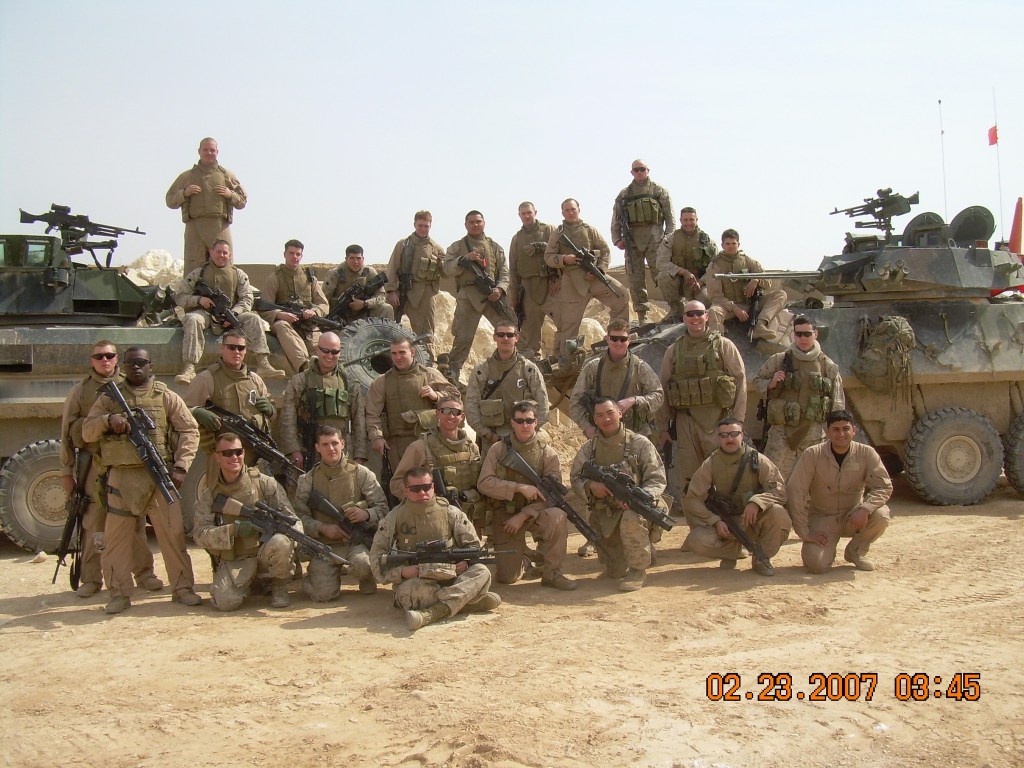
For years I thought of that memory as something that belonged only to Iraq. Time has a way of changing how you understand your own life, though, and I’ve come to realize that story really began years earlier in a classroom in a Butler high school, on Sept. 11, 2001.
Like many Americans, I remember watching the attacks unfold and realizing almost immediately that the country had changed. What none of us understood was how completely those events would shape the lives of those, like me, who were just beginning adulthood.
As we mark the 25th anniversary, I find myself thinking less about the attacks themselves than about the generation that grew up in their shadow. We often talk about where we were that morning, what we saw on television or the wars that followed. Those things matter, but I think the more interesting story is what happened to the millions of Americans whose adult lives were shaped by that day, often in ways they could not have anticipated.
Why I joined, and what I left with
Post-Sept. 11 veterans did not all enlist for the same reason. Some joined because they wanted to defend the country after the attacks. Others joined because military service had always been part of their family. Some were looking for college tuition, job training or a steady paycheck. Others were simply trying to find direction. Our reasons for serving were as different as our backgrounds, but the attacks on the World Trade Center had a way of placing people with very different stories onto remarkably similar paths over the next two decades.

People sometimes assume I joined the Marine Corps because I was inspired by patriotism after Sept. 11. That has never really been my story.
I joined because I wanted a way out of the environment I had grown up in. I was looking for discipline, structure, opportunity and a chance to build a different future than the one I thought was waiting for me. The Marine Corps offered that opportunity.
Sept. 11 didn’t change why I joined, but it changed the context of that decision. What I expected would be a path toward a better life quickly became part of a conflict that reshaped how I understood responsibility. In Iraq, responsibility was not an abstract value or something to discuss after the fact. Decisions had immediate consequences for the Marines beside me. I came home less interested in what people said they valued and more attentive to what they were willing to carry, fix and be accountable for.
Some of my peers went on to repeated deployments. Other soldiers served in places most Americans rarely heard about. Some came home with injuries that permanently altered their lives, while others carried experiences that were far less visible but no less real. Military families lived those years alongside us, often measuring time by deployments, homecomings, and phone calls rather than calendars.
A patriotism that asks questions
For many of us, adulthood arrived with a strange combination of purpose and uncertainty. We were proud of our service and loyal to one another, yet many grew skeptical of institutions that spoke in certainties while service members and their families lived with the consequences. That did not erase patriotism; it made it less ceremonial and more demanding. Loving the country also meant questioning its decisions, caring for the people sent to carry them out, and accepting responsibility for what came afterward.
As I’ve gotten older, I find myself asking different questions than I did in my 20s. I used to wonder whether the wars had been worth it, as though history could be reduced to a simple calculation. Extraordinary courage and sacrifice stood alongside mistakes and confusion.
Those realities are not mutually exclusive and acknowledging one does not diminish the other. That tension is part of what shaped us. We learned that pride in the people we served beside did not require blind faith in every decision made above us. We learned to keep functioning under pressure, but also how long the costs can remain after the public’s attention moves elsewhere.
After leaving the Marine Corps, I had the privilege of working with veterans from every generation, through patient advocate work for the Department of Veterans Affairs and in roles at Penn State, the Community College of Allegheny County and then the county itself. Across generations, I kept hearing the same questions: How do I rebuild my life? How do I reconnect with my family? How do I explain experiences that don’t fit neatly into everyday conversation? How do I find purpose after the military? The circumstances were different, but those questions seemed remarkably consistent regardless of when someone had served.
Among Iraq and Afghanistan veterans, I also recognized an impatience with easy narratives. The people I worked with generally did not want to be reduced to heroes or victims. They wanted competent care, honest recognition of what service had cost them and a meaningful role in what came next.
That experience also reinforced something I had noticed about my own generation. Most veterans eventually return to communities where they become teachers, nurses, police officers, business owners, public servants, parents, coaches and volunteers. They carry their experiences with them, but those experiences become only one part of much larger lives.
What we remember vs. what history may say
I eventually found my own path in municipal management, and while the work bears little resemblance to serving in Iraq, I have found that responsibility, preparation and service to other people continue to guide what I do. I still tend to look for what is failing, understand why, and build something that can hold when the pressure comes.
Looking back now, I think the lasting legacy of my generation will be found as much in what happened after we came home as in the wars themselves. In how we raised families, started businesses, worked in hospitals and schools, entered public service, mentored younger people and tried to leave our communities stronger than we found them. Most of that work has never attracted much public attention, but communities are built through steady contributions that rarely make headlines.
When I think back to that hill in Iraq, I don’t see it as the defining moment of my life anymore. It was one moment in a much longer story that I could not have understood at the time. My only concern that day was surviving the attack and helping the Marines around me. I had no idea how that experience would shape my understanding of service, leadership and responsibility. It taught me that survival creates an obligation: not to remain trapped in the worst day of your life, but to do something useful with the days that follow. Like many veterans from my generation, I eventually discovered that the most important chapters of my life were written after I came home.
That is probably what I hope people remember as we mark 25 years since Sept. 11. The attacks changed the country, but they also sent a generation into adulthood under the pressure of a long war. Many of us learned to distrust simple answers without abandoning the belief that the country was still worth serving. We carried pride in one another, grief over what was lost, anger at preventable failures, and a stubborn sense that our experience still created an obligation to contribute.
You can see that shaping now in a generation that is raising families, leading organizations, serving communities and teaching the next generation that responsibility is more than a word. We will always remember where we were that morning, but I hope history remembers what millions of ordinary Americans did with the years that followed.
Dwight Boddorf is a municipal executive, Purple Heart recipient, former U.S. Marine and former Allegheny County Veterans Affairs Director, and a 2025–26 Hoover Institution Veteran Fellow. He can be reached at mdboddorf@outlook.com.
This <a target=”_blank” href=”https://www.publicsource.org/911-shaped-veterans-generation/”>article</a> first appeared on <a target=”_blank” href=”https://www.publicsource.org”>Pittsburgh’s Public Source</a> and is republished here under a <a target=”_blank” href=”https://creativecommons.org/licenses/by-nd/4.0/”>Creative Commons Attribution-NoDerivatives 4.0 International License</a>.<img src=”https://i0.wp.com/www.publicsource.org/wp-content/uploads/2025/07/cropped-ps_circle_favicon_blue.png?resize=150%2C150&ssl=1″ style=”width:1em;height:1em;margin-left:10px;”>
<img id=”republication-tracker-tool-source” src=”https://www.publicsource.org/?republication-pixel=true&post=1336787&ga4=G-CCLXQK5C14″ style=”width:1px;height:1px;”><script> PARSELY = { autotrack: false, onload: function() { PARSELY.beacon.trackPageView({ url: “https://www.publicsource.org/911-shaped-veterans-generation/”, urlref: window.location.href }); } } </script> <script id=”parsely-cfg” src=”//cdn.parsely.com/keys/publicsource.org/p.js”></script>