

‘He had magnetism’: Lula returns to site of political origins to launch fourth-term campaign | Luiz Inácio Lula da Silva
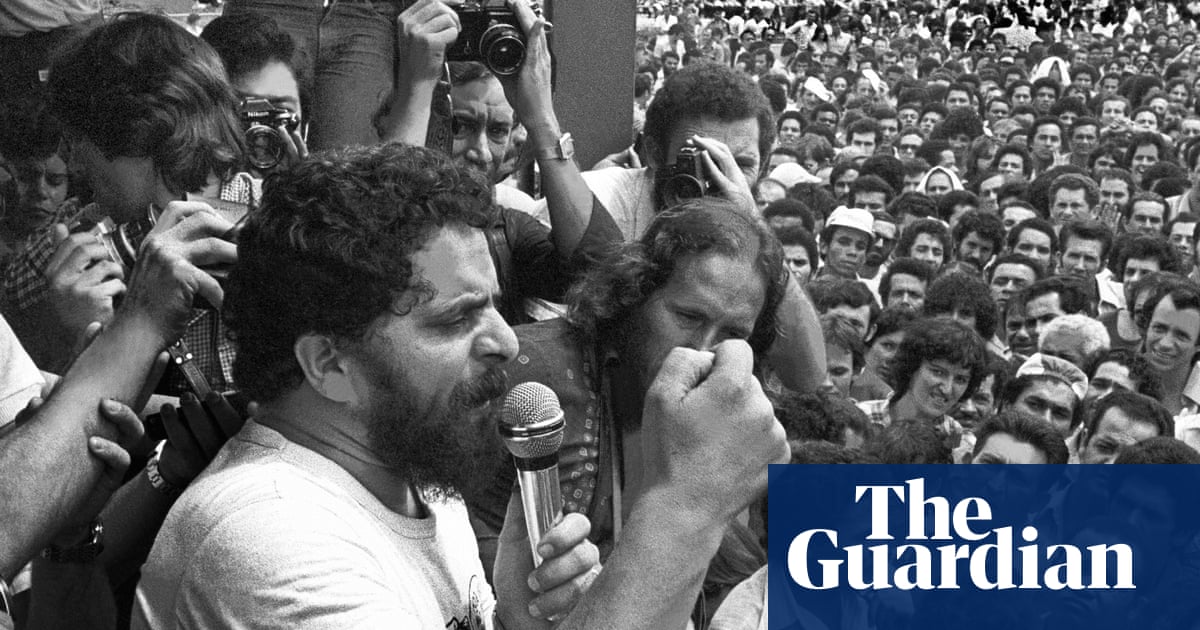
Day after day, tens of thousands of metalworkers would cram on to the football pitch in São Paulo’s industrial suburbs to demand higher wages and, perhaps unwittingly, transform the destiny of Brazil.
“You weren’t just documenting a fact – you were documenting history,” said photographer Jesus Carlos, who immortalised the now legendary strikes of 1979 and 1980 with his 24mm lens.
As Carlos snapped the sea of downtrodden but tenacious labourers, he remembers sensing the momentous nature of their challenge to Brazil’s military dictatorship, whose foot soldiers would surround the Vila Euclides stadium wielding truncheons and guns.
“I was a photographer – but before being a photographer I was a leftie,” recalled the former Communist party activist, now 75. “So I was fully aware what all it meant … [and] that the whole situation would be really important for the future.”
Carlos’s instincts were right. The strikes in the industrial city of São Bernardo do Campo – a bold act of defiance against a regime that ruled with an iron fist – were subsequently credited with helping to pave the way for Brazil’s 1985 return to democracy and spawning one of the most influential and enduring politicians in modern Latin American history.
For one of the key architects of those walkouts was Luiz Inácio Lula da Silva, a bushy-bearded, heavy-smoking 33-year-old union chief who became a household name in Brazil and a global icon as a result.
The New York Times hailed him as “the continent’s leading working-class hero” and “a Brazilian equivalent of Poland’s Lech Walesa”, the activist who became the European country’s first democratically elected president after the fall of communism.
In 1980, Lula helped found what became one of Latin America’s biggest leftwing political movements, the Workers’ party (PT), and in 2002, he was finally elected Brazil’s first working-class president after three unsuccessful attempts. The former lathe operator was re-elected in 2006 and won a historic third term in 2022, helping thwart an attempted coup led by his far-right opponent, the outgoing president Jair Bolsonaro.
João de Deus Martinez, a metalworker who came to know Lula during the São Bernardo strikes, said his leadership potential had been obvious to those who saw him charm the throng in Vila Euclides. “There was no one who could beat him up there on the podium … He had this magnetism. People cried [when he spoke] – tears of hope,” recalled the scraggly haired 85-year-old whom Lula calls “Cabeludo” (Shaggy).
Nearly 50 years after the São Bernardo strikes catapulted him to fame, Lula, now 80, is preparing to make an emotional return to Vila Euclides to launch the seventh – and final – presidential campaign of a storied life that began in rural poverty and took him to the highest job in the land.
On Sunday, thousands of PT supporters are expected to fill the football ground in the city where Lula’s astonishing rise began to watch him fire the starting gun on October’s election. “Vila Euclides is more than a stadium. It’s a symbol of democracy. A cradle of change,” reads the invitation urging party activists to travel to “where it all began” to make their voices heard.
Like 2022’s election, when Lula beat Bolsonaro by a whisker, this year’s contest is expected to be tight. Bolsonaro cannot run, after receiving a 27-year jail sentence for plotting to stop Lula taking power. His senator son, Flávio Bolsonaro, will stand in his place, with polls giving Lula a modest lead.
“I don’t think it’s going to be a walkaway,” said Lula’s American biographer, John D French, who has charted the leftist’s trajectory since first visiting the ABC Paulista – the industrial region of which São Bernardo is part – in 1980.
French called the factory strikes “a unique effervescence” of disgruntlement against worker exploitation and the “ignorant military men” who seized power in 1964 but suddenly found themselves on the back foot. “Nobody knew what was going to happen, which is what made it dramatic, because there were a number of moments when it could have turned into a massacre,” recalled the academic, whose next book focuses on the reporters and photojournalists who chronicled the workers’ rebellion in the heartlands of Brazil’s automotive industry.
Memories of that mobilisation, in which famous musicians, intellectuals, film-makers and politicians flocked to the region to champion the metalworkers and demand democracy, remain fresh to this day.
“There was an awakening,” said Fernando Ferreira, 67, another photographer who covered the Vila Euclides assemblies. “Brazil is only what it is today because of the ABC.”
Ademir Medici, a former newspaper editor who often interviewed Lula for the regional Diário do Grande ABC, said: “It was more exciting than a local derby between Corinthians and Palmeiras. It was thrilling. You thought: can this really be happening in my city? It gave you goose bumps.”
Back then, Medici said the buzz around Lula was such that locals would boast of ties to the union boss, however tenuous. “It was cool to go around saying: ‘I’m Lula’s friend! I know Lula! I used to play football with Lula!’”
Lula’s newfound fame even earned him a flattering profile in the Brazilian edition of Playboy, in which the interviewer asked the union leader if he would consider posing nude. (Lula declined.)
But the ABC has changed dramatically since those heady days of people power, amid factory closures, sociodemographic shifts, union splits, public anger at PT corruption scandals, and a lurch to the right driven by social media and the evangelical church.
Once known as the “red belt” – Brazil’s version of the Labour party’s “red wall” in the UK, or a smaller version of the US Democratic party’s “blue wall” – much of the region backed Bolsonaro when he won power in 2018. Today, only one of the seven cities in the ABC has a PT mayor. São Paulo state is governed by Tarcísio de Freitas, a close Bolsonaro ally who looks likely to be re-elected. “If Lula turned up on Marechal Deodoro [São Bernardo’s main street] he’d be booed,” Medici claimed.
Dalila Teles Veras, a PT-voting poet and cultural activist who also witnessed the strikes, lamented the rightward drift of an area so crucial to the history of Brazil’s left. “Today, the sons of those [1979] union leaders are grown men who subscribe to fascist ideas,” she said of their support for the Bolsonaros. “How do you switch sides just like that? I keep thinking about those old workers. What if they were still around? They’d die of heartbreak, no doubt.”
Veras, 80, had kept faith with Lula, calling him the “kind of leader [who] only comes along once every 100 years or more – if that”. She feared Brazil was facing its “most dangerous year” because of Donald Trump’s efforts to swing the election in favour of Flávio Bolsonaro, by slapping tariffs on Brazilian imports, revoking the visa of Brazil’s US ambassador and championing Lula’s rival as “a smart young man who loves his country”. But Veras was trying to remain upbeat, insisting: “We have to believe – otherwise we’d go mad.”
Martinez was also sticking with Lula, despite feeling frustrated that his octogenarian union comrade had failed to nurture an heir. “Lula has one flaw: he never bloody wants anyone to upstage him,” the former Volkswagen factory employee grumbled.
As he prepared to return to Vila Euclides’ yellow and black stands on Sunday to witness another historic day, Martinez vowed to vote for Lula, almost certainly for the last time. “I can’t betray my way of thinking,” he said. “He showed us the path.”