

Gulf Capital Fills Western Banking Void: Emirates NBD Absorbs HSBC Egypt Retail
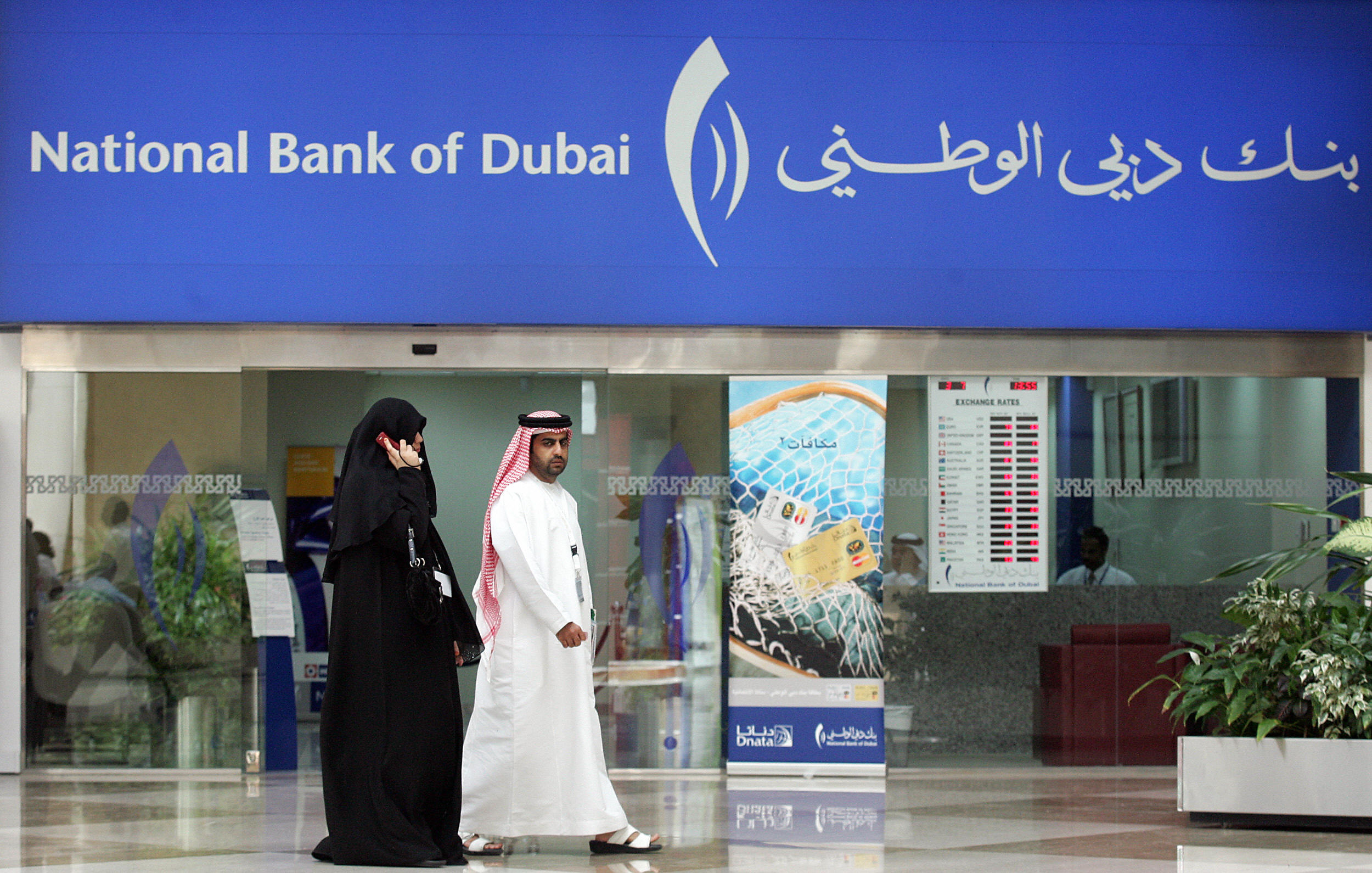
KARIM SAHIB/AFP via Getty Images
Emirates NBD, the Dubai government’s flagship banking institution and the largest bank in the UAE by assets, signed definitive agreements on August 2 to acquire the entire retail banking business of HSBC Bank Egypt — absorbing the British lender’s branches, ATMs, customer accounts, retail loans, deposits, and the employees who support them. The deal, which requires approval from the Central Bank of Egypt before closing — expected in the second half of 2027 — will generate an estimated pre-tax gain of approximately $300 million for HSBC’s London parent.
The transaction is not simply one bank buying another’s customer list. It is the latest — and among the most consequential — episodes in a documented shift: Western banks are systematically exiting retail banking in high-growth emerging markets, and Gulf sovereign-backed institutions are absorbing the franchises they leave behind. HSBC has now initiated or completed retail exits across multiple markets since 2021, including the United States, France, Bahrain, Bangladesh, Indonesia, and Sri Lanka. Emirates NBD, majority-owned by the Dubai government, completed a record $2.75 billion acquisition of India’s RBL Bank just weeks ago on June 18, 2026 — the largest foreign direct investment in the history of Indian banking. Two deals, two of the world’s most populous nations, one consistent strategic logic: the Gulf is financing the global south’s retail banking future.
HSBC’s Exit: Four Decades, Then a Fine, Then a Sale
HSBC established its Egypt presence in 1982, opening as the Hongkong Egyptian Bank — a joint venture that became the Egyptian British Bank in 1994, then HSBC Bank Egypt in 2001 after the group increased its stake to more than 90 percent. By the time chief executive Georges Elhedery announced the bank’s strategic review of its Egypt retail operations in October 2025, HSBC Egypt operated some 53 branches and roughly 3,800 employees — a substantial consumer banking franchise built over more than four decades.
Months earlier, in January 2026, the Central Bank of Egypt had levied a fine of EGP 1.143 billion (approximately $22.9 million) against HSBC Egypt. HSBC stated that it is “implementing corrective actions agreed upon with the CBE,” but did not publicly specify the nature of the violation. The timing — a major regulatory fine followed within months by a strategic review announcement — provides context the bank has not addressed publicly. HSBC’s stated rationale for the sale remains its group-wide simplification strategy: Elhedery is refocusing the institution on markets where it holds structural competitive advantages, primarily wholesale banking, wealth management, and Asia-facing services. HSBC Egypt CEO Todd Wilcox had told reporters in February 2026: “HSBC is very committed to Egypt as a strategic market in which we are squarely focused on the needs of our corporate and investment banking clients.”
True to that position, HSBC’s corporate and institutional banking operations in Egypt are not part of this deal — they remain under HSBC ownership and are described as a strategic anchor for the bank’s cross-border trade finance business connecting Egypt to China, Singapore, and the UK.
Emirates NBD’s Counterplay: Five Core Markets, Two Deals in Summer 2026
For Emirates NBD, the acquisition completes a summer of landmark transactions. The bank, which is 56 percent owned by the Dubai government through the Investment Corporation of Dubai and Dubai Holding Group, has articulated a clear five-market strategy: the UAE, Saudi Arabia, Egypt, Turkey, and India. Each market was selected for its demographic scale, economic trajectory, and strategic connectivity to the UAE.
Egypt was never in doubt as a priority. Emirates NBD entered the country in 2013 through the acquisition of BNP Paribas Egypt and has grown its Egyptian subsidiary into a network of 64 branches spanning Greater Cairo, the North Coast, the Delta, the Canal zone, Upper Egypt, and the Red Sea, employing more than 2,300 people. The subsidiary reported total assets of approximately $5 billion as of June 30, 2026.
HSBC Egypt’s retail book will expand that Egyptian franchise significantly, though neither institution has disclosed the retail portfolio’s specific loan book size, deposit base, or customer count.
“Our investment reflects our continued confidence in Egypt’s dynamic market and its long-term growth prospects,” said Hesham Abdulla Al Qassim, Emirates NBD’s Vice Chairman and Managing Director and Chairman of Emirates NBD Egypt. Group CEO Shayne Nelson described the deal as “an important milestone in the execution of our regional growth strategy.” Both quotes appeared in the official Emirates NBD announcement.
Emirates NBD was not the only bidder. Enterprise AM Egypt reported in February 2026 that at least four institutions were evaluating the HSBC Egypt retail book, including Egypt’s Commercial International Bank (CIB) and Qatar National Bank Al Ahli. Emirates NBD’s selection over domestic Egyptian banks signals that HSBC chose the deal that offered the largest scale and the strongest execution certainty — attributes that the Dubai-backed institution, with $360 billion in total group assets and a market capitalization of approximately $52 billion, could credibly offer.
Western Banks Cede the Field — and Gulf Banks Advance
To understand why this deal matters beyond its financial terms, set it alongside HSBC’s broader retreat. The bank that once aspired to be “the world’s local bank” has now initiated or completed retail exits in seven markets since 2021. Each exit has followed the same pattern: wholesale and wealth management stay, retail goes. The rationale is consistent — retail banking requires the density, local brand recognition, and regulatory embeddedness that a foreign bank can rarely achieve at competitive cost in a non-home market.
The beneficiaries of these exits, consistently, have been regional banks with sovereign backing and long-term mandates. BBK (Bank of Bahrain and Kuwait) absorbed HSBC’s 76,000 Bahrain retail customers when HSBC exited that market. Emirates NBD is now absorbing HSBC’s Egypt retail book. The pattern suggests a structural reconfiguration of who intermediates the daily financial life of hundreds of millions of people across Africa and the Middle East: increasingly, that role belongs to Gulf state-backed institutions operating under long-term sovereign mandates rather than quarterly-return pressures.
Emirates NBD’s financial performance reflects this structural advantage. The group reported first-half 2026 net profit of $3.5 billion (AED 12.9 billion) — a 3 percent year-on-year increase — while simultaneously absorbing RBL Bank’s $20.1 billion (AED 74 billion) in additional assets through the Indian acquisition. Shares of Emirates NBD, which trade on the Dubai Financial Market under the ticker ENBD, have risen more than 8 percent since the start of 2026.
The UAE-Egypt Corridor: Why This Deal Has Staying Power
The strategic logic for Emirates NBD’s Egypt focus is rooted in one of the most active financial corridors in the Arab world. Egypt-UAE bilateral trade reached $9.7 billion in 2025, a 61.7 percent year-on-year increase. Remittances from Egyptians working in the UAE reached approximately $3.6 billion in fiscal year 2024/25, according to Egypt’s government. Total remittances from Egyptians working abroad globally hit a record $41.5 billion in 2025 — a 40.5 percent year-on-year increase — with the largest share originating from Gulf Cooperation Council countries. As of July 2026, Egyptian workers abroad had sent $43 billion home in the first 11 months of the 2025/26 fiscal year — the highest level in the country’s history.
An expanded Emirates NBD Egypt — one that combines its existing 64-branch network with HSBC Egypt’s retail infrastructure and potentially captures a larger share of UAE-to-Egypt remittance flows through formal banking channels — is well-positioned to serve both ends of that corridor. Amr ElShafei, CEO and Managing Director of Emirates NBD Egypt, framed the digital dimension explicitly: the bank intends to offer incoming HSBC customers “seamless financial solutions, comprehensive digital banking services and a customer focused banking experience backed by the strength of the wider Emirates NBD Group.” The quote appeared in the official Emirates NBD press release.
What HSBC Egypt Customers Can Expect
For anyone currently banking with HSBC Egypt’s retail division, the immediate answer is: nothing changes yet. HSBC confirmed that no immediate changes are planned to products or services, and that customers’ accounts will continue to operate normally until the migration is complete.
The transaction is not expected to close until the second half of 2027, contingent on Central Bank of Egypt regulatory approval. That 12-to-18-month runway reflects, in part, the complexity of migrating a retail banking portfolio between two institutions’ core banking systems — a process that requires reconciling loan books, deposit accounts, ATM networks, and employee records. Emirates NBD unified its international core banking systems across all global operations by end-2020, consolidating all subsidiaries onto a single platform — a foundation that should facilitate, but not trivialize, the Egypt integration.
Industry precedent from comparable transactions — including HSBC’s Bahrain retail exit, in which approximately 76,000 customers transferred to Bank of Bahrain and Kuwait — suggests that customers should expect advance notice of product changes, account number migrations, and potentially some branch consolidation as overlapping network footprints are rationalized.
India, Egypt, and the Next Bid
The Egypt deal arrived weeks after Emirates NBD closed its India chapter. The $2.75 billion acquisition of a 60 percent controlling stake in Mumbai-based RBL Bank — completed June 18, 2026 — was the largest foreign direct investment in Indian banking history and the first time a foreign bank has taken a majority stake in a profitable Indian private lender. RBL Bank serves more than 15 million customers through 603 branches and 1,339 business correspondent branches across 28 Indian states and union territories.
Both deals — India and Egypt — reflect the same thesis: find high-growth emerging markets with deep connectivity to the UAE economy, acquire an established local franchise rather than building from scratch, and leverage the Emirates NBD network to serve the two-way flow of capital, commerce, and remittances. AGBI reported in late July 2026 that Emirates NBD had also submitted revised bids for a majority stake in India’s IDBI Bank, suggesting the acquisition appetite is not yet satisfied.
As of June 30, 2026, Emirates NBD operated 1,425 branches and 4,948 ATMs and smart deposit machines across 13 countries, serving over 25 million customers, and held total group assets of approximately $360 billion.
Frequently Asked Questions
What happens to my account if I am an HSBC Egypt retail customer?
Nothing changes immediately. Both banks have confirmed that HSBC Egypt’s retail products and services will continue to operate normally until the transaction completes — which is not expected before the second half of 2027, pending Central Bank of Egypt approval. Customers will receive advance notice before any account migration, product changes, or branch adjustments take effect, according to the HSBC official announcement.
Why is HSBC selling its Egypt retail banking business?
HSBC under CEO Georges Elhedery has been systematically exiting retail banking in markets where it lacks the scale to compete economically. Egypt is the latest in a sequence that includes retail exits from the United States, France, Bahrain, Bangladesh, Indonesia, and Sri Lanka. In each case, HSBC retains its wholesale and corporate banking operations — which it views as its structural competitive advantage — while divesting the consumer-facing business to a buyer with stronger local scale. The deal generates an estimated $300 million pre-tax gain for HSBC, to be recognized largely at completion, per the HSBC strategic review announced last year.
Is this deal part of a broader pattern of Western banks leaving the Middle East and Africa?
Yes. The transaction is one data point in a documented structural shift: European and American banks have been withdrawing from retail consumer banking in emerging markets, while Gulf Cooperation Council sovereign-backed institutions have been absorbing those franchises. Emirates NBD’s simultaneous acquisition of India’s RBL Bank — the largest-ever foreign direct investment in Indian banking — and the Egypt deal together demonstrate how Gulf state capital is financing a claim to the retail banking relationships of two of the world’s most populous nations. The UAE-Egypt financial corridor alone saw $9.7 billion in bilateral trade and approximately $3.6 billion in remittances from UAE-based Egyptians in fiscal year 2024/25.
What regulatory approval is still needed, and how long will it take?
The deal requires approval from the Central Bank of Egypt. Given Egypt’s deepening economic ties with the UAE — bilateral trade grew 61.7 percent in 2025 — and the broader context of Gulf sovereign investment in Egyptian infrastructure, regulatory approval is widely expected, though the timeline is not guaranteed. Both parties have targeted the second half of 2027 as the completion window, which also reflects the technical complexity of migrating a full retail portfolio between institutions.
Credit: Source link