

Gov’t’s Carbon Market Bet | News
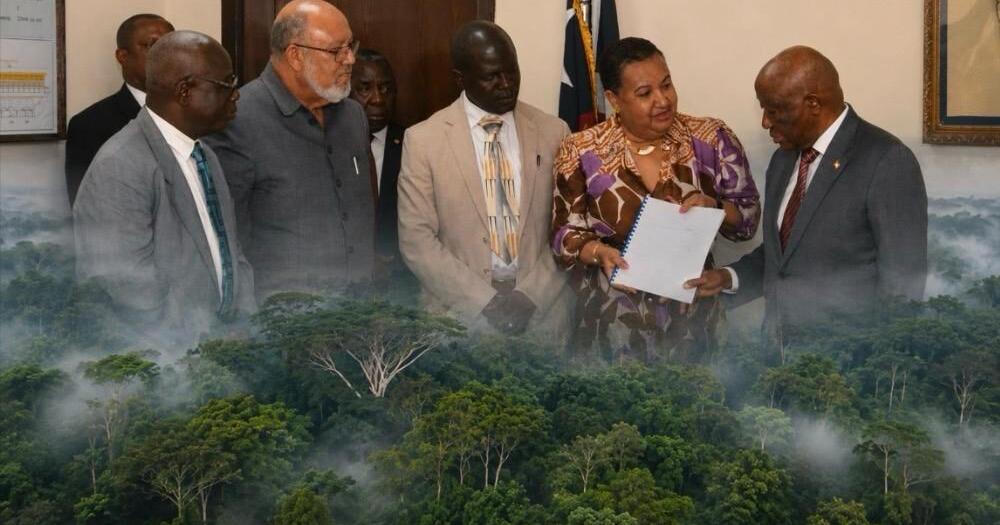
The government has moved closer to turning one of its greatest natural assets—its forests and other carbon-rich ecosystems—into a potential source of international climate finance.
But as President Joseph Nyuma Boakai received the national consolidated and validated National Carbon Market Policy on Tuesday, September 1, the question confronting the government is no longer simply whether the country should participate in the global carbon economy.
It is whether Liberia can build a carbon market that generates national wealth, protects forests and attracts investment without repeating the land, resource-governance and community-rights controversies that have already surrounded carbon trading in the country.
The policy, presented at the Executive Mansion by Carbon Markets Authority CEO Jeanine Cooper, Forestry Development Authority Managing Director Rudolph Merab and Environmental Protection Agency Executive Director Dr. Emmanuel K. Urey Yarkpawolo, represents a major attempt to put rules around an emerging and potentially lucrative market.
A carbon credit generally represents a verified reduction or removal of one metric ton of carbon dioxide equivalent. Countries, companies and other institutions can purchase such credits to meet climate commitments.
For Liberia, the attraction is obvious.
The country has approximately 6.6 million hectares of forest, covering about 69 percent of its landmass, according to UNDP, while its forests are managed and depended upon by Indigenous peoples, local communities and smallholder forest communities.
The World Bank has likewise identified significant potential for carbon markets and climate-finance benefit sharing as part of Liberia’s development strategy.
Yet the country’s recent experience shows that carbon is not merely an environmental commodity. It is also about land, ownership, money, power and the future of communities that depend on forests for survival.
The government’s carbon-market ambitions did not begin with the Boakai administration.
For years, the country has participated in international efforts to reduce emissions from deforestation and forest degradation under REDD+. The World Bank has previously identified gaps in Liberia’s framework, including uncertainty over carbon rights, benefit-sharing and the rules governing international sales of emission reductions.
At the 2021 UN Climate Change Conference in Glasgow, then-President George Manneh Weah highlighted the forests as a climate asset and called for an African carbon-credit trading mechanism. The World Bank subsequently hosted a Forest and Climate Resilience Forum in Liberia in 2023, where carbon markets, forestry, land tenure, benefit sharing and climate finance were among the central issues.
Liberia subsequently intensified its preparations.
In September 2024, the Government signed a Letter of Engagement with the Coalition for Rainforest Nations, aimed at strengthening Liberia’s participation in the global carbon market.
In August 2025, the Government convened a National Carbon Dialogue in Ganta, Nimba County, bringing stakeholders together to discuss carbon ownership, benefit sharing, institutional arrangements, market mechanisms, grievance redress and financial management.
Then, in October 2025, President Boakai issued Executive Order No. 155, establishing the Carbon Markets Authority and providing for a National Carbon Registry and Liberia Carbon Investment Fund.
The latest policy therefore represents the culmination of several years of efforts to move Liberia from being a country with enormous forest-carbon potential to one with an institutional framework capable of participating in the market.
The Blue Carbon controversy remains the warning sign
The nation’s carbon-market history also contains a major cautionary episode.
In 2023, the previous government entered into a controversial arrangement with Dubai-based Blue Carbon, involving approximately 2.5 million acres of Liberian forest.
Environmental and community-rights organizations criticized the arrangement over transparency, land rights and the reported absence of adequate consultation with affected communities. Forest Trends described the agreement as involving exclusive rights to generate and sell carbon credits over approximately 2.5 million acres and noted concerns over its legal basis and community implications.
The controversy became international news.
An Associated Press report described the proposed arrangement as covering about 10 percent of Liberia’s territory, while critics argued that communities dependent on the forests had not been adequately consulted. The controversy ultimately contributed to the deal being halted under the previous administration.
The episode exposed perhaps the most sensitive issue in Liberia’s carbon economy—who owns the carbon?
Is it the State because forests constitute a national environmental asset?
Is it the customary community that has occupied and managed the land for generations?
Is it the private landowner?
Or does ownership of land automatically confer ownership of the carbon stored in its forests?
The new policy attempts to answer that question by generally linking carbon ownership to legal ownership of the land, forest or resource generating the credit.
That is a significant improvement over an environment in which carbon rights were insufficiently defined. The World Bank previously identified the absence of clear legal definitions of carbon rights as a major gap in Liberia’s REDD+ framework.
But defining a right on paper and ensuring that vulnerable people can actually exercise that right are two different things.
One of the policy’s most important safeguards is its requirement for Free, Prior and Informed Consent (FPIC) from communities affected by carbon projects.
That principle could become the most important protection against a repeat of the Blue Carbon controversy.
The policy also recognizes customary and private landowners and requires environmental and social impact assessments for projects affecting community land and resources.
These provisions are particularly important because forests are not empty spaces waiting to be monetized.
For many rural Liberians, forests provide food, medicine, building materials, water and farmland. UNDP has emphasized that forest-dependent people must be treated as rights holders and central actors in climate solutions.
The policy’s proposed benefit-sharing mechanism is therefore potentially significant.
For government-owned carbon resources, after applicable taxes and verified project costs, 40 percent of proceeds would support national social, educational and health programs; 20 percent would go to relevant government institutions; 30 percent to the project developer; and 10 percent directly to affected communities.
For community- or privately owned resources, the proposed allocation is 50 percent to the community or private owner, 30 percent to the developer and 20 percent to government institutions.
On paper, this creates a pathway through which carbon finance could support schools, clinics, water systems, livelihoods and environmental protection.
But the percentages have already raised an important policy question—is a share of revenue sufficient if communities are effectively giving up control over a resource they own?
Civil society actors have questioned precisely this point. In reporting on the draft policy, Mongabay quoted NGO Coalition representative Dayugar Johnson asking why a community that owns the underlying resource should receive only 50 percent.
That debate cannot be dismissed as opposition to climate action.
It goes to the fundamental question of property rights and bargaining power.
Carbon markets could generate money from forests that have historically generated relatively little direct financial benefit for the people protecting them.
But there is a danger that sophisticated developers, consultants, brokers and international buyers could capture disproportionate portions of the value.
ActionAid Liberia has warned about precisely this risk, pointing to experiences elsewhere in Africa where communities have allegedly been marginalized, inadequately consulted or deprived of a fair share of carbon revenues.
The organization has specifically warned against the emergence of “middlemen” who could absorb benefits that should reach communities.
For vulnerable communities, the danger is not only that they could receive too little money.
They could also lose access to land.
A carbon project designed to prevent deforestation may restrict farming, hunting, gathering, charcoal production or other traditional activities. If a family loses access to forest resources without receiving a realistic alternative livelihood, carbon conservation could unintentionally deepen poverty.
The policy’s FPIC requirement therefore needs to mean more than obtaining signatures from community representatives.
Consent must be informed, voluntary, documented and understandable, with women, youth, traditional authorities and marginalized groups genuinely participating.
There must also be effective grievance mechanisms and accessible legal remedies when agreements are violated.
Despite these risks, rejecting carbon markets altogether could also cost Liberia a major development opportunity.
The policy deliberately expands carbon-market opportunities beyond forests.
Potential projects include reforestation, mangrove restoration, renewable energy, clean cooking, climate-smart agriculture, recycling, composting, landfill-gas capture, low-emission transportation, coastal and marine conservation and urban development.
The country’s carbon economy should not become synonymous with simply selling forest credits to foreign companies.
A properly regulated market could finance solar and hydropower projects, reduce dependence on inefficient cooking fuels, improve agricultural productivity, strengthen waste management and create employment.
It could also create an economic incentive for communities to protect forests rather than depend on activities that degrade them.
The World Bank has warned that climate change could shrink Liberia’s economy by 15 percent and push 1.3 million additional people into poverty by 2050 without adequate action. It has also identified carbon markets and climate-finance benefit sharing as potentially important sources of financing for resilience.
That makes climate finance more than an environmental issue. It is a development issue.
But Liberia must avoid selling its future too cheaply
The greatest danger is that the urgency to attract international climate finance could cause Liberia to prioritize speed over safeguards.
This concern has already surfaced during the policy process.
In 2025, civil society organizations and communities criticized the draft policy over questions surrounding inclusion, transparency, accountability and carbon ownership.
In 2026, the NGO Coalition again urged President Boakai not to finalize the policy without a sufficiently broad validation process. Mongabay reported concerns that civil society organizations felt excluded from aspects of the final review.
The Government, for its part, has argued that the policy is intended precisely to prevent future exploitation and establish a transparent framework for carbon transactions.
This disagreement is important because public confidence will determine whether the carbon market succeeds.
A carbon market whose transactions are technically legal but perceived by communities as secretive or unfair will face resistance.
A market that cannot demonstrate real emissions reductions could also damage Liberia’s international credibility.
The presentation of the policy to President Boakai is therefore a milestone—but it is not the end of the debate.
The difficult work begins with implementation. Liberia will need a Carbon Markets Authority that is genuinely independent, technically capable and transparent.
The National Carbon Registry must become a credible public record of who owns credits, where they originate, how much has been issued, who purchased them and how revenues are distributed.
The Measurement, Reporting and Verification system must be strong enough to prevent inflated or fraudulent carbon claims.
And perhaps most importantly, communities must have the capacity to negotiate.
A farmer in rural Liberia cannot meaningfully exercise FPIC if he or she does not understand the value of the carbon being sold, the duration of the agreement, restrictions on land use, the consequences of signing and the alternatives available.
That means the country will need legal aid, community education, independent monitoring and transparent financial reporting alongside the policy.
The Government should also consider publishing carbon contracts and project agreements, subject only to narrowly defined legitimate confidentiality protections. Every community should know what is being sold, for how long, by whom and for how much.
Liberia has experienced the consequences of poorly governed natural-resource deals before.
The carbon market presents a different proposition because the resource being monetized is not iron ore, timber or gold. It is the climate value of forests, wetlands, mangroves, soils and other ecosystems.
But the underlying governance questions are remarkably similar—Who owns the resource? Who makes the decision? Who receives the money? Who bears the costs? And who is accountable when something goes wrong?
The new National Carbon Market Policy provides some important answers through ownership rules, FPIC, benefit sharing, environmental assessments, a national registry and a dedicated carbon investment fund.
Its success, however, will ultimately depend on whether those safeguards work in the village as effectively as they work on paper in Monrovia.
Credit: Source link