

France vs. Morocco match is a transnational World Cup affair
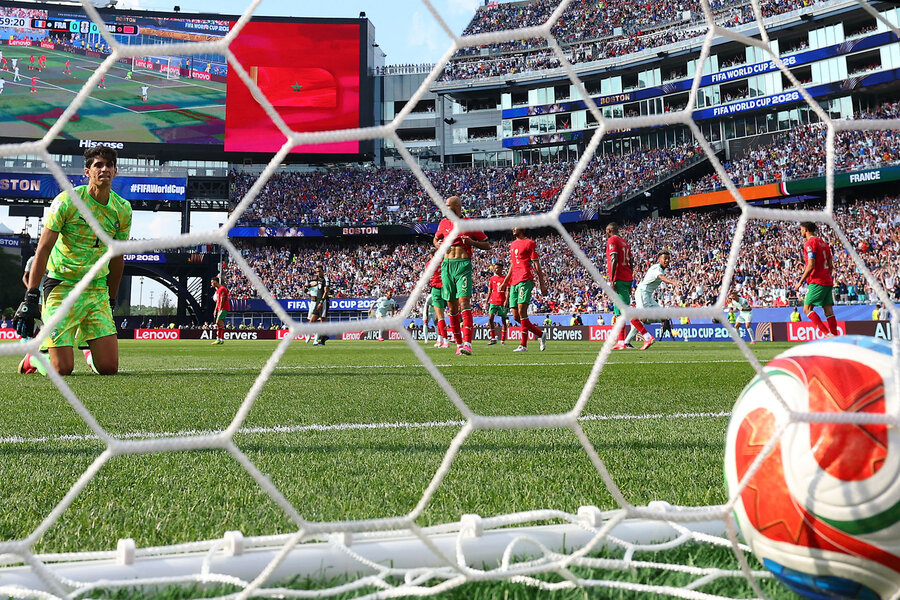
Today was a great day if you are a fan of the French, who beat Morocco 2-0 to advance to the World Cup semifinals. Unless, of course, you were a fan of one of the six French-born players playing for Morocco.
Or perhaps it was a great day for Cameroon, which game-winning goal scorer Kylian Mbappé could represent through his father, if he wished. Or Algeria, which he could represent through his mother.
It was also time to celebrate in Senegal, which saw Ousmane Dembélé score for the fourth time, and which can claim Mr. Dembélé through his mother. Or Mali, which can claim him through his father.
Why We Wrote This
The World Cup may in theory be a contest between nations, but if you look at the actual players involved, most countries’ rosters are actually quite transnational. The French and Moroccan sides, which faced off on Thursday, are cases in point.
OK. Maybe we just say it was a good day for the whole world, because this World Cup has more “world” in it than perhaps any other in history. It’s not just the increase to 48 teams from 32, though that’s a part of it. It’s the fact that players are thinking more flexibly about their nationality than ever before – and nations are eagerly waiting for those willing to play for the flag for their parents’ or grandparents’ nations than the places they were born.
In all, only six of the players for Morocco at this World Cup were actually born in Morocco. In addition to the six from France, another six hail from Spain.
This can have the scent of opportunism, with players not quite able to make the cut for their home nation accepting an invitation from a country for which they will be plenty good enough – even stars. Midfielder Ayyoub Bouaddi, arguably Morocco’s best player this tournament, was playing games for France’s under-21 national team as recently as this year. But in France’s five-star midfield, there was never going to be a place even for an 18-year-old as talented as Mr. Bouaddi. Both his parents are Moroccan.
But there is no doubt that switching allegiances can be far more than mercenary. Esmir Bajraktarević was born in Wisconsin and represented the United States through the youth levels of international soccer. But at this World Cup, he represented Bosnia-Herzegovina. Four of Mr. Bajraktarević’s uncles and a grandfather were killed in the Srebrenica massacre, which was later designated a genocide by the International Court of Justice.

“Srebrenica is something I will never forget,” Mr. Bajraktarević told a fan magazine of the New England Revolution, the Major League Soccer team he played for professionally from 2021 to 2024. “It’s a part of me and who I am. I carry it in my blood.”
Perhaps most important for the fans, the trend has made this World Cup immeasurably better. At the start of this World Cup, there was concern that many of the new teams – some of which had never played a World Cup match – would be used as dust rags for the world powers. What would happen, for instance, to Cape Verde or Curaçao – two of the smallest nations ever to qualify for the tournament?
Their answer was emphatic: They would go toe to toe with anyone they faced. Cape Verde went so far as to qualify for the knockout rounds by finishing second in their group ahead of Uruguay, which has twice won the World Cup.
How did they do it? By recruiting extensively in Portugal, finding players with Cape Verdean heritage. One Irish player with Cape Verdean heritage initially thought the LinkedIn query about potentially representing Cape Verde was spam – until it was later resent in English.
For Curaçao, 25 of their 26 players were born in the Netherlands.

The trend has also given games with old tensions new flavors. In the past, a match like Thursday’s game between France and Morocco would have echoed with colonial undertones. While France’s connection to Morocco was not nearly as fraught as its time in Algeria, where it fully colonized the country and dismantled local institutions, the period from 1912 to 1956 saw France control Morocco as a protectorate.
Thursday’s game saw Moroccans gather in Paris in Moroccan and French jerseys, either conflicted about whom to root for or happy either way. One woman interviewed on a German news feed held her hands out to the multicultural crowd around her at a Parisian watch party and said, “This is the new France!”
One needed only look at the French team to see that was true. The lines of “France vs. Morocco” blur when a quarter of the Moroccan team is French and a significant portion of the French team claims African heritage.
Even Erling Braut Haaland, who has essentially embraced the role of modern-day Viking as the face of Norway for this World Cup, could have represented England, had he wished to. His father, Alf-Inge, played for English club Leeds when Mr. Haaland was born, meaning Mr. Haaland is secretly a nice Yorkshire lad who likes cricket and a good pudding.
There is no word yet on whether England can get him to switch sides before the semifinal match between the two teams Saturday.
Credit: Source link