

Foreign policy expert and strategist speaks on Gaza, Cuba, Yemen, China and more
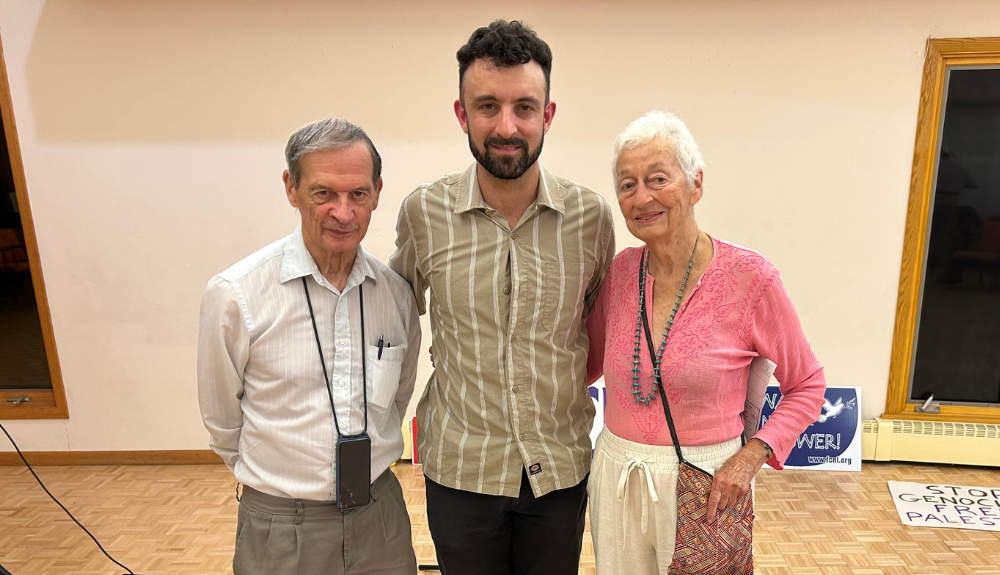
Members of Peace Action Wisconsin frequently organize demonstrations against harmful consequences of U.S. foreign policy.
Israel’s genocide in Gaza
“Just five years ago, I don’t think any of us envisioned how much opposition there would be to the U.S.-Israel relationship. That’s been a really exciting development, of course, coming from the horrific genocide in Gaza,” Sperling said.
“It was clear from the first moments what Israel was going to do. In just a couple days, they surpassed the death toll from Oct. 7. The question the U.S. faced was how quickly to call for a ceasefire. A huge group of us, about 100 organizations, called for a ceasefire right away. There was another set of groups saying, ‘We need to give Israel some time to react. This is their 9/11.’
“About a dozen members of Congress called for a ceasefire within that first week. Momentum grew from there and we built a movement, putting a lot of pressure on the Biden administration. We weren’t able to stop the genocide but we are putting a lot of pressure on them. There’s still a lot more work to do,” Sperling said.
Jim Carpenter, co-moderator of Peace Action Wisconsin, interjected, “Let’s talk about what is happening in Gaza right now. Basically, it’s a parking lot, turned into rubble. People say by the time we get something positive accomplished there, there will be no more Gaza left to save.
“There has been a movement to say to the United Nations, ‘Do your job. Stop this genocide. If you can’t stop a genocide, you’re going to be an irrelevant organization.’ There’s been some movement to use a uniting for peace mechanism to get the U.N. General Assembly to act if the Security Council doesn’t act. Do you know anything about this movement? Is there any talking inside the beltway about this? Is there any hope for the United Nations taking a more positive role in stopping this genocide?”
(Carpenter announced there will be a “Stand for Peace; Respect International Law” event Saturday, Sept. 19, from noon – 1 p.m. at the intersection of Martin Luther King, Jr. Drive and North Avenue, to support respect for international law.)
“Yes, the U.N. has this challenging structure with the veto of the permanent members,” Sperling responded. “This is a huge challenge. If you can get two thirds of the General Assembly, it can take a position, but it is still an advisory type thing.
“What we see is that our role here is to impact U.S. policy. In the case of Gaza and Israel, our view is that the U.S. is essentially enabling Israel’s entire ability to do anything there. We’re not just arming it. We’re also providing intelligence and diplomatic support,” he said.
“For those of us who are in the pro-Palestine movement, our goal is Palestinian dignity, sovereignty and freedom. I think there is going to be a debate in the coming years about what kind of a two-state formulation is acceptable. And I think there’ll be an effort to impose a two-state on the Palestinians.
“How do we engage in a way that really preserves Palestinian sovereignty at a time when there’s going to be a lot of pressure from people to say, ‘Just be happy they have a state it all?’”
Elections
“One important factor is elections. There are exciting electoral developments. We’re seeing AIPAC candidates losing at unprecedented rates. It’s an opportunity for us. “We’re looking to build pressure so that if the Democrats retake the house, they have to actually go follow through on binding legislation to limit U.S. weapons to Israel. Sen. Chris Van Holland (D-Maryland) announced he is going to force a vote in the Senate on human rights violations in the West Bank.
“Our focus has been to force voting in both chambers, getting our issues on the floor. Many (in Congress) would prefer for the executive branch to make the decisions and then they can critique it from the sidelines, but don’t have to have accountability. Establishment forces hate votes for a couple of reasons: the American public is more progressive than the body itself and, second, it raises issues the progressives and anti-war candidates can primary them on. When the Democrats get into power we want to hold them accountable so they can force the Trump administration’s hand. We want them to put in binding restrictions.”