

Fisheries Modernization, Investment Top Agenda | News
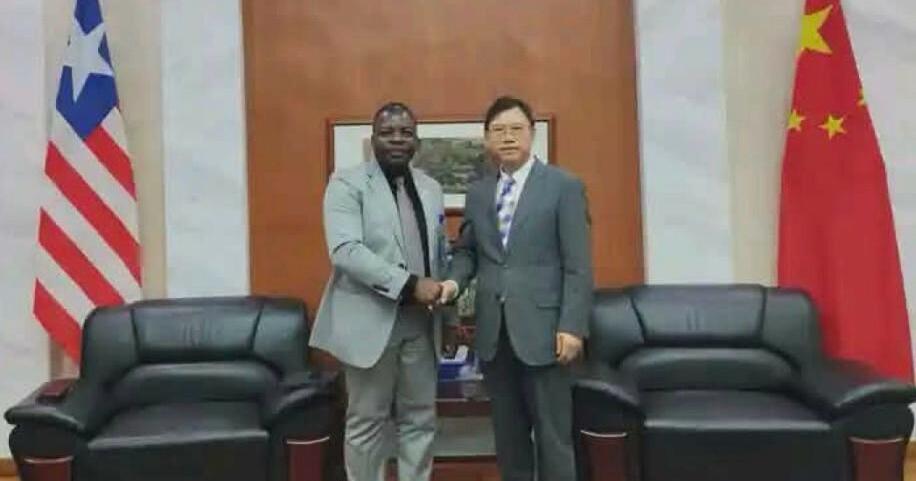
Liberia and China have reaffirmed their commitment to deepening cooperation in the fisheries and maritime sector, with a strong focus on modernization, investment, and technical development aimed at unlocking the country’s blue economy potential.
The discussions took place on June 10, when the Chinese Ambassador to Liberia, Yin Chengwu, met with the Director General of the National Fisheries and Aquaculture Authority (NaFAA), J. Cyrus Saygbe Sr., to explore practical areas of collaboration between the two countries.
The meeting, according to officials, builds on growing China–Liberia maritime relations and is expected to strengthen technical cooperation, investment flows, and trade in a sector widely seen as critical to Liberia’s food security, job creation, and long-term economic growth.
Ambassador Yin emphasized the broader foundation of bilateral maritime relations, noting in a related engagement that “both China and Liberia are important shipping countries in the world.” He added that there are “broad” prospects for expanded economic and trade cooperation between the two nations, particularly in maritime development and related industries.
Although no formal agreement was announced at the June 10 meeting, both sides described the engagement as laying the groundwork for “practical cooperation” in fisheries modernization and blue economy development.
Liberia’s fisheries sector remains heavily underdeveloped despite the country’s nearly 600-kilometer coastline. Weak enforcement capacity, limited patrol assets, and illegal fishing activities have long undermined domestic fish production and revenue generation. Most surveillance vessels operating in Liberian waters have been donated by development partners, leaving enforcement gaps that officials say continue to challenge effective regulation.
Against this backdrop, NaFAA has been implementing a series of reforms under its current leadership aimed at modernizing operations and strengthening sector governance. Since assuming office, Director General Saygbe—who was appointed acting head in March 2025 and later confirmed after 11 months in an interim capacity—has aligned institutional reforms with the government’s ARREST Development Strategy.
He outlined the sector’s challenges and opportunities while emphasizing the importance of fair global trade rules in supporting Liberia’s fishing industry.
“The Agreement levels the playing field by curbing subsidies that previously allowed foreign fleets to fish far from home at an unfair advantage,” Saygbe said, referring to global fisheries trade reforms. “With stricter global rules, Liberian fishers have a greater chance to access their own waters without being undercut by subsidized competition.”
He further stressed that global regulatory changes alone are not enough without stronger domestic enforcement, adding that the new World Trade Organization fisheries rules give Liberia a “stronger hand” in managing its marine resources.
In recent years, NaFAA has introduced several institutional reforms aimed at strengthening oversight and improving data-driven fisheries management. These include the modernization of a Quartermaster System for monitoring and surveillance, the revival of the Fisheries Information Management System, the establishment of a Department of Environment and Climate Change, and the rollout of a National Aquaculture Database.
To attract investment and accelerate sector growth, Liberia also convened its first Fisheries Investment Conference, branded “Kpongama 2026,” with support from the World Bank. The initiative is part of a broader push to transition the fisheries sector from subsistence-based activity to a commercially viable and sustainable industry.
The World Bank has supported catalytic investments in the sector, including the Klay hatchery, the introduction of Liberia’s first semi-industrial fishing vessel, “Sea King,” and an incubator program designed to promote fiberglass canoe production for local fishers.
World Bank Country Manager for Liberia, Georgia Wallen, described the reforms as a turning point for the sector, saying, “These efforts send a clear signal that Liberia is ready to build a well-governed, commercially viable, and environmentally sustainable fisheries economy.”
She added that the fisheries sector holds strong potential “to create jobs — particularly for women and young people — but also to contribute meaningfully to national economic growth while safeguarding marine resources.”
The Bank is also supporting NaFAA’s broader digitization agenda, including the development of a one-stop service center for fishers and improved monitoring systems designed to enhance efficiency and transparency in fisheries governance.
Looking ahead, NaFAA is preparing a 10-Year Strategic Plan covering 2026–2036, alongside a National Aquaculture Strategy aimed at shifting Liberia toward large-scale commercial aquaculture production. Three major investment-ready projects have already been identified: a Liberian Industrial Fishing Harbour, an Industrial Fishing Fleet, and Integrated Aquaculture and Inland Off-Taker Farms.
Saygbe has repeatedly emphasized that aquaculture could become a major driver of rural transformation. “Aquaculture has the potential to transform rural communities,” he said during his Senate confirmation hearings, adding that NaFAA will prioritize training, access to fingerlings, and technical support for fish farmers.
He also noted Liberia’s readiness to tap into emerging global financing opportunities. “Liberia welcomes the establishment of the WTO Fisheries Fund and is preparing proposals to access these resources,” he said. “We will prioritize investments in fisherfolk training, modern landing sites, aquaculture development, and enforcement capacity.”
China has already played an active role in Liberia’s maritime and development space, including recent support such as the donation of 3,600 metric tons of rice delivered at the Freeport of Monrovia, which officials have described as a symbol of enduring bilateral friendship.
As Liberia seeks to reposition its fisheries sector as a key pillar of the blue economy, both countries are now exploring expanded cooperation in aquaculture technology, vessel construction, fisheries research, and efforts to combat illegal, unreported, and unregulated fishing.
Saygbe captured the broader ambition of the sector’s transformation ahead of the upcoming Kpongama 2026 investment framework, stating: “The tide is rising, the opportunities are here, and Liberia is ready for business.”
Credit: Source link