

Faith leaders go door to door in Congo preaching peace amid renewed war

GOMA, Congo (RNS) — As gunfire and explosions echo across eastern Congo’s hills amid the ongoing violent conflict, another sound moves more quietly through the neighborhoods of Goma and surrounding displacement camps: the knock of faith leaders moving from door to door.
Goma, the eastern Congolese city near the Rwandan border, has long stood at the center of the region’s recurring conflict and displacement crises. Once again, the city has become a refuge for families fleeing fresh violence in North and South Kivu.
Each morning, pastors, priests, Catholic sisters and imams travel through conflict-hit streets, displacement camps and broken communities with Bibles, rosaries and words of peace. They pray with families who have lost loved ones, counsel young men tempted by revenge and try to preserve fragile ties between communities strained by war.
“The battlefield is outside,” Francis Mbombo, an evangelical preacher, told RNS, “but the next war can begin inside a home.”
The renewed violence in North and South Kivu, driven by advances by the M23 rebel group, drone strikes and retaliatory shelling, has deepened what humanitarian agencies describe as one of the world’s gravest displacement crises. More than 7 million people are internally displaced across the country of nearly 113 million.
For religious leaders on the ground, the struggle is no longer only over territory or political control. Increasingly, they said, it is also about preventing war from taking root inside families scarred by years of violence.
People who were displaced by the fighting between M23 rebels and government soldiers leave their camp after an instruction by M23 rebels in Goma, Congo, Feb. 11, 2025. (AP Photo/Moses Sawasawa)
Mbombo spends most of his days walking through some of Goma’s most volatile neighborhoods. At one home, he sat with a widow whose husband was killed in crossfire. At another, he spoke with young men angry enough to consider joining armed groups.
“If we do not come to them now, grief quickly becomes anger, and anger becomes violence,” Mbombo said. “We are trying to stop the war from entering people’s hearts.”
For Mbombo, peace building happens in kitchens where families talk about the previous night’s gunfire, in crowded shelters where displaced mothers fear their sons may be recruited by militias and in living rooms where suspicion is beginning to grow between host families and displaced communities.
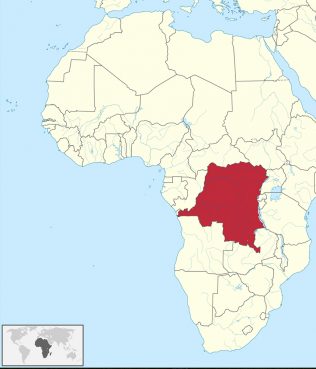
Congo, in central Africa. (Map courtesy of Wikimedia/Creative Commons)
Pastor Albert Nswadi of Goma International Pentecostal Church said much of his ministry now involves home visits, prayer circles in camps and mediation of disputes between frightened families.
“People are exhausted, traumatized and hungry,” Nswadi said. “In such moments, even small misunderstandings can become dangerous.”
Across eastern Congo, repeated displacement has frayed already fragile community ties, heightening tensions between host communities and the newly displaced. Faith leaders said they are increasingly called to mediate not just grief, but suspicion.
For evangelist Kevin Lupangu, who is also a psychologist, his work is part ministry and part emergency mental health response.
“Children wake up screaming at night because they think every loud sound is another drone strike,” Lupangu said. “Many adults no longer sleep deeply.”
Many of his visits begin with Scripture and prayer but often evolve into trauma counseling sessions. He said he recently met a teenage boy whose father had been killed in shelling west of Goma and who had begun talking about joining an armed group.
“That is the moment where faith matters most — before grief hardens into hatred,” Lupangu said.
Many families in camps around Goma have been displaced more than once, some fleeing for the second or third time in less than two years.
Catholic leaders in Congo have also sharpened their response to the worsening crisis, urging citizens to reject what bishops recently described as “the stones that keep the (Democratic Republic of Congo) in the shadow of death,” including war, political interests and economic greed that continue to fuel violence in the east.
For much of the international community, eastern Congo is often viewed through the lens of troop movements, mineral conflicts and regional diplomacy. But religious leaders say what happens in homes may ultimately determine whether communities can recover socially and spiritually.
Aline Kavira, a displaced mother in Bulengo camp near Goma, who fled violence westward with her three children, said the visits from faith leaders have become one of the few moments of calm in a life defined by uncertainty.
“When they come to pray with us, the children become quiet and sleep without crying,” Kavira said. “They remind us that even in this suffering, God has not forgotten us.”
As dusk settles over Goma and smoke rises faintly above the hills, Mbombo knocks on another door, where another frightened family waits for comfort and prayer. He bows his head and offers the words he has repeated across the broken city: “Peace must begin in this house, so that one day it can return to our country.”
Credit: Source link