

Elena Kagan sees through the Supreme Court’s new gift to Trump.
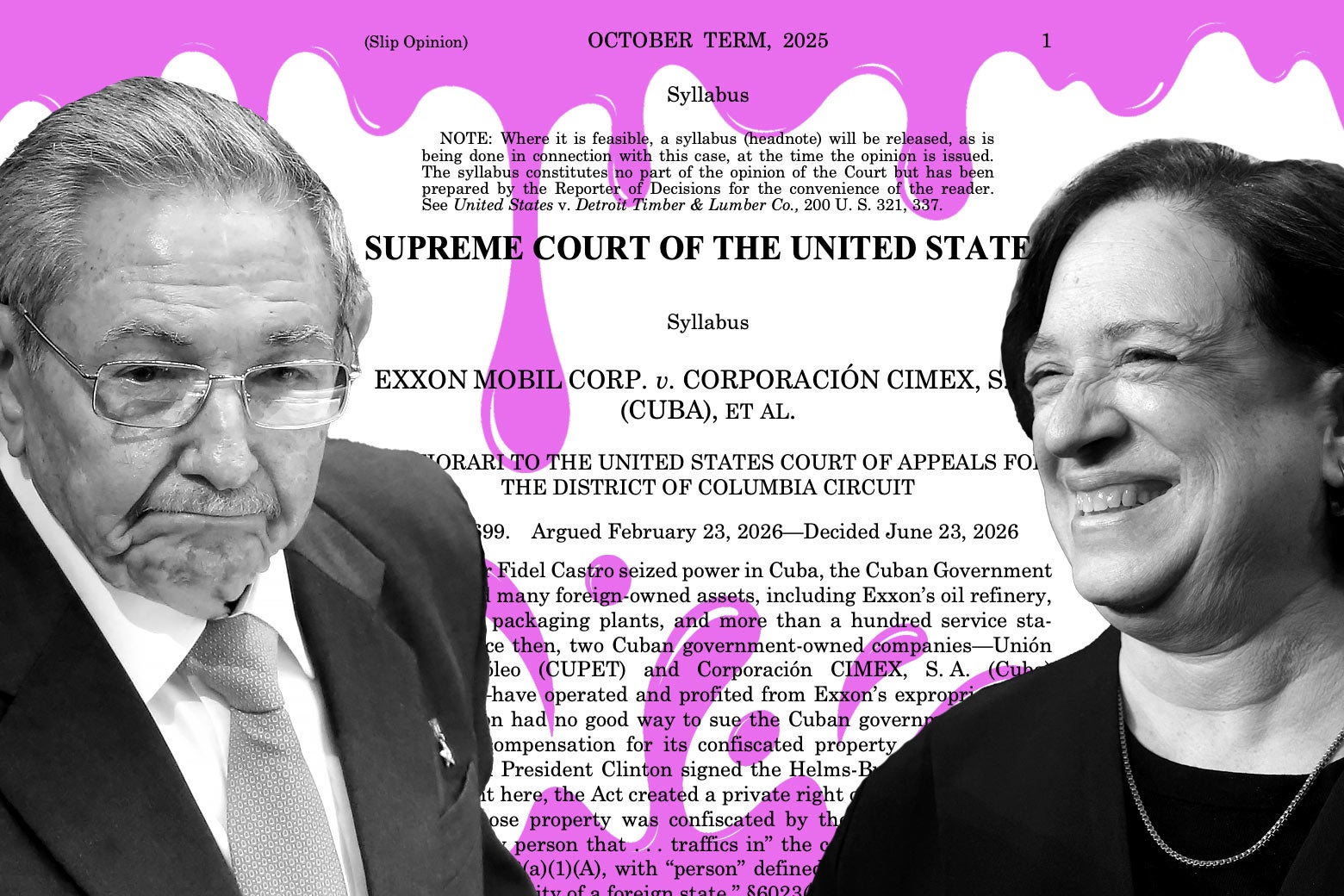
This is part of Opinionpalooza, Slate’s coverage of the major decisions from the Supreme Court. Keep up with all of our Supreme Court coverage and analysis by signing up for weekly email roundups. The best way to support our work—and unlock exclusive legal analysis—is by joining Slate Plus. (If you are already a member, consider a donation or merch!)
The Supreme Court issued a 6–3 decision along partisan lines last week in Exxon v. Cimex, about the U.S. legal system’s relationship to Cuba. In an opinion by Justice Brett Kavanaugh, the court held that a 1996 statute allows major corporations like Exxon Mobil to bring billion-dollar lawsuits against Cuban entities that they allege used their property. The court reached this decision even though these types of claims have been historically barred because of a foreign country’s sovereign immunity. Cimex was the second in a duo of cases about Cuban independence and corporate power, building off another case about cruise ships in Havana from the week before. The court’s mini “Cuba docket” offers us unexpected insights about Justice Elena Kagan, the only justice to hold the line on both cases, including her first-ever solo dissent in her 16 years on the bench. These cases also show how the conservative justices are reflexively comfortable giving corporations rights to sue in ways that mirror the Trump administration’s foreign policy goals while at the same time blocking so many actual human beings from legal remedies.
The first Cuba decision of the term concerned the seizure of property in Havana Docks v. Royal Caribbean. Havana Docks was an American company that operated several docks in the Port of Havana starting in the 1920s. The Cuban government owned the Port of Havana, but had allowed Havana Docks to use the dock on a type of lease agreement that was meant to last until 2004. But Havana Docks was never able to use the port for its full term, because Fidel Castro’s government seized Havana Docks’ property in 1960. Havana Docks was left without legal recourse for the seizure, until Congress passed the 1996 Cuban Liberty and Democratic Solidarity Act, which recognized some potential claims for companies in Havana Docks’ situation. The 1996 act was passed after Cuba shot down two planes, which killed three Americans. Among the act’s provisions was one that made it unlawful for a new American company to use or “traffic” in a property interest that a previous American company had once owned. In 2019, Havana Docks relied on the 1996 act to sue Royal Caribbean cruise lines for using the Port of Havana. The Supreme Court’s bottom-line conclusion was that Havana Docks’ claim was allowed to proceed under the 1996 act.
We’ll discuss in a moment why it took over 20 years for Havana Docks to bring this claim, but first we have to focus on a strange property issue that makes this case not as clear-cut as it might seem. As Justice Kagan explained in her dissent, everyone agrees that Havana Docks owned some property interest to use the Port of Havana from the 1920s until 2004. But the defendant, Royal Caribbean, never used the docks before 2004; instead, they only ever used the docks during a period of somewhat eased relations between the countries between 2016 and 2019. Why then should Havana Docks be able to sue Royal Caribbean for using the seized docks over a decade later? According to the majority, the fact that the property was once seized by the Cuban government in effect taints the property interest forever, so that any future American company that uses the property can be held liable, even if their use of the property doesn’t match up with the original property interest holder. Kagan said that this reading makes no sense. And so, on this seemingly technical legal issue about property, and for the first time since her nomination to the Supreme Court in 2010, Justice Kagan stood alone.
Kagan also wrote the dissent in Exxon Mobil v. Cimex, this time joined by her liberal colleagues, Justices Sonia Sotomayor and Ketanji Brown Jackson. Like with Havana Docks, this case featured a corporate-America plaintiff trying to take advantage of lawsuits that they argued were permitted by the 1996 act. Here, Exxon Mobil was suing an entity affiliated with the Cuban government for using an oil refinery that the Cuban government had confiscated from Exxon in the 1990s. The legal barrier Exxon faced was that it wasn’t clear that the 1996 statute allowed a plaintiff to sue companies like Cimex, since government-affiliated entities are generally protected by sovereign immunity. As the dissent forcefully argued, another law called the Foreign Sovereign Immunities Act provides the general framework for all foreign immunity issues, barring these claims out of respect for international sovereignty, except when specific exceptions apply. But the court ruled that Exxon Mobil could bring its claims regardless of the FSIA, treating the 1996 act as providing an independent pathway for a lawsuit.
Havana Docks and Cimex were the first two cases about the 1996 act to ever reach the Supreme Court, and they have a lot in common: They were argued on the same day, and both found in favor of the corporate plaintiff having more rather than fewer rights to bring lawsuits. Interestingly, reading the two cases back-to-back, you might be forgiven for not recognizing the similarities. The cases don’t cross-reference one another, as often happens when the court decides two similar cases in the same term. And except for a single mention at the top of each opinion, Justice Clarence Thomas’ and Kavanaugh’s respective majority writings even use different shorthand names for the law. So why have these cases come up now? It’s because, in the middle of the act’s sections about suits against Cuba, the 1996 act also has a provision that gives the president an immense new power—a space the court has particularly embraced this term. That section of the act lets the president suspend any lawsuits that would otherwise be brought under this law, letting the president use the threat of allowing lawsuits as a kind of bargaining chip for international negotiations. Fearing that allowing these lawsuits might put unhelpful strain on the Cuban government and its people, all presidents from Bill Clinton to Barack Obama had used the law’s authority to block these lawsuits. But in 2019, the first Trump administration lifted the ban and allowed these suits to begin. Kavanaugh described this presidential power at oral argument as an “on/off switch” of legal remedies.
At the risk of speculation, perhaps it’s this presidential power that led Kagan to dissent in both cases. While she usually has a reputation of being a bit more moderate than her two other Democratic appointees, Kagan has also set herself apart as the most staunch pro-democracy justice on the court, writing incandescent dissents in disastrous voting rights cases like Rucho v. Common Cause and Louisiana v. Callais. Generally, we expect Congress to be the master of rights and legal remedies when it comes to statutes, and this court has not been fond of Congress deferring its authority to the executive branch, even when it has been allowed for decades. So it is strange that this court seems perfectly comfortable with a president who can usher in such a significant change in foreign policy, via a congressionally authorized “on-off” switch.
But regardless of the motives of Kagan or the rest of the court, it’s unquestionably true that these lawsuits will begin playing a meaningful role in American foreign policy. The Trump administration has taken a hawkish stance against the Cuban government. Led by the Cuban descendant Secretary of State Marco Rubio, the Trump administration has increased sanctions against Cuba, blocking off oil and other goods to the country. Trump repeatedly threatens military action, with the assassinations of the leaders of Iran and Venezuela hanging over the country. The Department of Justice has also brought indictments against Cuba’s former President Raul Castro for the 1996 plane shooting that led to the passing of the 1996 act. Now, in addition to the administration’s public efforts, private corporations are able to add to the president’s pressure campaign by securing one legal judgment after another against Cuban-affiliated entities.
But these private actions risk unintended consequences for both Cubans and Americans. As Sotomayor explained in a separate writing from Havana Docks, the 1996 act is written so broadly that it might harm American people and companies. Under some readings of the act, Havana Docks can bring claims against not just one (American) company to correct the losses they’ve admittedly suffered, but potentially any company that has ever used the dock. Even cruise ship passengers who have used the docks may be considered “traffickers” of seized property under the 1996 law. Thus, companies like Havana Docks could seek monetary judgments over and over again, potentially raising due process concerns about disproportionate payouts. Similarly, the act also risks making matters on the ground worse for Cubans by siphoning money away from Cuban entities, just as the government actively seeks to remake its economy, and sending that money to large corporations like Exxon Mobil, who are hardly hurting for cash.
It’s true that ever since the 1960s, the U.S. federal government has used its economic power as a tool to create policy change in Cuba. But this term’s Cuba decisions have thrust the American legal system and private corporations even more into the mix. Time will tell whether this proves to be helpful for the vindication of wrongs from years ago and creation of stable relations in years to come. But the feeling one is left with as the court nears the end of this term is a deep frustration about who gets access to justice. At the same time a majority of the justices rule to shut the courthouse doors to religious minorities, immigrants, and minority voters, they also insist that some of the world’s largest companies simply must have their day in court.