

Education minister dissatisfied with pace of repairs to Melissa-damaged schools
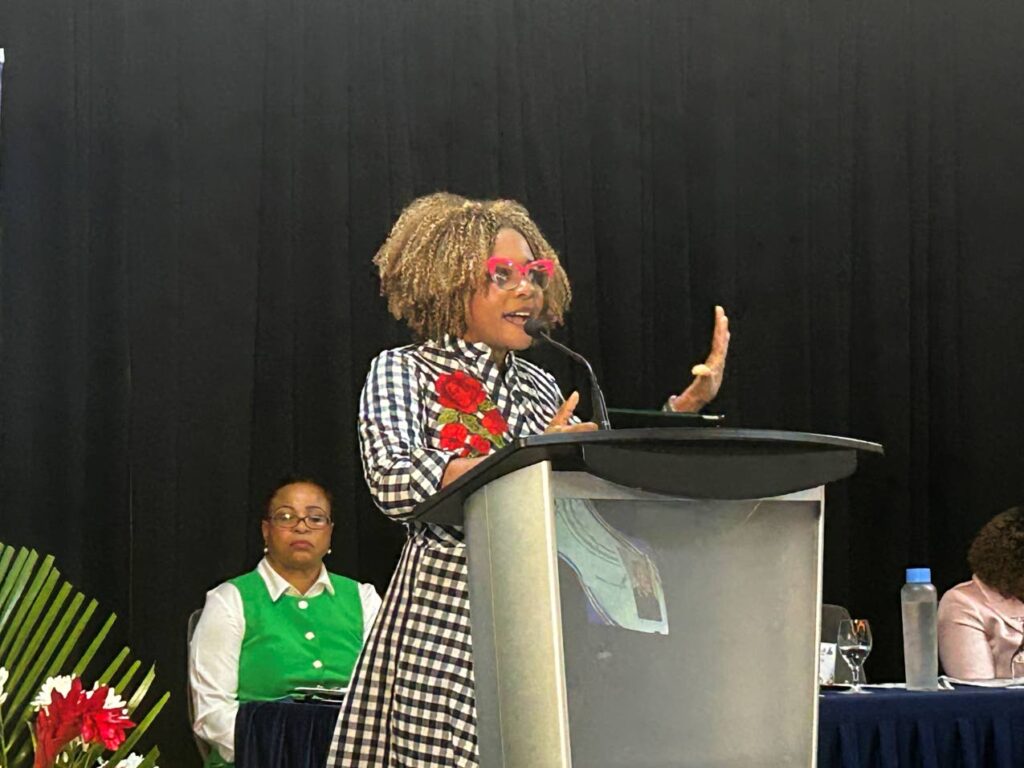
Education Minister Senator Dr Dana Morris Dixon delivering the keynote address at the ministry’s Region Six Principals’ Retreat at Ocean Coral Spring in Trelawny on Tuesday. (Photo: Horace Hines)
CORAL SPRING, Trelawny — Minister of Education Senator Dr Dana Morris Dixon has acknowledged mounting frustration over the slow pace of repairs to schools damaged by Hurricane Melissa and admitted that the ministry has fallen short in responding quickly enough to repair requests.
Addressing the ministry’s Region Six Principals’ Retreat at Ocean Coral Spring in Trelawny, on Tuesday, Morris Dixon expressed disappointment with the progress of the Government’s multi-billion-dollar school rehabilitation programme.
“I know there are a lot of repairs that are necessary to our schools, and one of the things I defend people when they need to be defended and I am your biggest cheerleader. But when something is not working I usually say it is not working and apologise for it,” said Morris Dixon.
“I know I have gotten so many complaints about how long it takes to get repairs done at your schools; how long it takes for building officers to come and do the assessments and to get the work done; we have not gotten that right… We have not done that as well as we could,” added Morris Dixon.
The minister’s remarks came against the backdrop of an $18-billion programme to repair nearly 800 educational institutions damaged by Hurricane Melissa which hit the island last October.
She told the principals that her concerns are based on reports she has received that the pace of the restoration work remains unsatisfactory.
“As I said, there are a number of your schools that need to be repaired, and some of this work is going a lot more slowly than I would want. And so I know this region is working with central ministry on this, but it is important that we move more quickly than we have been moving,” she said.
“I’ve been disappointed as minister when I get the reports on where we are. We are not far enough ahead,” she stressed.
The education minister pointed to an inadequate complement of technical personnel as part of the problem as she argued that the current arrangement of having a single building officer assigned to each of the ministry’s seven regional offices is insufficient.
“One of the things we are saying [is that] we want accountability from our schools, but the ministry also has to be accountable. It’s a two-way street… We have to do some more work. And I tell you that we are working on it. We’re looking at it in the ministry now in terms of how we can expand the numbers, because one building officer in our region doesn’t work. We need more. We need more staff, and we have ageing plants,”she added.
The education minister pointed out that many school facilities are decades old and require extensive maintenance, placing additional pressure on the ministry’s limited technical resources.
“When you have ageing plants, you’re going to have more problems, and that’s just the reality of it. And so we just have to work with the reality and get more staff so that as a ministry we can be more responsive to you.
“You shouldn’t have to be calling every minute and then always escalating to somebody else to get your school repaired. So I’m aware of it. I’ve heard it. I’ve heard your cries, and we’re going to be working to fix that,” added Morris Dixon.
Some participants in attendance at the Ministry of Education’s Region Six Principals’ Retreat at Ocean Coral Spring in Trelawny on Tuesday. (Photo: Horace Hines)
But despite her concerns about the pace of implementation, Morris Dixon announced that all 77 schools classified as “priority two” institutions in Region Six ,which covers St Catherine, are scheduled to begin repair work during this summer period.
Following Hurricane Melissa, the education ministry placed schools in three categories — priority one which indicate severe damage; priority two, moderate damage, significant repairs needed; and and priority three, minor damage.
According to Morris Dixon, there will be transparency in the management of the repair programme with detailed information on every project being published online and updated regularly.
“We are going to be putting online the names of the schools to be repaired, how much money the repair is, who the contractor is, and what the completion date should be,” said Morris Dixon.
“We are not going to hide any of the information. The information needs to be public. All of this is taxpayers’ funds that we’re using to fix the schools, and nothing should be hidden,” added Morris Dixon.
She said the online platform, which will be updated every two weeks, will allow stakeholders to monitor project time lines, contract status, and construction progress.
Beyond immediate hurricane-related repairs, the minister argued that Jamaica must adopt a broader strategy to modernise school infrastructure as piecemeal interventions are not enough to address long-standing deficiencies.
“We have to be open with the situations that we face, and we also have to figure out how we really get a good capital project in place to repair our schools more broadly. Because we’re doing a lot of little fixes here and there, but the entire plant needs to be redone,” said Morris Dixon.
She singled out outdated electrical systems as one of the most pressing concerns across the school network.
“I worry about the electrical systems in many of our schools — they are outdated. When you go in, you see it. You can look up and you see that there are issues, and so we have to prioritise that,” she said.
Morris Dixon urged principals whose schools are slated for repairs to take an active role in overseeing the projects and ensuring contractors address as many long-standing issues as possible while work crews are on site.
“As principals, I’m asking for your help. If your school is one of the 77 schools that is being repaired, look at the scope of works. Make sure that the scope of works includes things like the electrical work somewhere that needed to be done from a long time ago,” she said.
“I have some principals who tell me they walk behind the contractor. [If] that’s what you have to do. I can’t be there, so you are me out there with the contractor,” Morris Dixon added.