

Djibouti Signs Artemis Accords at NASA Headquarters, Becoming 72nd Signatory
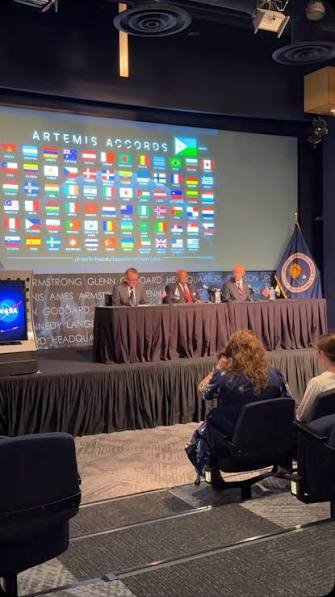
WASHINGTON — The Republic of Djibouti signed the Artemis Accords during a ceremony at NASA Headquarters in Washington on Monday, becoming the 72nd country to join the international framework for peaceful and responsible space exploration, while neighboring Somalia continues to pursue a separate space strategy anchored in a Turkish-backed spaceport project.
NASA Deputy Administrator Matt Anderson hosted Djibouti’s Ambassador to the United States Mohamed Siad Douale for the ceremony, alongside U.S. State Department Assistant Secretary for African Affairs Frank Garcia. The Artemis Accords are a non-binding set of principles grounded in the Outer Space Treaty of 1967, designed to guide civil space exploration in the 21st century.
Djibouti’s signing makes it the fourth East African nation to join the Accords, following Ethiopia, Kenya, and Rwanda. Across the continent, African nations have increasingly engaged with the framework, with Senegal becoming the 56th signatory in July 2025 and Mauritius joining as the 70th in July 2026.
Somalia’s Divergent Space Path
While Djibouti aligns with the US-led framework, Somalia has charted a different course. Turkey is building a $350 million space facility in the Warsheekh district of Middle Shabelle region, with the first satellite launch from Somali soil planned for 2027.
The project was officially announced in December 2025 as a technological partnership between Somalia and Turkey, and construction began in late 2025, with the first phase expected to be completed by summer 2027. Somalia was chosen for its strategic location near the equator, which provides optimal conditions for rocket launches due to Earth’s rotational speed, reducing fuel requirements and improving payload capacity.
Turkey has completed the design phase of its next-generation Turksat 7A communications satellite, and reports suggest Somalia could serve as the launch site for the project, marking a major technological milestone for the country.
Dual-Use Concerns and Regional Implications
According to reports citing French newspaper Le Monde, the facility is designed as a dual-use installation combining a satellite launch base for Turkey’s space programme with a testing site for long-range ballistic missiles. An investigation by the Middle East Forum found that a missile test facility at this location would place most of Africa and the Middle East within range for ballistic missile strikes.
Turkey has so far declined to sign the Artemis Accords, preferring to align itself with the Chinese-Russian space axis, according to analysis published by The Hill. This divergence places Somalia outside the US-led framework that Djibouti has now joined.
Somalia has also signed a cooperation agreement with China to expand the use of satellite technology for national development, marking a significant step toward strengthening the nation’s capabilities in space-based technologies and data-driven decision-making. The memorandum of understanding was signed between Somalia’s Department of Space and Satellite and China’s Land Satellite Remote Sensing Application Center during the NewSpace Africa Conference 2026 in Libreville, Gabon.
Turkish Industry and Technology Minister Mehmet Fatih Kacır said Türkiye plans to launch its lunar spacecraft in the first months of 2027, powered by a domestically developed hybrid propulsion system, and that work was underway to secure independent access to space through the construction of Turkey’s own equatorial spaceport in Somalia.
Critical Note
The contrasting space strategies of Djibouti and Somalia illustrate the wider geopolitical competition playing out in the Horn of Africa. Djibouti’s decision to sign the Artemis Accords aligns it with a US-led framework emphasizing transparency, data-sharing, and responsible behavior. Somalia’s partnership with Turkey, by contrast, is more infrastructure-focused and raises questions about the extent of Somali ownership and the facility’s potential dual-use capabilities.
For Somalia, the spaceport project offers the prospect of technological development, job creation, and international visibility. Yet the terms of the arrangement remain opaque. The Somali government has not publicly detailed its financial and technological participation in the project, nor has it addressed the dual-use allegations that have circulated in international media. If the facility serves primarily as a platform for Turkish strategic ambitions, Somalia risks becoming a host for external power projection rather than a genuine partner in space technology development.
The divergence between Djibouti and Somalia also reflects broader regional dynamics. Djibouti’s alignment with the Artemis framework places it within a coalition that includes Israel, a country Turkey views as a regional rival. As Turkey deepens its military and technological footprint in Somalia, the Horn of Africa is becoming a theatre for competing visions of space governance and strategic influence. For Somali policymakers, the challenge will be to ensure that their country’s space ambitions serve national development goals and do not simply become another arena for external competition.
Recommended Reading On ftlsomalia.com
Credit: Source link
Comments are closed.