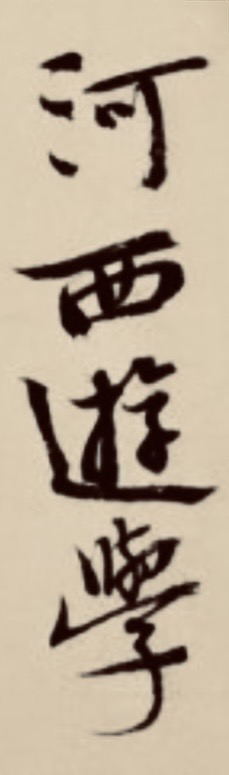
Dasheng Goes West — a Scholar’s Travelogue – China Heritage
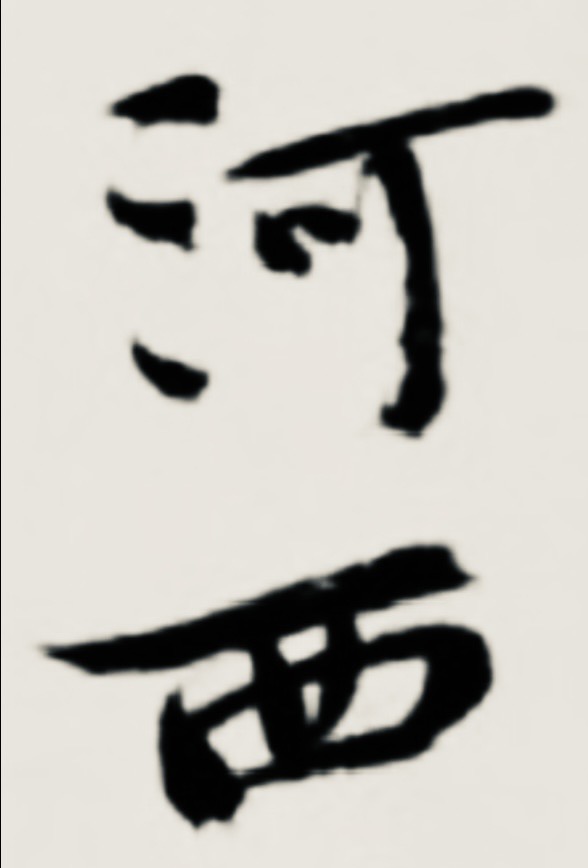
西遊日記
In August 2026, Dasheng Liu Chan 大生劉蟾, the scholar, essayist, calligrapher and editor whose work features in The Other China section of China Heritage, was invited to accompany a study tour of the Hexi Corridor in western China as a guest lecturer. He has kindly granted China Heritage permission to reproduce his travel diary. A daily account of a nine-day trip, Dasheng’s handwritten diary is a contemporary contribution to a hallowed tradition of landscape prose and travelogues 遊記 yóujì in Chinese letters.
It is a private work made public and China Heritage is honoured to be able to share what is delightful work of casual artistry with our readers in full. The following translation can barely do justice to Dasheng’s sparse and affecting prose. For that reason I urge readers to study the original text both to appreciate the composition as well as the casual hand of a practiced artist.
This is Part I of Dasheng’s Diary of a Journey to the West.
***
The style of Dasheng’s dairy, added to the fact he recorded it with a calligraphic brush, firmly places this material in both The Other China and the Celebrating New Sinology sections of China Heritage. A list of Dasheng’s other contributions to China Heritage can be found at the end of this chapter.
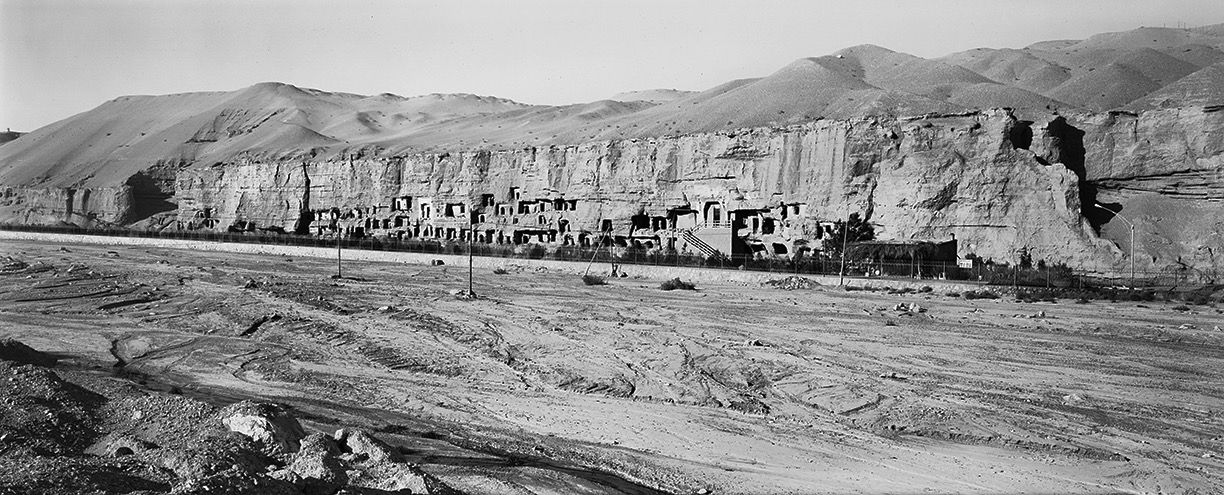
I am grateful to Dasheng for sharing his diary with us, to Lois Conner for allowing to include work from her travels in Gansu, Qinghai and Tibet and to Callum Smith, our webmaster, for his technical assistance.
— Geremie R. Barmé
Editor, China Heritage
14 September 2026
***
A Study Tour of the Hexi Corridor
河西走廊遊學
Dasheng Liu Chan 大生劉蟾
In late August 2026, I was invited to join ‘A Study Tour of the Hexi Corridor’ in western Gansu province organised by NewBooks Publishers in Beijing as a guest lecturer. As a speaker, my role was to provide participants in tour with some cultural background and historical context to where they were going and what they were seeing.
The Hexi Corridor, an arable plain west of the Ordos Loop of the Yellow River (Hexi 河西 means ‘west of the river’), was for millennia a crucial passage for trade and various forms of contact between dynastic China, what is now the Middle East and Europe. Historically, the region had a diverse population including Persians, Yuezhi, Mongolians, Zang-Qiang, Tujue, Uyghurs, Arabs, as well as peoples of the Central Plains …. Religious groups were just as diverse, with Zoroastrianism, Nestorian Christianity, Buddhism, Manichaeism, Islam, Taoism, Confucianism and Shamanism all being present at various times and in various strengths …. The unique position and history of the region made it something of a cosmopolitan melting pot.
Unfortunately, influenced by the dominant narratives of the Central Plains [that is, the core of dynastic China], many people mistakenly regard the Hexi Corridor as a far-flung ‘border region’ even now. From a broader perspective, however, Hexi has been an important ‘centre’ in its own right. And, so, this is why, the theme of our study tour was ‘Seeing the Hexi Corridor in a Global Context’. Our lectures and site visits were organised with this theme in mind in the hope that participants would be able to step out of the conventional narrative framework to look afresh at the ways in which the Chinese world has engaged with global civilisations in the past.
I always find that study tours like this often spark inspiration and insights and it’s why I take a portable set of calligraphic tools with me so that I can make a daily record of the trip.
This is how my Dairy of a Journey to the West came about. The ten entries in it record the ten days of our trip.
— Dasheng Liu Chan, 3 September 2026
translated by Geremie R. Barmé
[Note: NewBooks Publishers 先知書店 was established in 2016. It specialises in academic works and publications suited to niche readerships.]
2026年8月底,先知書店組織“河西走廊遊學之旅”。我忝列其中,做隨行老師,給大家講一些文化背景與思想常識。
河西走廊是古代中國連接印度、中亞的交通要道,進而連通歐洲。波斯、月氏、蒙古、藏羌、突厥、回鶻、阿拉伯、中原……各族混居;索羅亞斯德教、景教、佛教、摩尼教、伊斯蘭教、道教、儒教、薩滿教……諸多文化形態,在此交融,其地理意義,無比重要。
可惜一直受中原王朝視角的敘事影響,很多人覺得河西走廊只是“邊陲之地”,實則用更大視角尺度來看,河西走廊,可能才是某種中心。
因此,這次遊學的主題,便定為“以世界的視角,看河西走廊”,途中講座、分享,也都以此為基調,試圖突破慣常敘事框架,換個角度看中國與世界文明的交流。
這類遊學之旅,較為有趣。所以每每攜帶行囊筆硯,日間行走,夜裡記錄。此次共得旅行日記十篇。是為緣起,略作說明。
***
***
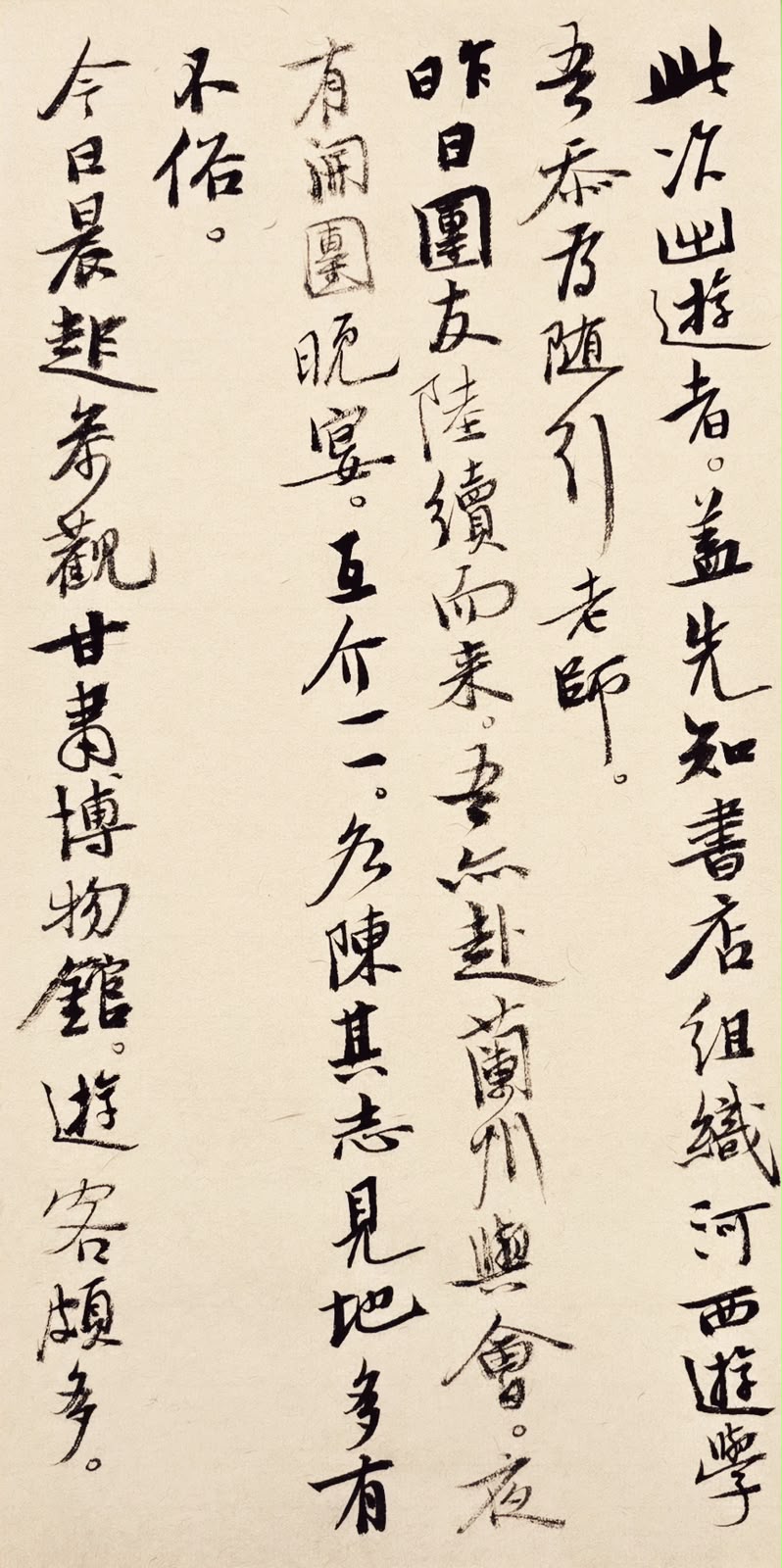
Liu Chan’s Travelogue
an excerpt from the first day
2026年8月21日
***
Dasheng’s Journey to the West
河西遊學
a diary
21-29 August 2026
Liu Chan Dasheng 大生刘蟾
Translated and annotated by Geremie R. Barmé
Photographs by Lois Conner
Part I (21-24 August 2026)
21 August
8月21日
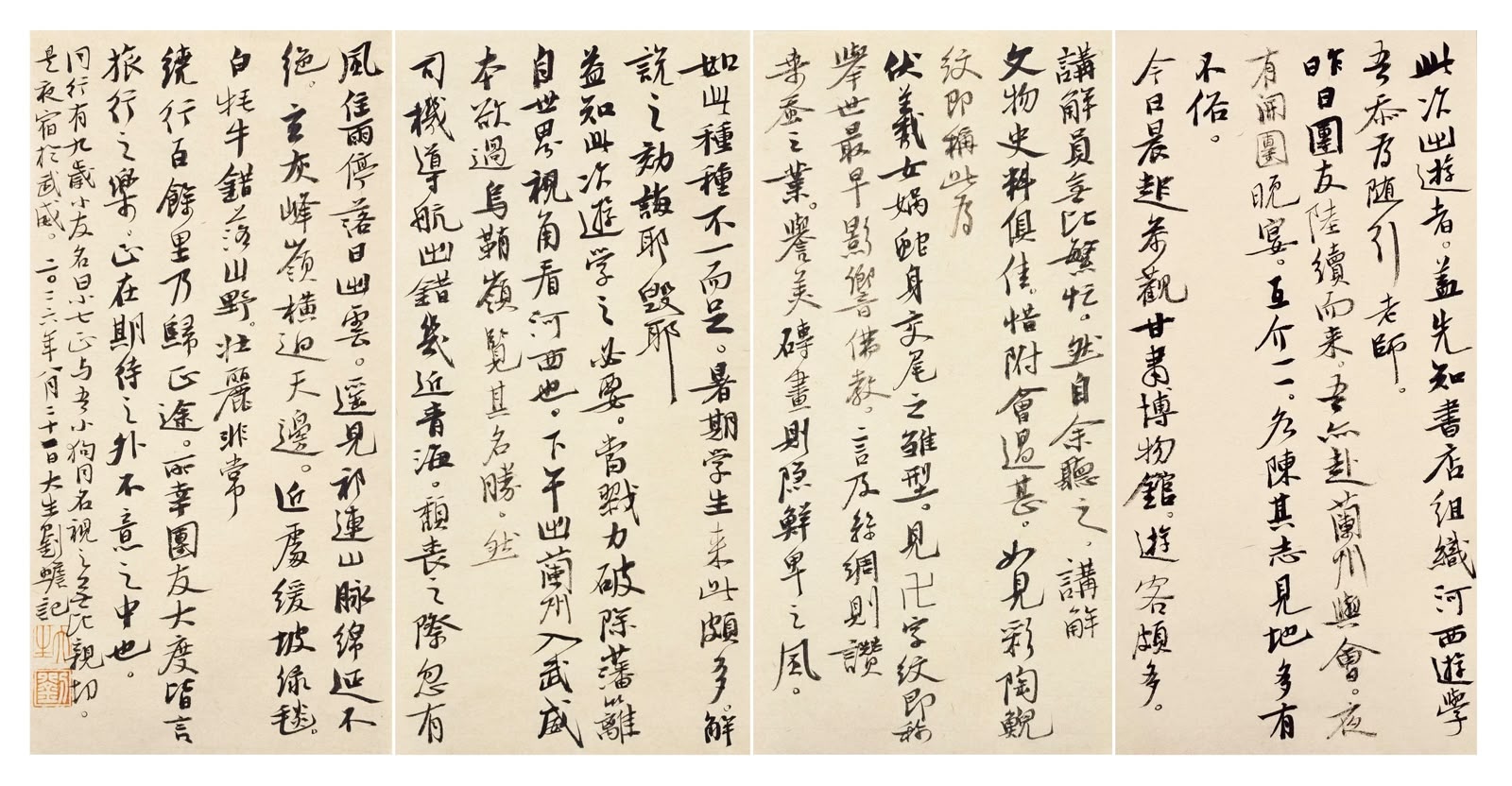
[Click on the image to enlarge it.]
The present trip came about when NewBooks in Beijing invited me to join the ‘Hexi Study Tour’ that they had organised as a guest lecturer. Having assembled in Lanzhou, Gansu province 甘肅省蘭州市, the group celebrated the occasion with a banquet during which introductions are made. It turns out that participants come from various backgrounds and in expressing their hopes for the trip the revealed a rather uncommon sophistication.
On the morning of 21 August our group visited the Lanzhou Museum. The crowds of tourists were such that the museum’s docents seemed quite overwhelmed. Listening in it to their presentations it seems that they are quite informed both in regard to the history of the area and the objects on display, although their extrapolations on various topics tend to be overwrought. When explaining the salamander designs on painted pottery amphora [彩陶鯢紋], for example, one docent claimed that this was an artistic prototype that depicted [the legendary figures] Fuxi 伏羲 and Nüwa 女媧. Furthermore, the swastika motives on prehistorical pottery, one docent claimed, were proof that these influenced Buddhism itself. When they talked about the Silk Road the focus was on the glories of sericulture and painted earthenware tomb bricks reflected artistry of the nomadic Xianbei people. There were numerous such examples. Many visitors were students on summer holiday and one wonders if such explanations don’t do more harm than good.
If nothing else, such encounters on our first day confirmed the need for the kind of study tour upon which we have embarked. It really is important to break through the common tangle of misconceptions and to appreciate the history of the Hexi Corridor from a more global perspective.
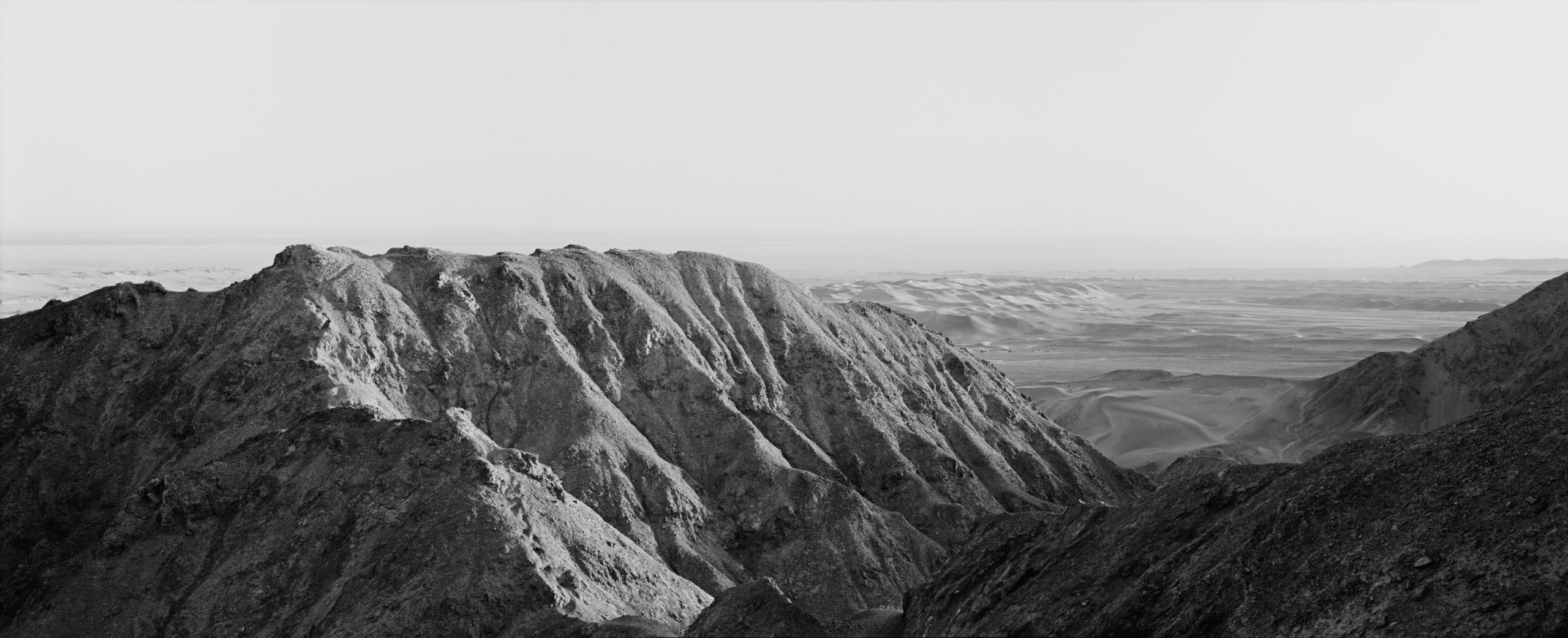
In the afternoon, we quit Lanzhou for Wuwei 武威 with the hope that on the way north as we crossed the Wushao Range 烏鞘嶺 [aka the Wuqiao Range] we might see some of the famous sites in the area. Unfortunately, a glitch in the driver’s GPS put us off course and we nearly ended up crossing over into Qinghai province. Though despondent, our spirits rallied when, suddenly, the wind and rain abated and, as the clouds parted, we caught sight of the setting sun over the Qilian Mountain Range 祁連山脈 that snaked into an impossibly far off distance. The black grey mountains and peaks reached up into the skies while, closer to hand, rolling hills and green pastures looked like a carpet at our feet with white and grey yaks dotted about the landscape. What a majestically beautiful vista!
After this accidental detour of over one hundred li 里, we were finally back on track. Fortunately, our group took it all in their stride and their spirits remained high. What started out as an unexpected event ended up being treasured in its own right.
(One member of our group is a nine-year-old by the name of Xiao Qi [小七]. This happens to be the name of my pet dog and I found the coincident to be warmly affecting. We spent the night at Wuwei.)
— recorded by Dasheng Liu Chan on 21 August 2026
***
22 August
8月22日
[Click on the image to enlarge it.]
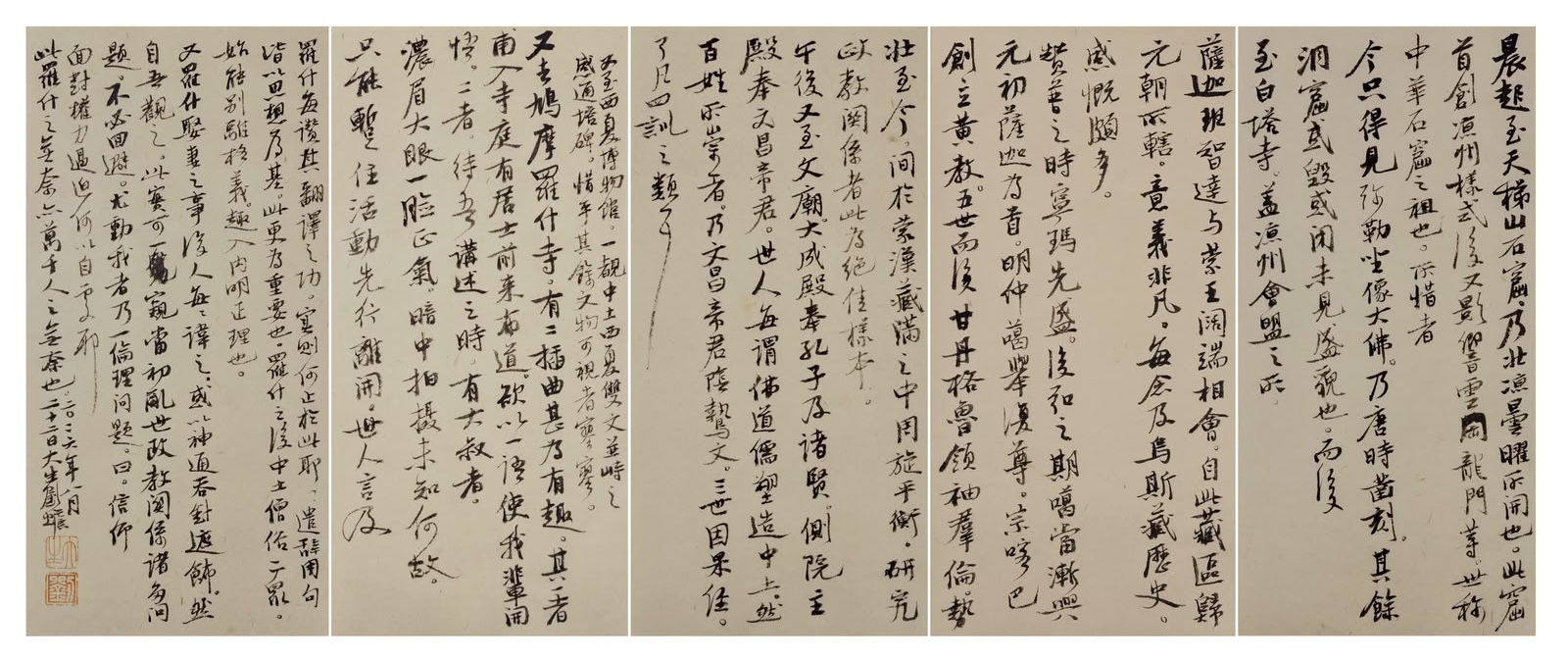
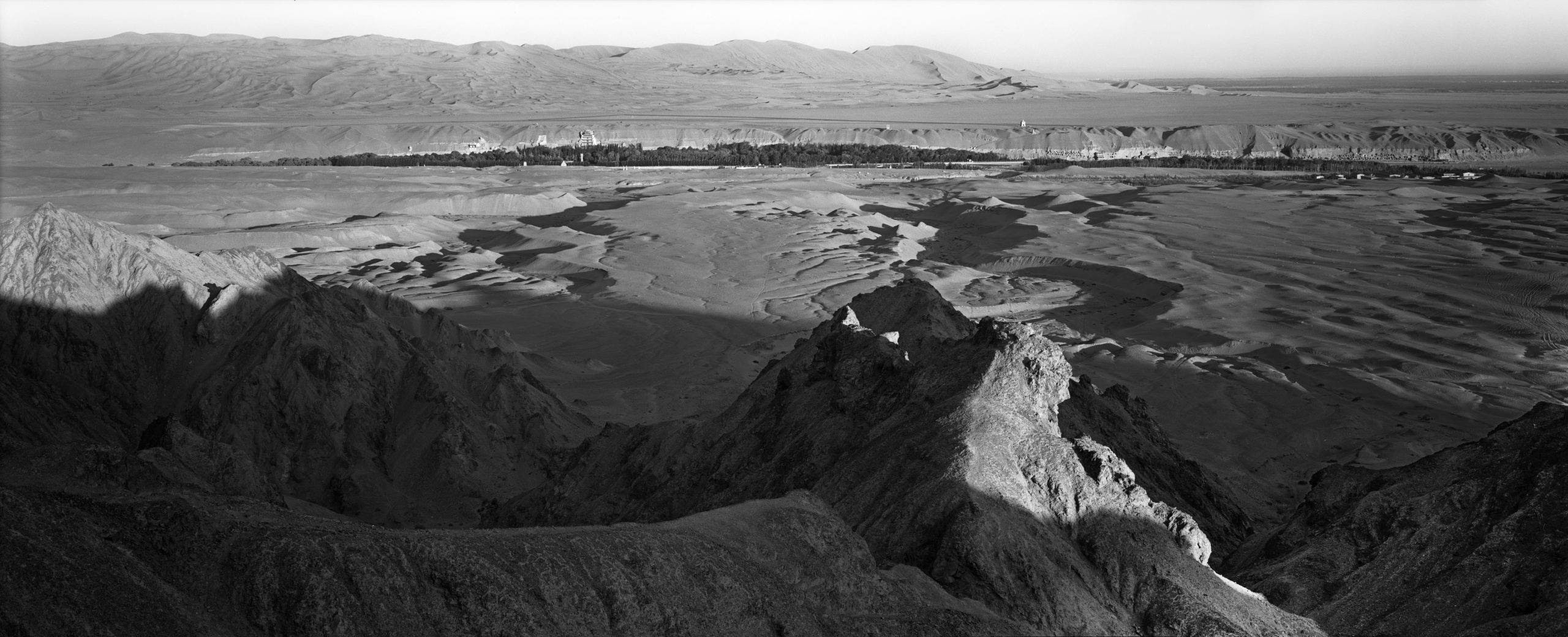
After rising and preparing ourselves in the morning, we headed off to see the grottoes at Tianti Mountain 天梯山石窟 [a series of rock cut temples in the Liangzhou district of Wuwei] first carved out by Tanyao 曇曜 [a prominent Buddhist artist-monk] during the Northern Liang dynasty. The ‘Liangzhou style’ of these grottoes later influenced the grottoes at 雲岡 and Longmen 龍門 as a result of which the Tianti cave temples are celebrated as ‘the ancestor of China’s grottoes’ 石窟鼻祖. It is unfortunate, therefore, that today you can only really see the large seated Maitreya Buddha, which dates from the Tang era. We were unable to appreciate the grandeur of the other grottoes either because they have been destroyed or due to the fact that they’re simply not open to the public.
After that we went to see the White Pagoda Temple 白塔寺, famous for the Liangzhou Parley [of 1247 CE] during which Sakya Pandita 薩迦·班智達 [representing Tibet] and the Mongolian Prince Ködan 闊端 [grandson of Genghis Khan] negotiated the peaceful integration of Tibetan regions into the expanding Mongol Empire. This was of momentous significance for the history of Ü-Tsang 烏思藏 [from the time of the Mongol-Yuan] and I found that I was rather affected by our visit.
In the era of the early Tibetan kings, the Nyingmapa [‘Red Hat’] School of Buddhism flourished though later Ganden gradually rose to prominence and by the time of the Yuan, Sakya was in ascendancy. In the mid-Ming, Ganden Monastery was prominent once more and Tsongkapa established the Gelugpa [‘Yellow Hat’] School. Following the reign of the Fifth Dalai Lama [and the establishment of the Ganden Podrang with the support of the Oirat Mongols], the Gelugpa enjoyed preeminence among the schools of Tibetan Buddhism and it has remained powerful up to the present day. They were able to navigate a successful course between the Mongols, the Han, the Manchus and Tibetans maintaining thereby a careful balance. They are something of an exemplar even for those interested in the relations among the various religious sects in Europe.
After lunch, we went to the Confucian Temple of Wuwei, the main hall of which is dedicated to the worship of Confucius and various eminent worthies. The object of veneration in a side structure is the God of Cultural and Literature 文昌帝君. Despite all the talk about Buddhism, Taoism and Confucianism being accorded similar status, the figure that everyday people still revere is the God of Literature along with such devotional texts as Wenchang’s Tract on the Quiet Way 文昌帝君陰騭文, The Cause and Effect Sutra 三世因果經 and Liaofan’s Four Instructions 了凡四訓.
We then proceeded to the Xixia Museum of Wuwei 西夏博物館 which houses stelae featuring parallel texts of Chinese and Xixia script. Unfortunately, apart from an ink rubbing of the Stele for the Reconstruction of Gantong Pagoda, few other objects were worthy of our attention.
Then on to Kumārajīva Temple 鳩摩羅什寺 [built in 389 CE on the order of Emperor Lü Guang of the Later Liang dynasty for an eminent monk from the Western Regions the temple was completely refurbished in 1998]. Two interesting things happened that merit being recorded here:
- upon entering the temple we were approached by a Buddhist layman who began preaching at us, presumable in the hope of opening our wisdom eye on the spot; then,
- when I started my own lecture about the temple, an older chap with prominent features and an air of authority who surreptitiously started filming us.
There was nothing we could do about it, so I stopped talking and our group quit the place.
People generally heap praise on Kumārajīva’s translations [of Buddhist scriptures], but his accomplishment was far from limited to mere religious vocabulary. His work was grounded in profound thought and true artistry. Indeed, it was in the wake of his efforts that Chinese Buddhists — sangha and laypeople alike — were introduced to scriptural interpretations that had been enriched by the adaptation of Confucian and Taoist strains of thought [known as 格義].
Then there’s the talk of Kumārajīva supposedly having taken a wife. It’s a topic that is generally avoiding and efforts are often made to distract people by repeating that story about him having swallowed needles [羅什吞針] as proof of his dharma power. The way I see it, all of this reflects the chaotic and contradictory relations between politics and religion at the time and there’s no reason for us to sidestep any of it. We do, however, have to confront an ethical issue that is alive even today: just how can belief preserve itself in the face of political pressure.
Such was the impotent dilemma of someone like Kumārajīva, something experienced by innumerable others both then and thereafter.
— Dasheng Liu Chan, 22 August 2026
***
23 August
8月23日
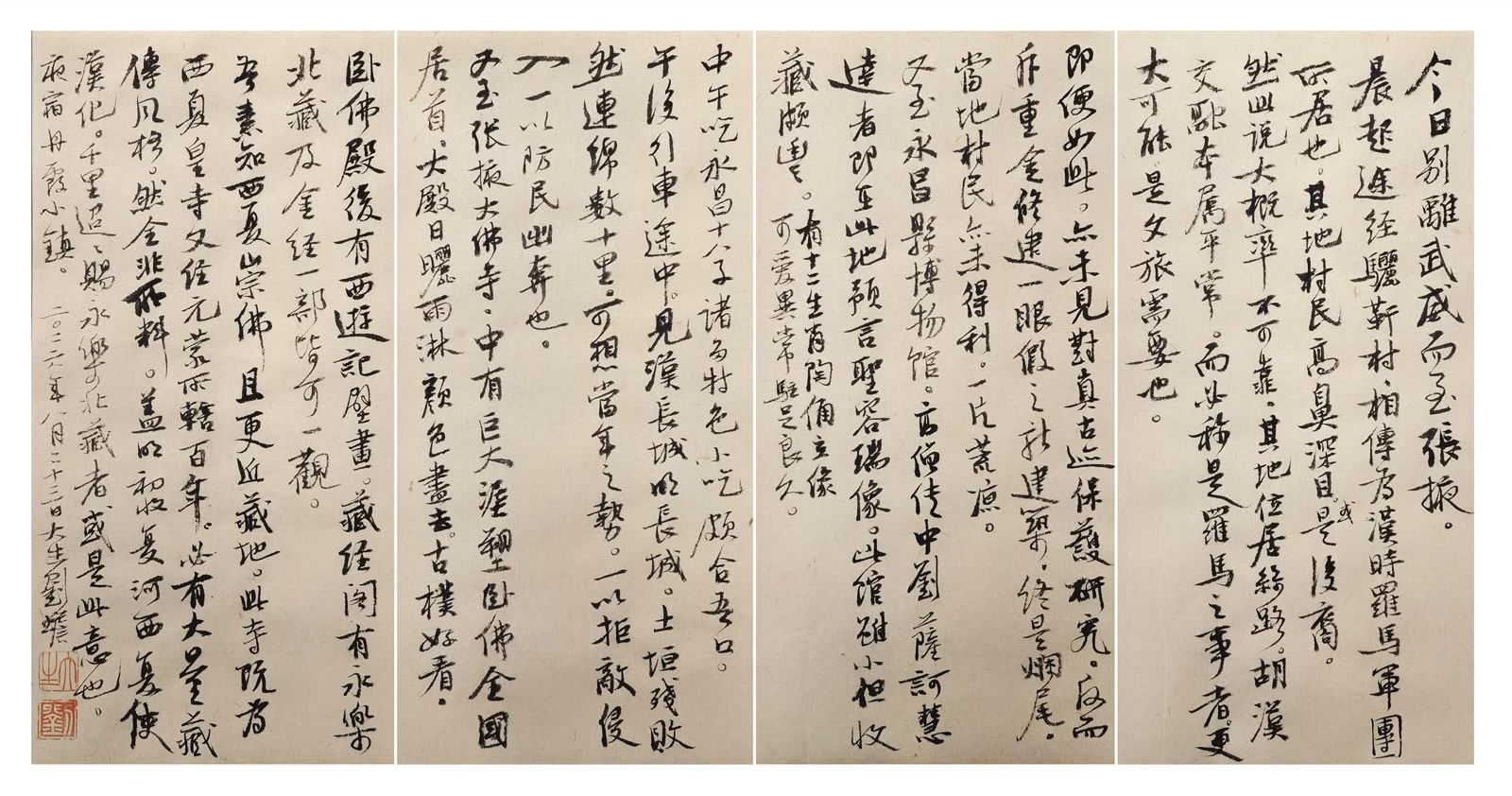
[Click on the image to enlarge it.]
Today, we left Wuwei and headed for Zhangye. In the morning, we passed through Liqian Village 驪靬村, a place that according to legend was a Roman garrison town during the Han dynasty [according to some, the place name 驪靬 lí qián/ lí jiān is a transliteration of the Latin ‘legio’]. Even today, locals with prominent noses and sunken eyes are presumed to be the descendants of the Romans. Though I very much doubt that any of this is reliable.
The village is on one of the Silk Routes and the intermingling of Han and ‘barbarian’ people would have been commonplace. Those who claim that the physical appearance of some individuals is evidence of the presence of an ancient Roman army are probably doing so more for PR purposes than anything else. Despite this, there is little evidence that any effort is being made to study let alone preserve the physical artefacts of the past. What was on display, however, was the fact that large amounts of funding has gone into the construction of ‘new old buildings’, the majority of which are either incomplete or in a state of decay. It’s not as though the locals had benefitted from all of the lavish funding, either: what we witnessed there was a scene of desolation.
We than arrived at the Yongchang County Museum 永昌縣博物館 where the eminent Buddhist priest Liu Sahe (劉薩訶, 345-436), known by the religious name of Huida 慧達, attested to the spiritual power of carvings of Buddha and he predicated dire consequences for anyone who did not protect them. Despite its modest size, this museum turned out to house a rich collection of artefacts. Among these was a set of pottery figurines of the Twelve Zodiac Animals. They really were quite compelling and we found ourselves lingering with them for quite some time.
For lunch we had the local speciality known as ‘The Eighteen Zi Dimsum’ 永昌十八子, each of which has the word zǐ 子 in its name. [They are: 卜喇子、炕鍋子、窩窩子、(清粉)漏魚子、甜丸子、面辣子、油餅子、爐轉子、炒花子抖皮襖、灰豆子、油餅子卷糕、搓魚子、糖餃子、糖花子、爐盔子、熱鍋子、麻花子、羊肉墊卷子。 ] I found that I pretty much had a taste for the lot.
Continuing on our way after lunch we passed by remains of the Great Wall that variously dated from the Han as well as the Ming dynasties. The ruins of the earthworks snake over the landscape for dozens of kilometres and give one a sense of the breathtaking scale of the original. It was a structure built to keep invaders out while making sure that the people were kept in.
Thereafter, we reached the Temple of the Great Buddha 大佛寺 at Zhangye 張掖 which houses what is reputedly the largest clay statue of a recumbent Buddha in China. The statue is housed in very picturesque building that is all the more charming because centuries of erosion have stripped it of all the gaudy colour and paint of the original. There is a mural depicting scenes from the Ming-dynasty novel Journey to the West 西遊記 behind the temple. The Hall of Scriptures 藏經閣 is also worth a visit as it contains copies of the Yongle North Tripitaka 永樂北藏 and the Diamond Sūtra 金經.
I’d long been aware of the fact that the rulers of the Xixia were devout Buddhists, something influenced by their proximity to Tibet. The Temple of the Great Buddha was built under the aegis of the Xixia court and after its fall the complex was maintained for a century by the Mongol-Yuan. By all rights, the temples should look Tibetan, but that is not the case at all.
When the Hexi Corridor was conquered by the Ming, a complete ‘Han-ification’ of the area was undertaken. That a copy of the Yongle North Tripitaka was presented to the temple from the distant Ming capital of Beijing, is pretty clear evidence of this.
We spent the night at a small town at Danxia 丹霞.
— recorded by Dasheng Liu Chan on 23 August 2026
End of Part I
***
Dasheng in China Heritage
- Liu Chan’s Memorial for the Departed, 12 January 2023
- On Rumours & Lies — Dasheng’s Little Lectures, 16 January 2023
- Brainwashing vs. Educating — Dasheng’s Little Lectures, 17 January 2023
- Resisting Cultural Capture — Dasheng’s Little Lectures, 18 January 2023
- In the Eyes of the Beholder — Dasheng’s Little Lectures, 19 January 2023
- Praise for the Orange Tree, Remembering the Plum, 8 February 2023
- Craven, Servile Knaves Hold Office, 7 March 2023
- Return to Vulture Peak — Qingming 2023, 5 April 2023
- Don’t Let the Dogs Eat World Book Day, 23 April 2023
- Dragging One’s Tail in the Mud on 1 May 2023, 1 May 2023
- When Bamboo Invites a Zephyr, 12 May 2023
- In the Company of Cats, 4 June 2023
- I’d rather support stray cats in Japan than donate a single penny to China’s disaster relief efforts, 8 August 2023
- Liu Chan’s Calligraphic Comment on 7 October 2023, 8 October 2023
- Liu Chan 劉蟾, Caged Birds and Turd Blossoms, 1 March 2024
- Liu Chan’s Studiolo of the Heart, 5 March 2025
- Underground Elegies — on a China that won’t be silent, 30 August 2025
- Dignity, Decency and the Lies of the Present, 6 September 2025
- Visiting Tao Yuanming in the Autumn, 10 October 2025
- When Cats Sleep, Perchance to Dream, 28 October 2025
- A Different Kind of Deluge at Davos — a calligraphic comment from Beijing, 24 January 2026
- The Little New Year, 12 February 2026
- Who will adjudicate the how’s and why’s? — Professor Xu Zhangrun’s New Year, 17 February 2026
- Hang High the Lanterns, 3 March 2026
- When the Ayatollah Called the General Secretary, 3 March 2026
- War, OpenClaw and CEOs — Dasheng’s Calligraphic Comments on Current Affairs (I), 20 March 2026
- In the Field of My Heart, 26 March 2026
- Hong Xiuquan’s American Brother, Orbán Goes and the KMT Comes — Dasheng’s Calligraphic Comments on Current Affairs (II), 16 April 2026
- The Zealot and the Pretender — Dasheng’s Calligraphic Comments on Current Affairs (III), 1 May 2026
- Trump Alert in Beijing, 13 May 2026
- Black gold streaked red with blood — Dasheng’s Calligraphic Comments on Current Affairs (IV), 30 May 2026
- From the President of Ukraine to the Would-be Tsar of Russia — an exercise in Classical Chinese, 10 June 2026
- Poetic Couplets from Lao Shu’s Atelier, 11 June 2026
- The Case of the Deceptive Duck, 12 June 2026
- The Buzz Around Huawei — Dasheng’s Calligraphic Comments on Current Affairs (VI), 6 August 2026
- Trump Proves He’s a Patzer at Chinese Chess — Dasheng’s Calligraphic Comments on Current Affairs (VII), 12 August 2026
- Premier Zhu, avē atque valē, 15 August 2026
- Censorship and Chicanery Aplenty — Dasheng’s Calligraphic Comments on Current Affairs (VIII), 21 August 2026
- Get Gigged, Prof! — Dasheng’s Calligraphic Comments on Current Affairs (IX), 25 August 2026
- The Case of the Killer Cabbage — Dasheng’s Calligraphic Comments on Current Affairs (X), 25 August 2026
- The Floodwaters Reach Heaven Itself — Dasheng’s Calligraphic Comments on Current Affairs (XI), 30 August 2026
***