

Cuba’s Miracle Breakthrough for Alzheimer’s Amidst the Genocidal Oil Blockade
Part II (part one is available HERE)
Having met up with ICAP (Cuban Institute for Friendship with the Peoples) workers in their office in central Vedado, we piled into the back of a recharged 3-wheeled electric ‘taxi’ with wooden benches, an ability to hit about 30 km’s an hour, and a reluctance to do just that given the total lack of shocks for the people riding on the skinny benches. Slowing down to about 4km/h around multiple pot holed areas of Playa in western Havana, after passing a few embassies we were able to make it to the Center for Molecular Immunology.
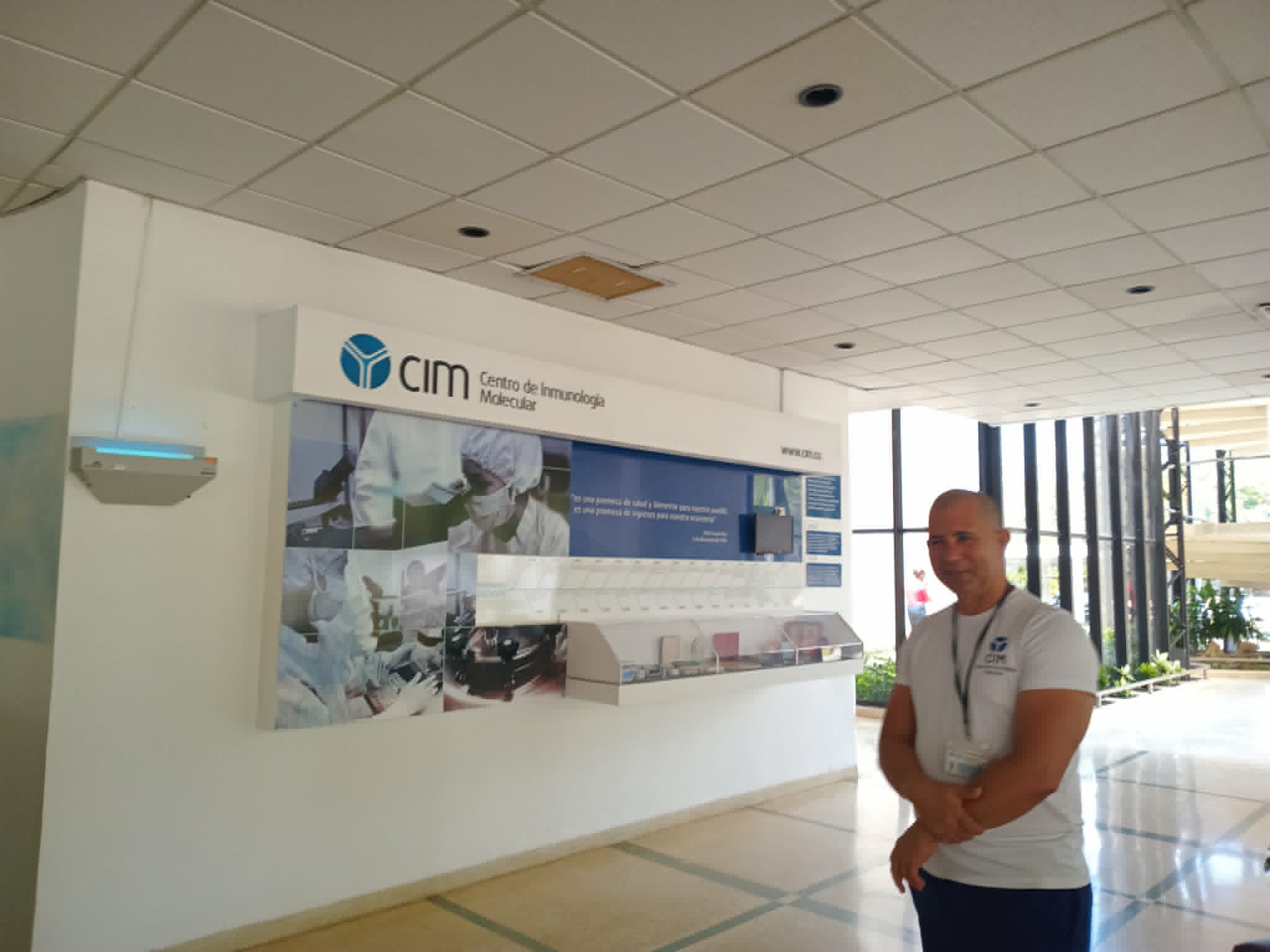
Near the entrance to the CIM.
I arrived, and very quickly the pride on the faces of the staff at CIM was apparent. So too was typical Cuban warmth and openness. Despite the many years of brutal embargoes, this building of science and health was treated with amazing love and high priority. Marble etched and highly modern, the structure was a reminder that Cuba has almost no reconstruction abilities (even before the oil blockade) thanks to US economic interference, but what little they have goes to schools, hospitals and health infrastructure, such as scientific health research (as well as the tourism both recreational and medical that brings in hard currency).
Scaling large staircases to the research areas, the words of dedication spoken by Fidel Castro are still on the wall:
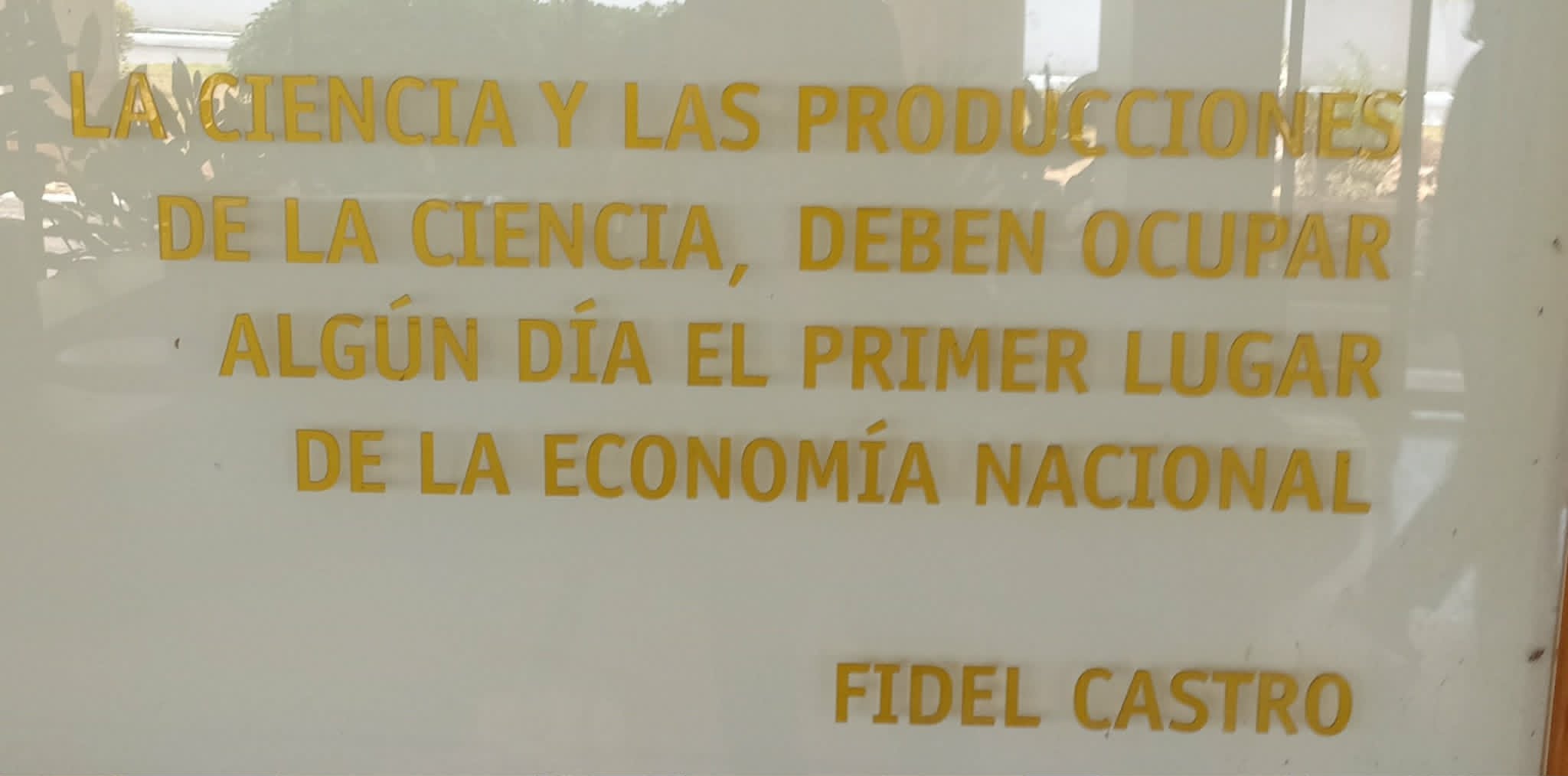
Words of dedication from Fidel Castro.
Science and the products of science must one day occupy the first place in the national economy.
I was shown the layout of the facility, given short brief on its history (long story short: Fidel gambled that investments in this type of research– even when the country was in a bad spot after the fall of the USSR– would pay dividends both financially and in human terms over time. The existence of what is being discussed now proves history has absolved him on the matter).
We went down a hallway where we gathered around a presentation table, and I readied myself among the others to learn.
Doctor Belinda Sanchez led the presentation, and explained the data for me.
Multiple different types of cancers, treated through the production of antibodies at CIM, have been reduced or defeated in thousands of patients already, covering some 25 different countries. As I would learn later that afternoon, one of the most important similarities these vaccines and cancer treatments have with NeuralCIM for dementia is an almost total lack– complete absence– of adverse effects. In other words, people tolerate these treatments without side effects. For example, when you puke for hours and lose your hair from chemotherapy, those are adverse side effects.
Dr Sanchez explained:
I mean, there are many biotechs that have antibodies against the same molecule. But our antibody have a very, very nice safety profile, because the affinity of the antibody is not so high [….]
That’s the but I was saying, I mean, compared with the competition, we have no adverse event. That’s why we say this is the best in class.
I’m not here to go at length into cancer treatments; Suffice to say I was not only impressed but inspired, as like almost everyone reading this cancer has taken the lives of family members and friends from me for decades. But, a little more on this from the CIM presentation on their treatment of lung cancers:
This is the [CIMAvax-EGF] vaccine. This is not an antibody. This is a vaccine. When people hear about vaccines, they always think about the vaccines we use to prevent infections when you are a child, that’s not the case. These are therapeutic vaccines. I mean vaccines that you [take] activate the immune system to respond when the people are ill. And the indication for this vaccine is a non small cell lung cancer.
[….]
And with these vaccines, I mean, the idea in patients is that when you vaccinate patients, the patients can produce antibodies against the protein that is contained in the vaccine formulation, and when the patients develop The antibodies against the protein, this protein this protein is like disappearing […] and because this protein is very important for the tumor to grow, the tumor stop growing. [….]
You can see here after vaccination, […] you can vaccinate people for years. For example, this is a patient that have been vaccinated for seven years without adverse events. Vaccines are really, really, very safe.
So, this is a little bit of background that I didn’t ask for, but it makes for the reasons why top scientists, doctors and researchers from all over the world already have so much time and credibility that they will give to the workers and scientists at Cuba’s CIM.
So let’s hear them discuss what they tell us they are achieving for the treatment of dementia, specifically Alzheimer’s and Parkinson’s.
At the beautiful facility Dr Sanchez again gave a very thorough overview presenting the advances of the treatments.
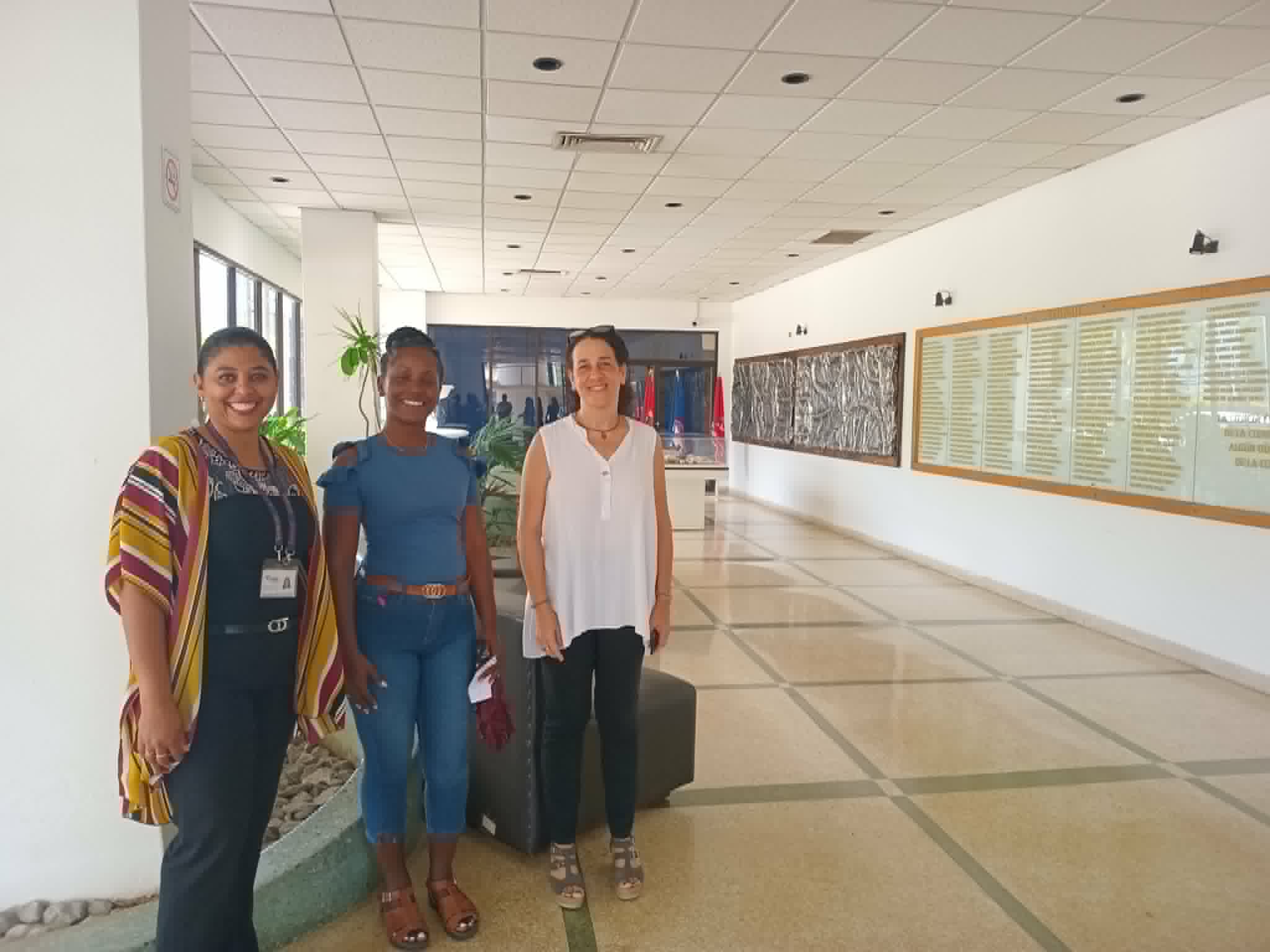
Dr Sanchez in white on the right with 2 colleagues from the CIM.
It was a clinical trial phase two that was conducted using two different amounts, those two doses of A) and we have a control group that received only placebo. This was a very controlled side with 174 participants in the site, and the primary outcome was the assessment of the other scope is the way you made sure the how is the disease improved or not improved?
I show you here [transcript is from a powerpoint presentation– MS] what happened with the people that received. This is the group receiving only point five milligrams of neuroEPO, receiving only one milligram of neuroEPO, this is the result; They were very, very similar, and this is the people that received the placebo. This is something that I mean is just to see you can understand that 80% of the patients were really better, better than before, or at least stable.
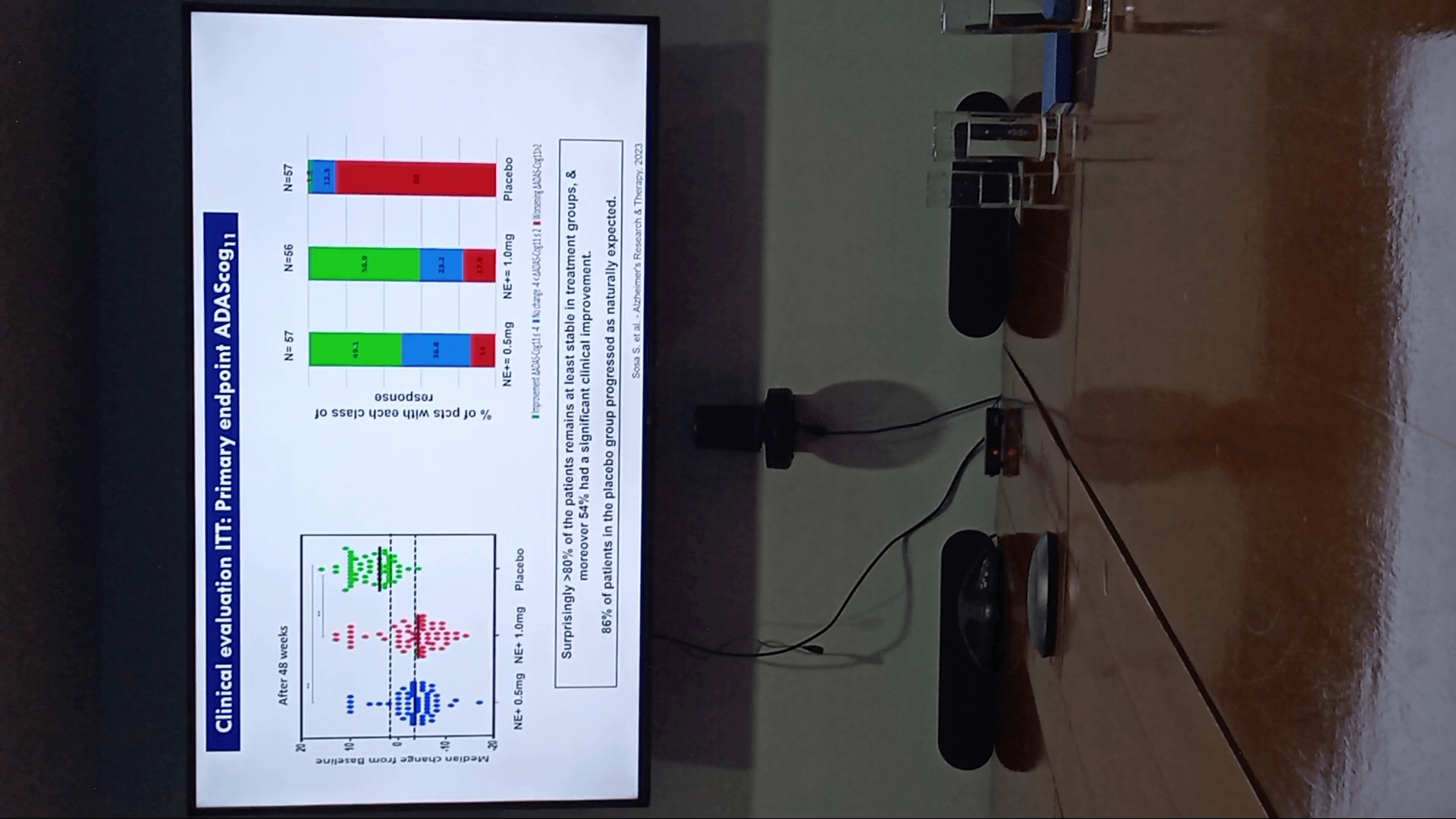
Left graph: small dose of neuroEpo 2nd graph: larger dose, 3rd graph: placebo (red means decline, blue stability, green improvement).
This is a disease in which, normally, the people get worse every time, and then what this shows you here is in green the improvement of the patients in blue, while the people, the people that get stable and in red, the people that get worse. Yeah, and you can see here comparing placebo group with neuroEPO treatment group. Yes, this is most of the people [84%–34% blue stabilized, 50% green improved– MS].
I was shown how historically already approved and distributed drugs that treat anxiety as well as Alzheimer’s have common adverse effects (bad and/or common nuisance side effects), while only providing partial stabilization of decline for dementia. With NeuralCIM [the international market name for neuroEPO], there are seemingly no adverse side effects, they promote improvements in over half those who are administered the drug properly, and the application of the drug (via a nasal spray) is simple and non-intrusive enough to make it easier on the whole family.
As a caregiver to my mother who had to wrestle with her on public transit to keep her mask on during the pandemic lockdown, I greatly appreciate the concept of “easy to apply” treatments to someone with dementia.
I asked Dr Sanchez about the trials being run in Canada with NeuralCIM. It’s now been in testing, research phases for some three years, involving the University of Saskatchewan. Unfortunately, and this is my take, it seems foot dragging is a serious issue on the Canadian side of this miraculous treatment. Nonetheless, Canadian trials have not contradicted and only confirmed thus far all of these ridiculously high levels of success.
I’m gonna stop here, and try to put the numbers in perspective. With a treatment that is affordable, accessible and has seemingly no major side effects? If that safe, easy to tolerate treatment were able to slow down the progression of dementia in 25% of patients, that would be a success, and it would once tested, get to patients. The numbers of people who receive not a slowing down, but a minimum of a complete halt to progression of dementia in Cuba receiving NeuralCIM is at 84%. 54% of the people in the multi year trial actually recovered lost faculties, the other 30 “only” stabilized.
Those numbers from the Cuban researchers are shocking, Olympic gold level performance & should have been front page news in every part of the world for the years since it has taken place and been verified. But numbers will always be boring.
So I want to know more about what this looks like in the patients. The numbers, the scientific explanations, all the data is there to prove that these changes are real, but what does a caregiver see in their loved one?
Dr Blanchet recounted to me:
So I had a conversation with Dr Sosa, who was the principal investigator in the ATHENEA trial in Cuba, and I was sharing my story about my friend who couldn’t use a cell phone. Dr Sosa said, ‘Yeah, we had a patient like that. She couldn’t use her cell phone. Now she is setting up group chats on WhatsApp. She’s doing video clips, sending them to the group chats and writing jokes about the video clips.’
So she went from not living like a normal human being, [to] better than most normal human beings.
Another patient went from being isolated in her bedroom, not able to follow a conversation, to going back to work and holding down two jobs successfully.
Without specific to vascular dementia data, I wanted to know more about the type of dementia I helped my mother deal with for years. I asked:
MS: And so when you say dementia instead of Alzheimer’s related dementia, you’re saying there’s an application for vascular dementia as well?
Dr B: Absolutely, absolutely, yeah, I have a patient who I’m fairly certain has vascular dementia. And I mean, [one] can never be certain until you do the brain biopsies. We haven’t done those, but she has all the stigma of vascular dementia. She’s been on the drug for about nine months, and she’s the one I talked about who could not name her grandchildren nine months ago, and now can name her grandchildren and identify which of her kids is responsible for them. She can give me the date. She can tell me what she had for breakfast. She’s always maintained the ability to have a good conversation, right? She’s always maintained her sense of humor. And the quote that she had that was my favorite is that during the worst of her dementia, says, you know, Bill for me, memories are things of the past.
When it comes to any new treatment and/or drug, the real kicker is that they need to produce the results specified over a longer term, not just in the immediate, and stay adverse effect free.
Well, in Cuba, the longest patient has been on it for five years now. And basically they’re seeing stable or stability or improvement. The longer they’re on it, they’re not seeing the drug taper off after X number of years. And so, you see this really and truly, can potentially be the answer for dementia. The other observation is that the sooner we start it, the more likely the person is to return to a normal level of function. And so to be able to identify it early, start the drug early, get people to a normal level of function, we can take dementia off the table for a lot of people.
So, based on this information, and my discussion with Dr Blanchet, it seemed the only question is how can people in the rest of the world benefit from Cuban scientific research work? Guess what, as with almost everything in Cuba, it comes back to the US Blockade of the entire economy of the country, including the entire medical system.
See, the US Blockade– and we are not even talking about what the Cuban government has termed the “Genocidal Oil Blockade” yet, just the “regular” one that has been in place since JFK’s head was still in one piece– is extra territorial. It includes extremely illegal acts like the Helms Burton act, which can punish third countries who want to trade with Cuba, even when that trade doesn’t involve the United States in any manner.
So, when you ask about receiving treatment, you have to first hear the exhausting tales of US Imperialism trying to suffocate the island economically to punish them politically. Dr Sanchez explained it:
What we are showing you here is what we do in the middle of a strong blockade. Because we are. We have lived from more than 60 years. We [deal with the] blockade, okay, but we always say is that Cubans never stop, never stop. And can you imagine what we will show you if we have no blocking, okay, but this is with blockade.
For example, every time we want to produce something, we have to ask to buy some [drugs or equipment], [it can take] like months, even one year before the production anywhere around the world, [that] you buy in two weeks, you have the regions and its own material, raw material, we have to pay more than the rest of the people, like sometimes three times more than the rest of the people, because we cannot buy directly [from] many countries.
If I bought a large, multi-million dollar high-tech medical equipment machine, and one little piece or part stopped working? It could be impossible to replace. If a German company sells a small part of a machine designed for ultrasounds to Cuba, then all of their massive other machines become sanctioned, subject to seizure and other penalties for simply trading with Cuba. In other words, Cuba’s blacklisted on a global scale by only one country. Yet that country has direct or indirect influence over the majority of the entire global economy.
Today, the oil blockade has become so much more brutal, cruel and unforgivable; it is estimated that one child in Cuba dies needlessly every single day right now. Some 30 000 plus women cannot get proper prenatal treatments for their pregnancies. In the hospitals– where limited energy supplies are prioritized– no surgery that can even partially be delayed is happening. With a blackout that affects a hospital, rare but it does happen, there is a lag when the back up generators are turned on before they start up properly.
Those minutes are why multiple needed surgeries are not happening right now. It simply is less safe. Pediatric cancer victims? They should normally be able to survive given Cuba’s medical system, and given their research and treatments, it should be a country with the very best chances and prognoses, but the oil blockade is killing the next generation. In medical research, it is forcing a competition with scarce resources for medical necessity.
At the CIM, Dr Sanhez explained what that looks like.
We have to stop almost completely the research, because we cannot use the low energy and what we have to do it. We have to use this low energy for the production of neuralCIM and similar things because the patients are waiting for it.
I leartned before I left that prior to Trump’s oil blockade announcement of January 29, 1000 people worked at the facility. Now, only 200 are keeping it operational and moving forward.
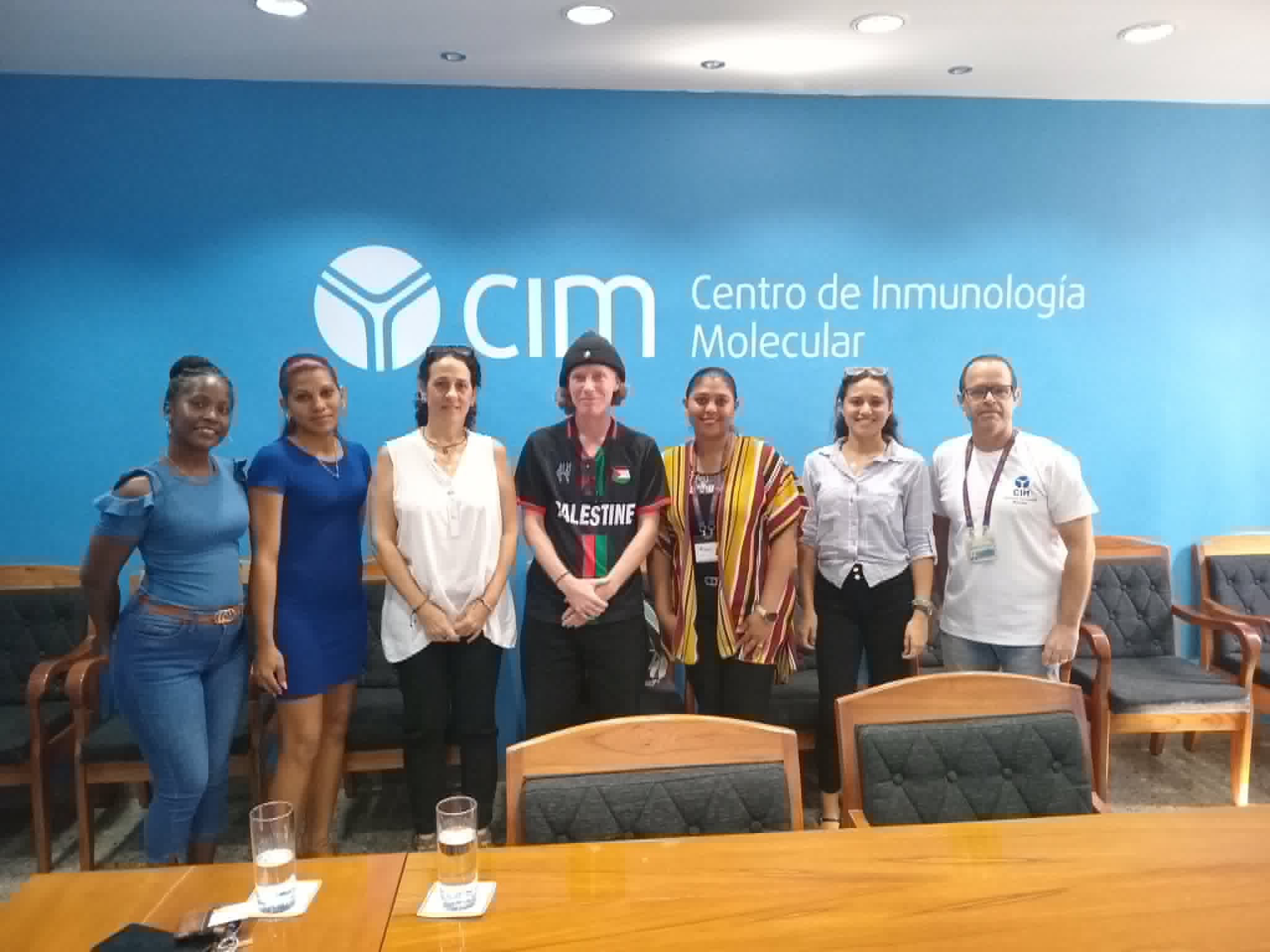
Some CIM staff presenters and myself.
Figure 5: some CIM staff presenters and myself
The notion that Cuba is anyone’s enemy, let alone a national security threat to the US is beyond comical, except without the laughs. The results– more than one unneeded dead child per day– is intolerable for any population, let alone this population of amazing resistance and ingenuity. That before 2020 had an infant mortality better than the US.
In the near future, I have intentions to return to Cuba and meet with people who have already experienced the benefits from neuroEPO/NeuralCIM, meet first hand with families whose lives have shifted under the treatment of this research, and what the barriers of the oil blockade mean to them directly.
With a goal of June, my next visit will seek to learn more directly from impacted families, possibly speak with others as well, and explain more for families that need to receive Cuban help more about what that could look like, and how to make it happen.
For a caregiver, being able to take on the workload of helping your loved one has very, very few promises. The only promise I can guarantee is that one-on-one with the human being you love will give you moments where it all feels worth it. That their responses will sustain you. The hope of these Cuban revolutionary treatments is that these moments last months, not seconds.
There is so much beauty in caregiving, but nothing is more beautiful than those extremely rare moments where you just know it’s all been worth it. Where the beauty of life and defiance overshadow the ugliness. Just like Cuba, really.
And, in order to understand the beauty inside the ugliness, you get special reminders of what once was in flashes and moments that become powerful anecdotes for when you will try to warn/tell someone else beginning the caregiving journey. Here is my attempt to do this impossibility.
My mother lived with me as her full time caregiver for 8.5 years, more than five of them I was alone aside from her as well. For the last few years, I stopped doing anything that could seem like a “test,” her ability to recognize what was in front of her was not there anymore. We got a new cat for her at the end of 2020; I named the cat Sweetie so that my mother would say her name correctly. There was zero chance she would get it right any other way. All animals were called Sweetie by her loving smile at this point in her life, so Sweetie would be her cat. She’s literally sitting here on the table as I type this out.
In early 2022, I had a full breakdown and lost the ability to care for her further. At Christmastime that year, I brought her back home with me for a couple of nights, and she promptly fell and broke her arm after Christmas dinner. I went to Cuba shortly after to try and relax, with mixed success.
In April of that year, when her arm had mostly recovered, I dared to have her visit her real home overnight again for the first time since her injury. In the weeks prior, she had started to get to the most painful stage of her dementia for everyone else. The part where, even with me forcing myself into her line of sight, using my most “It’s your boy!” voice, and all the things I had learned to do? I still could not get her to focus on me in a way that made me feel seen. She had not said my name properly in years, but her eyes had previously always said “my son.”
This was just beginning, it wasn’t something constant, but her few remaining focused brain cells were shutting down. She wasn’t able to sort out that it was me the way I had seen and felt for the few prior years.
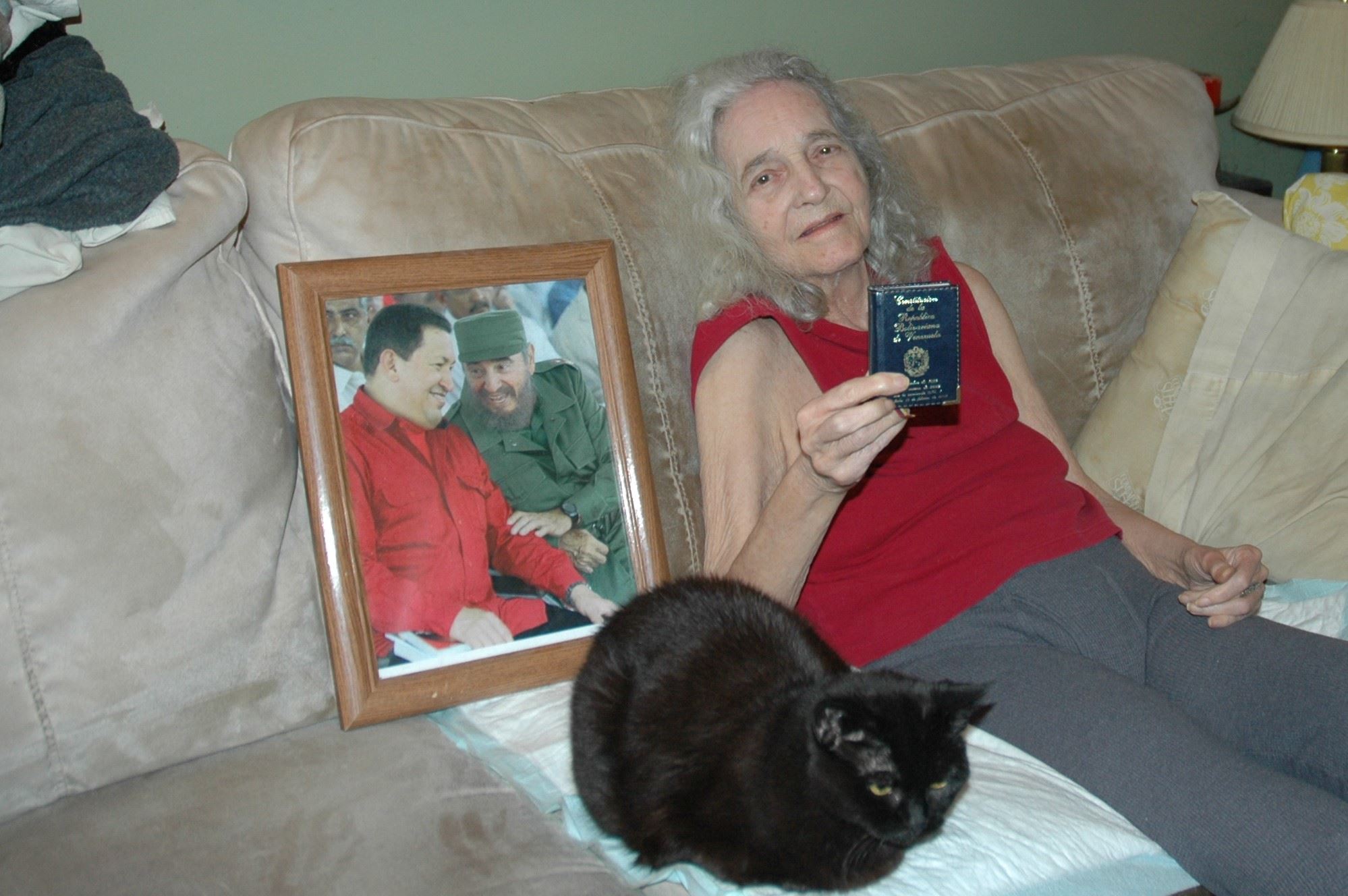
Mom, Chávez, Fidel & Mollie on Feb 23, 2019.
The night I tried to settle her into bed using her new walker designed to help her broken wrist, it all worked. I became exhausted doing it, but I had her in her bed, looking up at me as I was very used to and comforted by at the time.
Suddenly, she furrowed her brow with alarm, and her arms started to move with a stiffness, and she grabbed at my left arm and hand. She took my hand, looked at me as if she was passing along an important state secret.
“I just want you to know I’m always so very proud of you,” and all I could do in the moment was thank her, lean in and kiss her forehead and do whatever I could to make her feel that I understood the moment. She was utterly lost, and words stopped coming out again.
I realized that the alarm that had been on her face was that she had all of her remaining brain cells lining up together, and that she had a short amount of time where she could communicate deliberately. Say something meaningful and important. So she let me realize that she had seen what I was trying to do with her all of those years. I had to leave the room because I had to sob and let out the immensity of that moment. In her tiny glimpse into reality, making me feel seen and appreciated is what she groped for– and hit 100%.
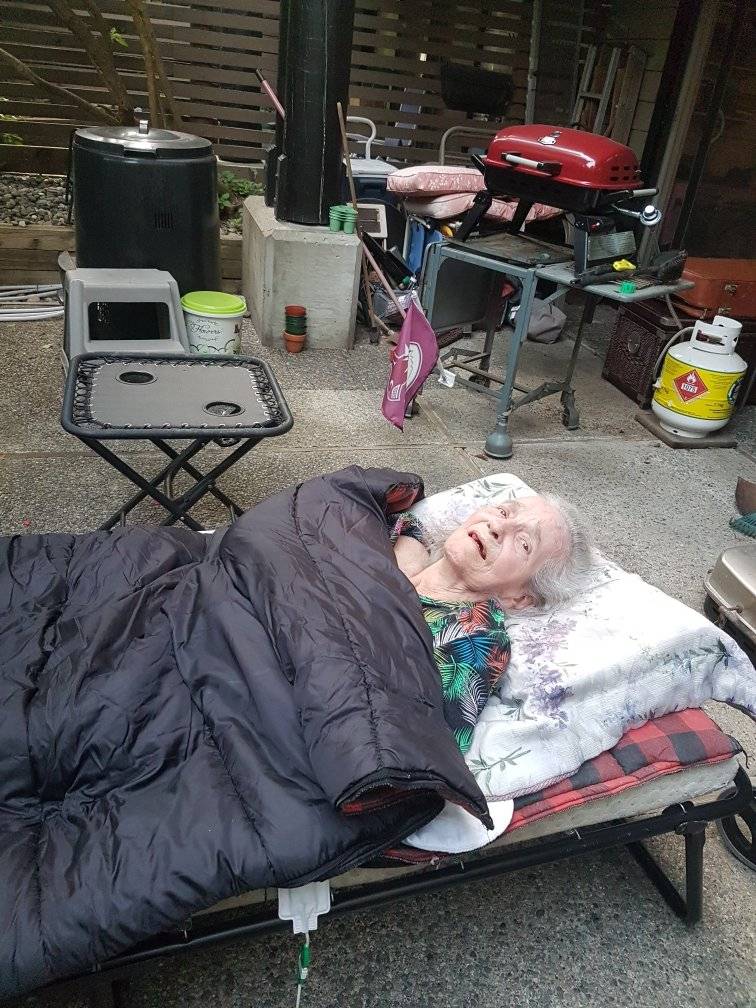
Donna sleeps outside on her patio for the last time.
That’s who I had been trying to be loyal towards.
That story is about when the most important person in my life before or since came back to me, from a place of dementia and total loss, for only a few seconds– some of the greatest seconds I have experienced on this spinning globe.
I don’t however, wish to repeat the fallacy of the caergivers who were speaking to me before I took on that role full time. It’s only a glimpse, you can’t know what it’s like until you do.
But I am using that story to explain a treatment that exists now, and can extend that moment of caregiver bliss, united again with my disappearing mother, from mere seconds to not just mere months but even years. And that this remarkable new medical treatment has been developed by the scientists and doctors of the Cuban Revolution.
So this article and story is an absolute multi-directional labour of love for me. My mother, my uncle and myself have all (at different times of our lives) become Fidelistas, and friends to the Cuban Revolution. Being a friend means answering their call when they need it. Cuba has continued to answer the call of humanity to unheard of levels, and does so while under siege from the most powerful country in human history.
We have a choice. We can fight back, defend our friends in Cuba, and in so doing defend our families. For me? It’s for my late Mom, and my sister in law that I would love to meet again.
We’ll Meet Again,
Don’t know where, don’t know when…
but I know we’ll be together, some sunny day.
And you can’t blockade the sun. Or, in this case, a son.