

Cuba condemns new US sanctions targeting tourism entities

Cuban President Miguel Diaz-Canel on Monday condemned a new round of U.S. sanctions targeting the country’s tourism sector, calling the move an escalation of Washington’s campaign to “strangle Cuba’s economy.”
The sanctions, announced by the U.S. Department of State on Monday, blacklisted 10 Cuban entities, including the Ministry of Tourism, according to the U.S. Treasury Department’s website.
In a post on social media, Diaz-Canel said the latest sanctions list reflected the United States’ growing pressure aimed at suffocating Cuba’s economy and inflicting greater hardship on the Cuban people. He also noted that the U.S. policy had been condemned at the United Nations less than a week earlier.
Cuban Foreign Minister Bruno Rodriguez also denounced the new sanctions in a separate social media post on Monday.
The latest measures mark the Trump administration’s newest step in its “maximum pressure” campaign against Cuba since imposing an oil blockade in January.
Tourism is one of Cuba’s most important sources of foreign exchange earnings.
Cuba condemns new US sanctions targeting tourism entities
Heavy rains triggered by Typhoon Bavi have been lashing northeast China’s Liaoning Province since Sunday, with the provincial capital Shenyang recording an average precipitation of 188.7 millimeters as of Tuesday.
As Bavi started to move northward Sunday, many parts of Liaoning experienced heavy rains, particularly in central Liaoning.
According to the latest weather forecast, the heavy rain will continue throughout Tuesday.
In some areas of Shenyang, cumulative precipitation at multiple monitoring stations has already exceeded 420 millimeters over the past 30-plus hours. Shenyang’s average annual rainfall is approximately 615 millimeters, meaning some areas received more than 70 percent of their typical yearly total in just over 30 hours.
Due to the heavy rainfall, several rivers in Liaoning Province are now experiencing significant rises in water levels. Nine rivers, including the Liaohe River, the Hunhe River and the Taizi River, have already exceeded their warning levels, and 43 reservoirs across the province have surpassed their flood control limits.
The provincial river and reservoir management service center has issued its first flood alert of the year.
In response to the heavy rain, local authorities have evacuated more than 360,000 people across the province.
On Tuesday, Shenyang continues to maintain the Level I urban flood emergency response declared on Monday.
Enterprises and public institutions are operating remotely. Schools and kindergartens are closed, while tourist attractions are shut down. Passenger transport services are suspended, with some subway lines and station exits remaining closed.
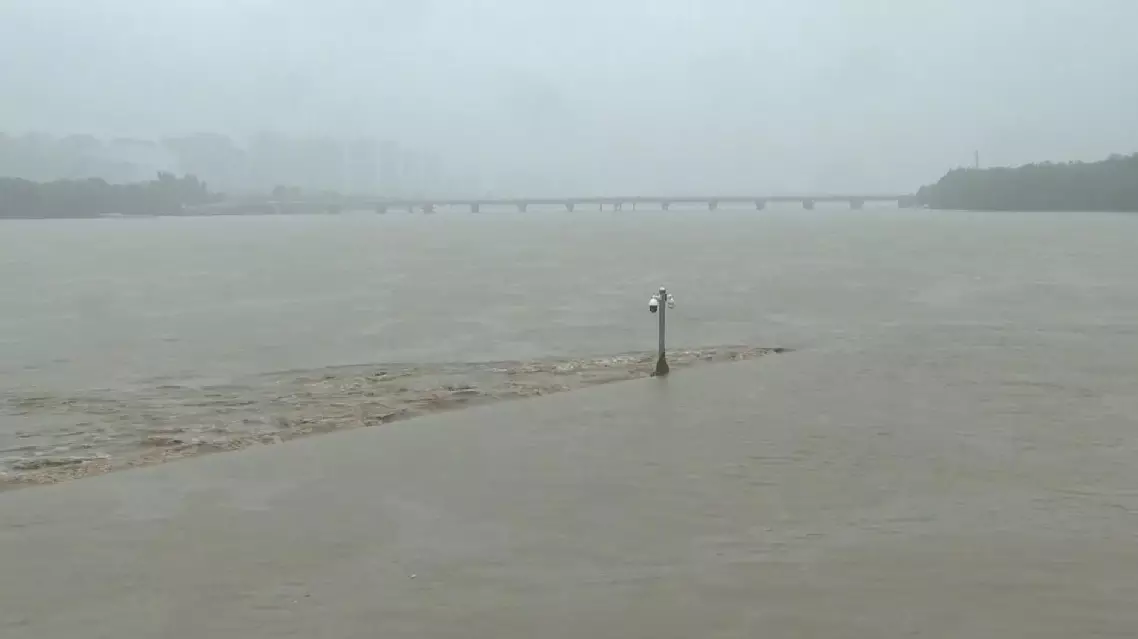
Typhoon Bavi triggers heavy rainfall, flood alert in northeast China’s Liaoning Province