

“Cuba: Capital of…” › World › Granma
It might even be acceptable to us, if it weren’t for the fact that it negates the work of thousands of organizations and millions of people worldwide over decades, and erases the role of their circumstances, their accumulated experience, their aspirations.
In some of its lines, it might even stroke our egos if it weren’t yet another attempt to convince—whoever wants to be convinced—that our heads belong on the ground, pocked, covered in dirt, and still with our tongues hanging out, searching for our boots.
We’re talking about “Cuba: The Capital of Communism in the 21st Century,” the latest report the State Department dedicated to us, dated July of this year. It’s not a theoretical document, even though it uses citations, footnotes, and has a methodology between the lines. It’s a political and instrumental text, through and through, that tries to put us—even more so, if that’s possible—in its sights. What does it say? What does it leave unsaid?
REPEATED AND REITERATED
The term Cuba is by far the most repeated, with some 314 mentions. If we add the frequencies of other related words such as Revolution (53), Havana (107), Cubans (108), Cuban women (26), Cuban (114), Cuban woman (68, not counting the 11 that accompany Revolution), the total reaches 790, in a document of just 107 pages. This gives us a ratio of approximately seven mentions of our country per page, including those pages that are merely images.
Another interesting correlation is that of terms such as terrorism (21), terrorists (30), terror (4), radicals (37), radical (26), and extreme (22). In no case are these related, of course, to operations of the U.S. government or any of its allies; Nor is there any mention of the Islamic groups that the U.S. status quo positioned as the “capital of terror” during the first two decades of the 21st century. There isn’t even a reference to the counterrevolutionary groups based in South Florida, who are treated with the merciful deference of exiles.
In almost every instance, in a typical case of selective and flawed memory, the obsession of the moment—Cuba—is discussed, either directly or indirectly.
The pattern of dates also reveals a series of historical biases and decontextualizations. Of the 285 times a specific year is mentioned, 71 correspond to the period 1959-1970 and 80 to 2017-2026. Therefore, more than half of the periodization focuses on these two periods, during which Cuban foreign policy, supposedly the victim of “Americanness,” had very different characteristics.
WE HAVE FIGURES TOO…
…and they aren’t the figures of repeated words. If the report in question is particularly vague about anything, it’s in telling us how much the human cost of the Cuban Revolution’s “transnational terrorism” has amounted to for the U.S.; at the very least, it’s odd… in a document that goes to such lengths to highlight the adversary’s wickedness.
Most of the time, this boils down to phrases like “the full extent of the damage from the covert activities may never be known”; or “the information they transmitted to the Cubans, which was then systematically passed on to Cuban representatives and allies around the world, caused incalculable damage to U.S. interests”; or “it was certainly directly responsible for the deaths of several Americans.”
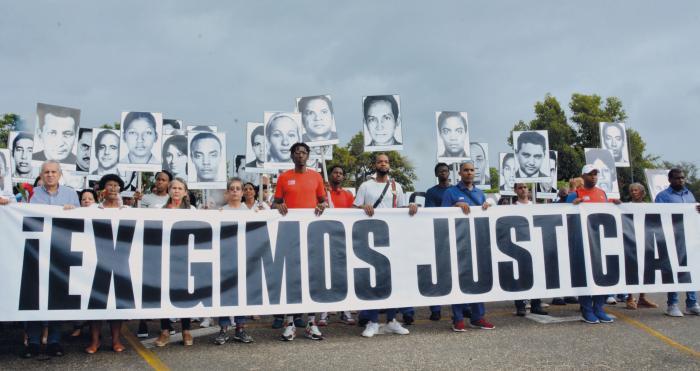
Meanwhile, Cuba has recorded at least 3,478 of its sons and daughters killed by sabotage and terrorist acts since 1959, most of them sponsored, coordinated, or facilitated by successive White House administrations. That number alone would be enough to list the names of 32 different martyrs on every page of the report.
In a serendipitous twist of both sorrow and dignity, 32 was the number of our internationalist combatants killed—the Spanish version published by the State Department uses this word—in the January 3rd attack on Venezuela, perpetrated by none other than regular U.S. troops.
We can speak of our more than one hundred children who died from dengue hemorrhagic fever in the 1980s; of the one hundred killed in the two explosions aboard the steamship La Coubre; of the dozens of victims of the mid-air explosion of the Cubana de Aviación aircraft departing from Barbados; Of the more than 600 assassination attempts against Fidel Castro, now a documented and acknowledged fact, but which were planned as a policy in Washington since 1960; we can speak of the funding of armed groups in the country, responsible for the murders of teachers, children, and even children who were teachers; we can refer to fishermen and villages machine-gunned, to shops and daycare centers set ablaze, to the civilian victims of the Bay of Pigs invasion. And we must say that those who committed these acts have enjoyed systematic protection, exaltation, and freedom on the streets of the United States.
We could also mention the tens of thousands of victims of Operation Condor, with more than 30,000 disappeared in Argentina and 4,000 in Chile, to name just a few examples; or the support for regimes that still maintain a colonial character today, such as Israel and Morocco.
AGREEMENTS AND DISAGREEMENTS
Beyond the document’s stated objectives, we in Cuba can agree with several points it raises, such as the fact that we were never a satellite of the Soviet Union; that our interpretation of Marxism and its subsequent implementation contributed to a new theory of revolutionary politics that sought not only economic equality, “but also social, cultural, and even spiritual transformation.”
We agree that our intelligence services have never had to bribe anyone to join in helping us survive as a project. Nor should we be ashamed to acknowledge that our struggle has felt a kinship with the Black American in Detroit, the Vietnamese peasant, the Congolese rebel, the Black Panther, the Puerto Rican independence activist, the anti-war student, and the Algerian insurgent.
The document accuses Cuba of “training and advising a number of extremist African organizations, and assisting radical African governments.” Fortunately, it does not refer to apartheid South Africa. We are not ashamed to have given more than we had for the concrete decolonization of the peoples of the Third World.
According to the report, this means being anti-American. And so, from their perspective, are Lucius Walker and the entire Pastors for Peace movement, organizations like Code Pink, The People’s Forum, the National Lawyers Guild, Democratic Socialists of the United States, and even Black Lives Matter; all, according to the State Department, heavily influenced by Havana. It should also be mentioned that the Cuban government convinced a police officer to suffocate George Floyd, subsequently generating a wave of anti-racist protests across almost the entire country.
WE, THE “ANTI-AMERICANS”
First of all, Cuba cannot be anti-American because it is part of the Americas, a continent that begins in Tierra del Fuego, is baptized in the Antilles, crosses the Rio Grande, and freezes in Alaska. Secondly, it is not anti-American either, to the point of having helped, when it was still in its infancy as a nation, to expel the British from our neighbors’ soil.
Many of our children—now parents—fought alongside Abraham Lincoln, and many of the Americans who had also fought came later to our first War of Independence, not exactly to die for the Spanish. We say “blúmer,” “pullóver,” and “frízer”—whether we like it or not—with the same ease with which we pronounce “asere,” “mamey,” and “jicotea.”
But in Cuba, we do not hijack the meaning of the word America, not even that of the United States. For us, the United States is not just the supremacist elite that governs it, nor is it simply its long list of fighters for civil rights and justice in general. It is all of these things together, with all the complexities that entails.
Contrary to what the text tiresomely reiterates, we are not at war against Western civilization—a term that has also been hijacked—of which we are, moreover, a cultural and geographical part.
We are at war, if forced, for our sovereignty and survival as a nation. On this path, as we have for over 60 years, we simply ask our “gentle victims” of the U.S. government—who shed inconsolable tears over their thousands of nuclear warheads and aircraft carriers—to leave us in peace.