Critics Say Recommended 765-kV Route Crosses China-Linked Land

Texas regulators are set to decide whether to approve a proposed 765-kilovolt transmission line route that would run near or across property tied to Chinese businessman Sun Guangxin, whose past Texas land purchases have drawn national security scrutiny. Companies associated with Guangxin deny that they or their owner are affiliated with or acting on behalf of the Chinese Communist Party or the Chinese government.
Specialists have warned of the growing China threat. The U.S. Office of the Director of National Intelligence (ODNI) identified China as a national security competitor to the United States in its 2026 Annual Threat Assessment.
Despite critics’ warnings, administrative law judges recommended that the Public Utility Commission of Texas adopt a route for the proposed Howard to Solstice 765-kV transmission line that comes near Guangxin’s land.
A project of transmission companies AEP Texas and CPS Energy, the line would stretch approximately 370 miles across South and West Texas from the San Antonio area to Fort Stockton.
It is part of the 765-kV Strategic Transmission Expansion Plan (STEP) Permian, a key part of the Permian Basin Reliability Plan (PBRP). STEP-Permian proposes three transmission lines, broken down into five segments, spanning more than 1,200 miles to move power from East Texas to the natural gas-rich Permian Basin. The Howard to Solstice line is the southernmost line.
A pro-landowner group likened this project “to hauling water to the sea.”
Each segment has moved through an administrative law hearing process at the State Office of Administrative Hearings, where landowners and project applicants debated the project’s merits and different proposed routes. Afterward, administrative law judges wrote a Proposal for Decision (PFD) to PUCT, whose commissioners make the final decision.
On July 27, 2026, Judges Sarah Starnes and Amy Davis recommended commissioners adopt Route 4 for the Howard to Solstice line, which includes Link 238—the connection to Guangxin’s property.
The owners of Greenwood Ranch took exception to this. “Contrary to the PFD’s determination, the administrative record contains unrefuted, official documentation from both state and local government entities establishing that land along Links 124, 127c, 139, 236, and 238 is owned and controlled by Chinese-majority entities,” wrote Anson Howard, an attorney for the ranch.
The companies in question are Brazos Highland Properties LLC and Harvest Texas LLC, which Howard wrote are “controlled by Sun Guangxin, an individual tied to Chinese national interests and the Chinese Communist Party.”
Val Verde County previously raised this concern to PUCT. In an April filing, County Attorney David Martinez wrote that “the proposed transmission line routes, as currently configured, may traverse lands in Val Verde County owned by an individual identified as a retired member of the Chinese Communist Party.”
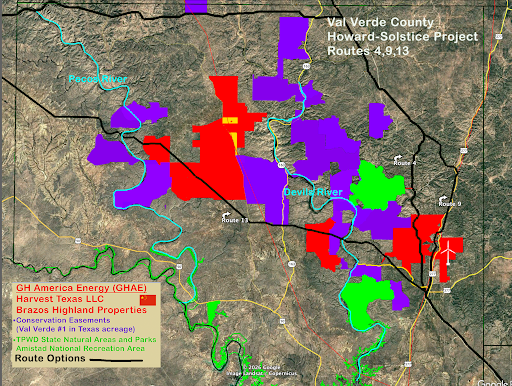
It submitted a map showing in red and yellow, the land owned by companies tied to Sun Guangxin and the locations where those holdings intersect with AEP Texas’ proposed route links.
As previously reported, both Harvest Texas and Brazos Highland Properties filed to be intervenors. In a letter to PUCT dated April 16, a Harvest Texas representative requested it “exclude or deprioritize Route Segment 238” because it is located roughly 1,000 meters from “the primary residence” of Morning Star Ranch, which Harvest owns.
Greenwood Ranch maintained its national security concern. “The PFD’s assertion that ‘no record evidence’ exists is factually incorrect. The administrative record contains explicit, verified evidence confirming that proposed transmission links cross property owned by foreign adversary entities,” Howard wrote.
Randy Nunns, a Val Verde landowner and founding director of the Devils River Conservancy, believes the risk isn’t isolated to Link 238. He shared with Texas Scorecard a map he said he created based on public records, which showed proposed routes 4, 9, and 13 crossing into Brazos Highland Properties or Harvest Texas land.
In a March 2026 letter, State Rep. Eddie Morales (D–Eagle Pass) asked PUCT Chairman Thomas Gleeson to clarify whether any Howard-Solstice route options cross land owned by Chinese-affiliated or CCP-connected entities, whether Texas laws, including the Lone Star Infrastructure Protection Act and a Gov. Greg Abbott Executive Order, apply to these easements, and how PUCT will factor those issues in the final route decision.
PUCT spokesperson Rich Parsons wrote to Texas Scorecard that the “rules related to ex parte communications prohibit commissioners from discussing or communicating with outside parties on active cases, and that the agency “cannot comment on on-going cases.” State Rep. Morales’ office did not respond to a request for comment before publication.
“Route 4 relies on links-including Links 124, 238, and related segments-that sit directly on land owned by Chinese Communist Party-affiliated entities,” Anson wrote. “Selecting Route 4 forces the Commission into a direct conflict with the Lone Star Infrastructure Protection Act and state critical infrastructure security policies.”
Judges Starnes and Davis wrote in their PFD that “there is no record evidence substantiating” the allegation “that prohibited foreign entities own land on any affected route.” Therefore, they concluded that the Lone Star Infrastructure Protection Act “provides no basis to reject any otherwise viable route.” They noted another landowner’s argument that easements may be obtained through eminent domain even if a landowner has prohibited foreign ownership.
Signed into law in 2021, the Lone Star Infrastructure Protection Act (LSIPA) prohibits agreements that give a covered foreign-owned company direct or remote access to, or control of, critical infrastructure.
In statements to Texas Scorecard, Brazos Highland Properties and Harvest Texas expressed support for the Howard to Solstice line and are “participating as an affected landowner in a public routing process.” Harvest Texas requested PUCT “consider residence safety and health issues while approving any specific route selection including Link 238 because of its proximity to a residence and the resulting site-specific land-use and property impacts.”
Neither company disputed Sun Guangxin as owner, or in Brazos’ case, “majority owner.” Both called “categorically false” “any suggestion” that he or these companies are “part of or acting for the Chinese Communist Party or the Chinese government.”
They also described Guangxin as “a respected international businessman, whose companies are not supported by or a part of the Chinese Government and that, in fact, were largely funded through investment of American investors.”
The Guangxin Saga
Guangxin and his land purchases grabbed state and federal lawmakers’ attention previously when reports tied him to the CCP. Since 2015, he bought about 7 percent of all land in Val Verde County with the intention of building a wind farm, 70 miles from Laughlin Air Force Base, and connecting it to the Texas power grid. A national security specialist expressed concern that China could use those wind farms to conduct surveillance of the base.
In response, the Texas Legislature passed LSIPA in 2021.
In June 2024, GH America Energy (GHAE) sued ERCOT and its leadership in the U.S. District Court for the Western District of Texas. GH America objected to ERCOT canceling its interconnection request to the state grid and refusing a new screening study request.
The company’s complaint admitted that its owner, Xinjiang Guanghui Industry Investment, is “majority owned by Sun Guangxin, a citizen of the People’s Republic of China.”
ODNI has warned of China’s National Intelligence Law requiring “any organization or citizen” to “support, assist, and cooperate with state intelligence work.” An analysis from Focus Taiwan on the August 2026 revision of China’s National Defense Mobilisation Law noted it added “expropriation” to sections on requisitioning “civilian resources” during mobilization for the military.
GHAE alleged the federal Supremacy Clause preempted LSIPA and that the Committee on Foreign Investment in the United States (CFIUS) “carefully reviewed and not objected to asset purchases, land holdings transactions, and wind and renewable energy projects by GHAE and its affiliates, including transactions and projects in Val Verde County, Texas,” and that the U.S. Department of Defense had “entered into agreements with GHAE and its affiliates to mitigate national security risks presented by those transactions and projects.”
In July 2024, U.S. Sen. John Cornyn (R–TX) urged the then-U.S. Department of Defense to block Guangxin’s proposed wind farm. He tied multiple companies—including GH America, Harvest Texas, and Brazos Highland Properties—to Guangxin through China-based Xinjiang Guanghui Industry Investment, in which Cornyn wrote that Guangxin holds a majority stake.
“Mr. Sun is a member of the Chinese Communist Party (CCP), former senior leader in the Chinese Military and likely had other plans concerning surveillance of Laughlin AFB or interfering with the Electric Reliability Council of Texas (ERCOT) at the behest of the Chinese government,” he wrote.
PUCT commissioners Thomas Gleeson and Courtney Hjaltman, in their capacity as ERCOT board members, were among the defendants in the lawsuit. Judge Robert Pitman dismissed the case in September 2025. GH America appealed to the United States Court of Appeals for the Fifth Circuit.
Harvest Texas and Brazos Highland Properties addressed Cornyn’s letter in their statements to Texas Scorecard. Both wrote that they had “voluntarily subjected” themselves “to review and clearance by the Committee on Foreign Investment in the United States (CFIUS). The resulting national security agreement addressed – and continues to address – the national security concerns identified by CFIUS and remains in full effect notwithstanding the allegations made in Senator Cornyn’s 2024 letter.”
Both Brazos and Harvest wrote that they had requested “nothing” in the PUCT proceeding that “would provide access to or control of the electric grid.”
In a statement, a Department of War spokesperson wrote to Texas Scorecard that “as a matter of policy, the Department does not comment on pending or ongoing litigation.” CFIUS did not respond before publication.
Upcoming Decision
The PUCT commissioners, appointees of Gov. Abbott, are scheduled to take up the Howard to Solstice line on September 11. Despite a growing group of lawmakers saying stop, they approved the first line on August 29.
Michael Lucci of State Armor has warned of the threat CCP-linked agents pose to the Texas power grid.
“The Chinese Communist Party wants to be able to sabotage Texas’ electrical grid,” he wrote. “The reason is simple: Texas is America’s energy powerhouse, and in the event of Communist China starting a conflict, they want to be able to shut down Texas as a way to shut down America’s ability to fuel our defense and counter-attack.”
Like other landowners and lawmakers, Nunns prefers PUCT to deny all pending 765-kV applications; he argues that if the project is needed, state lawmakers should weigh in first.
The Texas Public Policy Foundation estimates the lifetime cost of all STEP projects ERCOT approved through December 2025 at nearly $100 billion, to be borne by ratepayers. Critics argue that PUCT, ERCOT, and electricity delivery company Oncor transformed a regional reliability directive into a de facto statewide 765‑kV grid plan without an explicit vote by state lawmakers.
“AEP Texas continues to follow the process established by the State of Texas and the Public Utility Commission of Texas (PUCT) regarding our proposed transmission improvement project. We followed a comprehensive routing process that takes state law, land use, the environment, public input, engineering guidelines and estimated costs into account to develop potential routes,” AEP Texas wrote in a statement. “The Public Utility Commission of Texas (PUCT) also requires that we provide a set of geographically diverse route options for the commission to consider. We look forward to the remainder of the administrative process and to the decision delivered by the PUCT.”
CPS Energy, San Antonio’s city-owned utility, did not respond to a request for comment before publication.
If you are a citizen with information regarding bureaucratic overreach, please email scorecardtips@protonmail.com.