

Colombia Ends “Total Peace” Shield, Signs Fast-Tracks Extraditions to the U.S. of Five Illegal armed groups
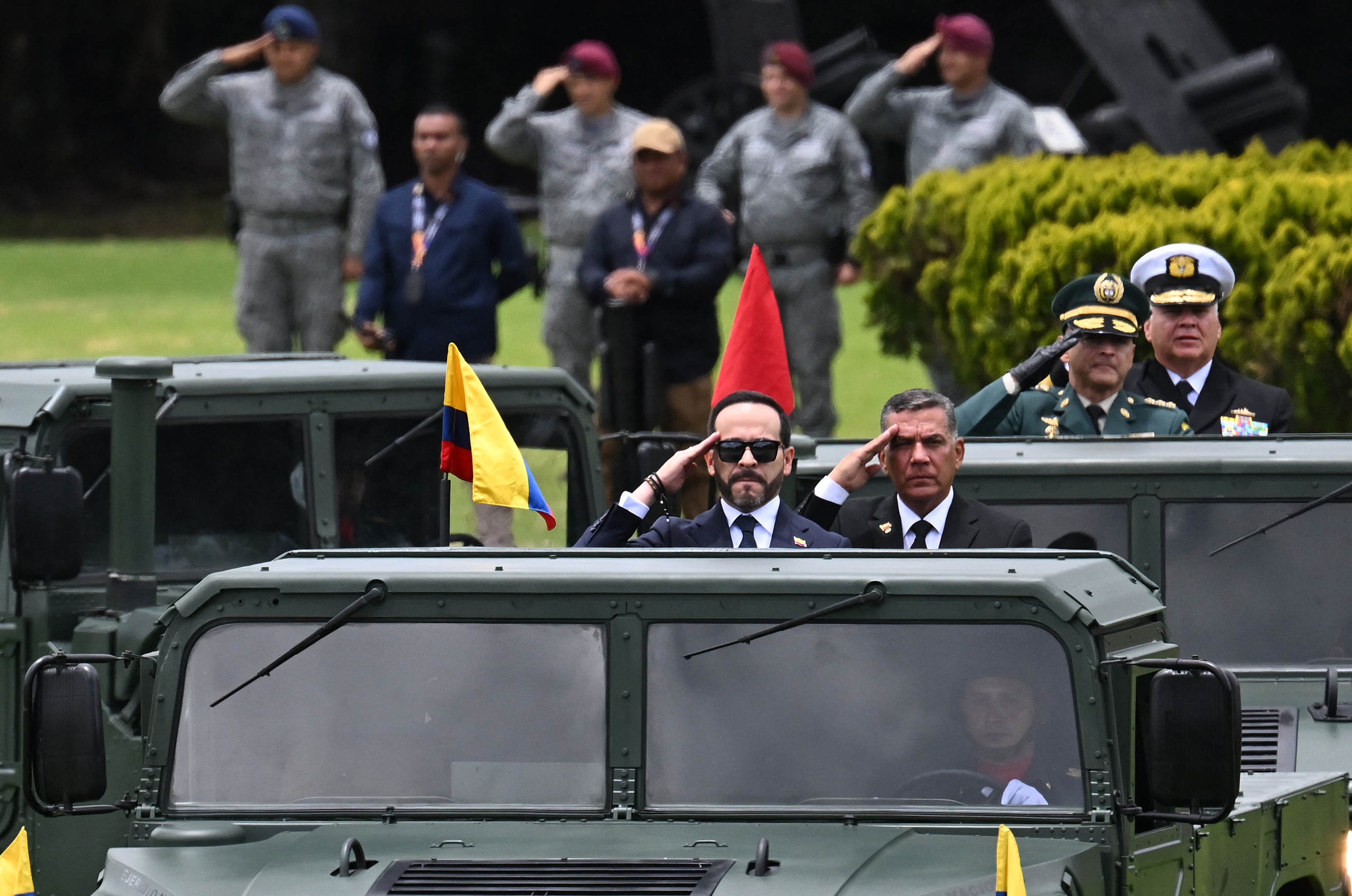
by Raul ARBOLEDA / AFP via Getty Images
CALI/BOGOTÁ — President Abelardo de la Espriella this week ordered the extradition of five leaders of illegal armed groups to the United States, unwinding legal shields his predecessor, Gustavo Petro, had extended to the men while they sat at “Total Peace” negotiating tables. All five extraditions had already been approved by Colombia’s government in 2025; what changed is that the new administration lifted the freeze that kept them from being carried out while the men served as negotiators.
Who the Five Wanted Men Are
Three of the five are already in Colombian custody and can be handed over as soon as legal procedures are complete; two remain fugitives who must first be captured. Willington Henao Gutiérrez, known as “El Mocho Olmedo,” was second-in-command of Frente 33, a FARC-dissident faction based around Catatumbo in Norte de Santander; he surrendered to the Colombian Army in the rural municipality of Teorama in February 2025. Carmen Evelio Castillo Carrillo, alias “Muñeca,” led Los Pachenca — formally the Autodefensas Conquistadoras de la Sierra Nevada — and was captured in Pereira. Giovanny Andrés Rojas, alias “Araña,” is described as the top commander of Comandos de la Frontera. The two still at large are Gabriel Yepes Mejía, alias “HH,” who heads Comuneros del Sur, a faction that broke away from the ELN guerrilla, and Fredy Castillo Carrillo, alias “Pinocho,” also tied to the Autodefensas Conquistadoras de la Sierra Nevada. Depending on the case, the men face U.S. charges spanning drug trafficking, money laundering, criminal conspiracy, weapons possession and narco-terrorism.
From a Bogotá Hotel Room to a California Courtroom
Rojas’s case became the clearest symbol of the reversal. Colombian investigators arrested him on February 12, 2025, inside a Bogotá hotel just as a round of talks between his faction and the government was wrapping up — a detention carried out under an Interpol red notice issued the same day at Washington’s request. He faces charges of international conspiracy to distribute cocaine and narco-terrorism in the U.S. District Court for the Southern District of California, over allegations that his network produced cocaine in Colombia and moved it north through Mexico. That prosecution isn’t isolated: a Comandos de la Frontera lieutenant, Teodulio Anacona Papamija, alias “Pitufo,” was separately charged in the same California court earlier this year with providing material support to a foreign terrorist organization and drug trafficking — evidence U.S. prosecutors are building a broader case against the network beyond Rojas alone. Petro’s government suspended Rojas’s extradition in December 2025, conditioning his handover on verifiable contributions to the peace process; De la Espriella’s team says it found none.
A Florida Case Puts South Florida’s Diaspora on Watch
The story carries a direct line to South Florida: Henao Gutiérrez is wanted by the U.S. District Court for the Southern District of Florida on charges of criminal conspiracy, drug trafficking and money laundering. For the region’s Colombian community, concentrated in Doral and greater Miami-Dade, that detail turns a Bogotá policy fight into a case that could eventually land in a local federal courtroom. The U.S. delegation at De la Espriella’s August 7 inauguration in Cali also had a South Florida face: Miami-area Republican Rep. Mario Díaz-Balart attended alongside Acting Attorney General Todd Blanche, DEA Administrator Terry Cole and at least six other named U.S. officials. Blanche later wrote online that the visit marked “the start of a new friendship and partnership” between the two countries on security cooperation. De la Espriella himself carries both American and Colombian passports, having naturalized as a U.S. citizen in 2023 — a personal detail that has fed his framing of security cooperation with Washington as personal as well as political.
The Collapse of “Total Peace”
De la Espriella cast the extraditions as the formal burial of Petro’s signature security initiative, which pursued parallel negotiations with FARC dissident factions, the ELN and the Clan del Golfo criminal network. Speaking from Bogotá’s Palacio de San Carlos, the president said his government reviewed each case and concluded the men had delivered no verifiable progress toward peace. “Dialogue and false peace are not judicial refuges,” he said, according to El Tiempo. The reversal follows an August report from the Fundación Ideas para la Paz think tank, drawing on Colombian Armed Forces figures, showing the country’s illegal armed groups grew roughly 90% in personnel during Petro’s four years in office — from about 15,120 fighters in December 2022 to close to 28,800 by July 2026 — while flashpoints of armed confrontation between rival groups roughly doubled, from seven to fourteen.
What Happens Next
De la Espriella has ordered that Yepes Mejía and Castillo Carrillo be extradited the moment they’re located, meaning the case will likely resurface as Colombian forces press operations against the remaining fugitives. The reversal has also drawn pointed, if qualified, criticism from within Petro’s own former cabinet: Jorge Iván Cuervo, who served as justice minister for much of the first half of 2026, said publicly that Total Peace’s failure stemmed from the absence of a legal framework to reduce uncertainty in negotiations — a warning he says he raised while still in office. On the same day as the extradition announcement, De la Espriella’s government also signaled plans to build new maximum-security prisons for captured armed-group leaders, part of a broader platform built on the campaign message that dialogue alone would no longer substitute for prosecution. For now, though, the immediate consequence plays out in extradition paperwork and, eventually, U.S. federal courtrooms — including, in Henao Gutiérrez’s case, one in Florida, a jurisdiction South Florida’s Colombian diaspora will be watching closely as the cases move forward.
© {{Year}} Latin Times. All rights reserved. Do not reproduce without permission.